
By continuing, you agree to LoansJagat's Credit Report Terms of Use, Terms and Conditions, Privacy Policy, and authorize contact via Call, SMS, Email, or WhatsApp
Disclaimer: The information published on LoansJagat is intended for general informational and educational purposes only and should not be considered financial, legal, or investment advice. Interest rates, loan terms, statistics, and other data may change over time and may vary by lender or source. Please verify the latest information and consult a qualified financial advisor or the respective Bank/NBFC before making any financial decisions.
Subscribe Now
About the author

LoansJagat Team
‘Simplify Finance for Everyone.’ This is the common goal of our team, as we try to explain any topic with relatable examples. From personal to business finance, managing EMIs to becoming debt-free, we do extensive research on each and every parameter, so you don’t have to. Scroll up and have a look at what 15+ years of experience in the BFSI sector looks like.
Related News
Simplify All Your Loans Into One Affordable EMI

Customers Served

Debt Consolidated

1200+ Reviews

Locations in India
Club all Loans & Credit Card Bills into Single EMI

Quick Apply Loan
Consolidate your debts into one easy EMI.

Takes less than 2 minutes. No paperwork.

10 Lakhs+
Trusted Customers

2000 Cr+
Loans Disbursed

4.7/5
Google Reviews

50+
Banks & NBFCs Offers
Other services mentioned in this article
Goldman Sachs has cut India’s 2026 current account deficit estimate by $32 billion after lowering import projections and factoring in stronger foreign-currency inflows.
Key Highlights
Goldman Sachs revised India’s external-sector forecast in its report, India: A More Favourable Balance of Payments Outlook. According to NewsBytes, published on June 16, 2026, the bank cut India’s CY2026 current account deficit forecast from 2% of GDP to 1.3%. It also expects India to record a balance-of-payments surplus of 0.6% of GDP after 2 consecutive years of deficits.
For households, the immediate effect may be limited. Petrol prices or EMIs will not fall simply because a forecast improved. Still, a narrower deficit can reduce pressure on the rupee, which affects the cost of imported oil, electronic goods, fertiliser and industrial equipment. Crude prices remain the weak spot.
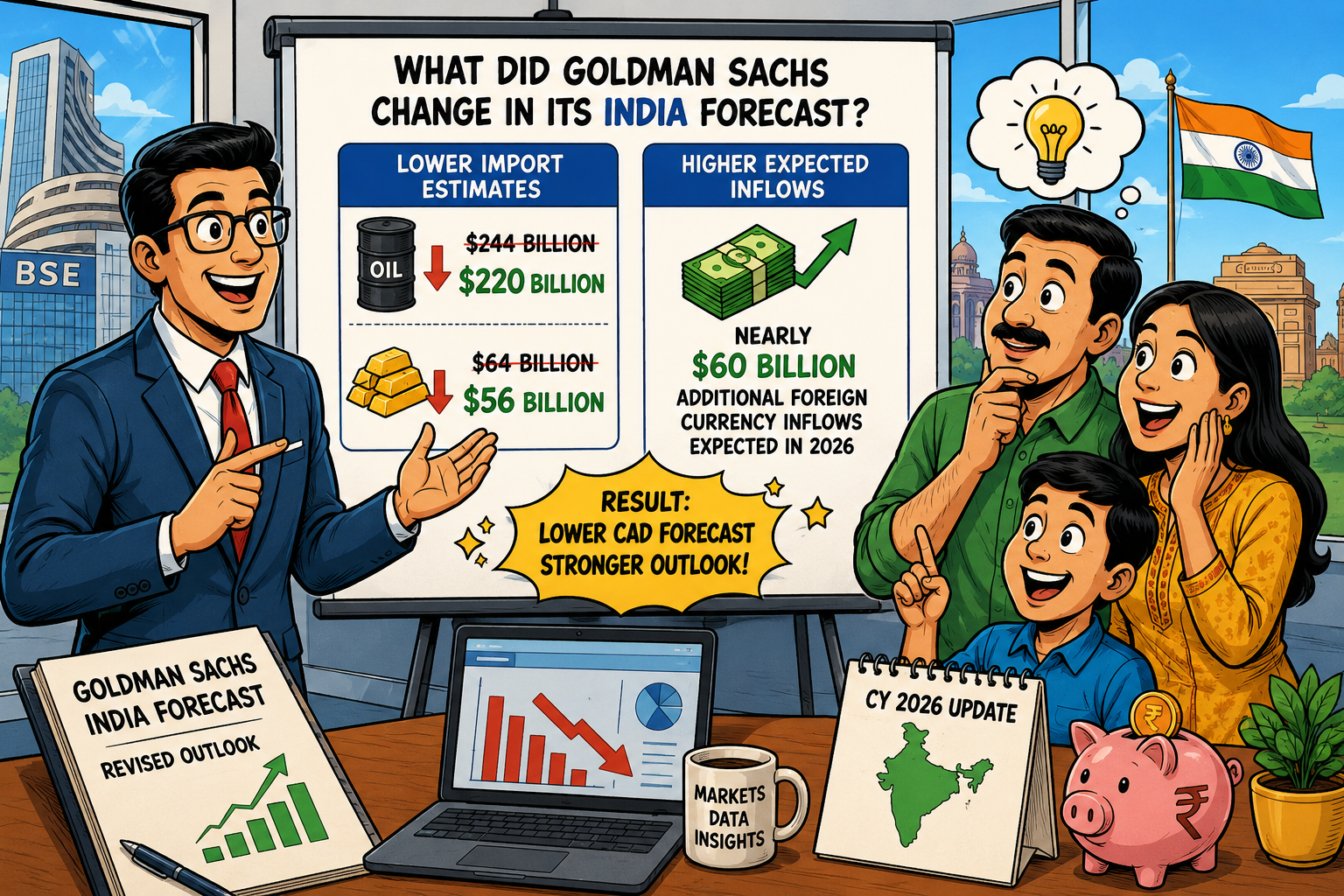
Goldman Sachs cut its oil-import estimate from $244 billion to $220 billion. Its gold-import projection also fell, from $64 billion to $56 billion, according to Fortune India, which published the details on June 15, 2026.
The bank also expects nearly $60 billion of additional foreign-currency inflows during 2026. That estimate helps explain why its BoP view has shifted from deficit risk to a projected surplus.
A smaller current account gap means India may need less overseas money to pay for imports. That can take some strain off the rupee. When the rupee weakens sharply, importers pay more for every barrel of crude and every shipment priced in dollars.
The benefit reaches families slowly. Transport companies face higher diesel bills first, manufacturers pay more for inputs, and food distribution costs follow. A steadier rupee can soften that chain. A LoansJagat analysis examined how services receipts and remittances helped India move from a $13.2 billion quarterly deficit to a $7.1 billion surplus.
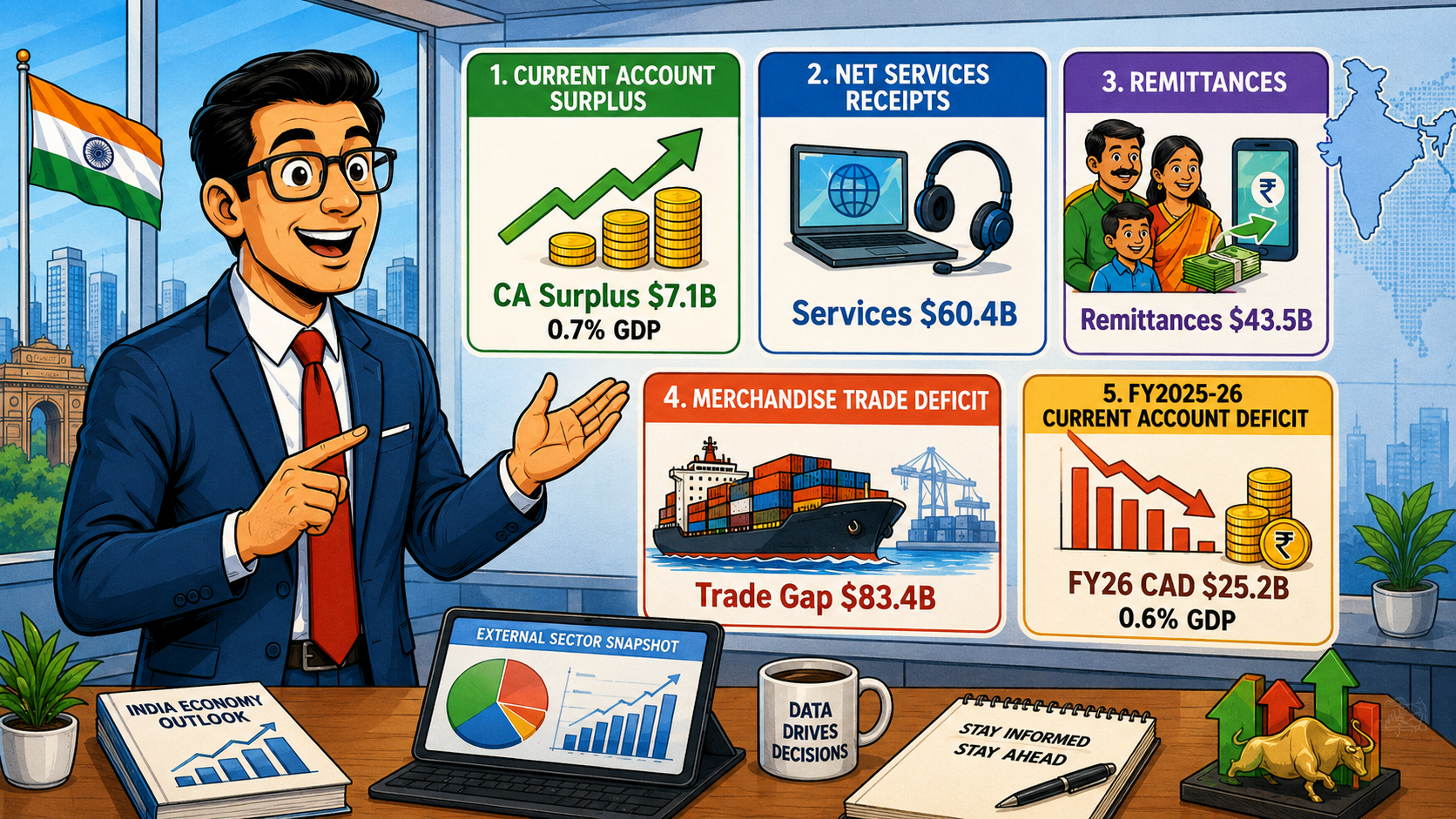
The January-March 2026 figures gave Goldman Sachs a stronger base for its revision. Services and remittances covered a large part of the merchandise trade gap.
*T&C Apply
Net services receipts
Remittances had stood at $33.9 billion a year earlier, while net services receipts were $53.3 billion. For FY2025-26, India’s CAD came to $25.2 billion, or 0.6% of GDP.
Goldman Sachs estimates that a 10% rise in oil prices could cut India’s net oil-import volumes by nearly 6%. Households and companies usually reduce fuel use when prices stay high, so the total import bill may rise by less than the headline oil-price increase.
Capital flows remain harder to predict. Reuters reported on June 15, 2026, that $8.7 billion of portfolio outflows pushed India’s April balance of payments into a $6.6 billion deficit, despite a $4.7 billion current account surplus. A LoansJagat analysis suggests borrowers should not treat the revised CAD forecast as an immediate signal for lower EMIs. The bigger benefit is reduced currency risk. If the rupee avoids a sharp fall, imported inflation may stay lower and the risk of fresh interest-rate pressure from an oil shock could ease.
Goldman Sachs has cut India’s 2026 CAD estimate by $32 billion, backed by lower import forecasts and stronger expected inflows. Oil prices and foreign portfolio movements will decide whether the 1.3% projection survives the year.
Why Did Goldman Sachs Lower The Forecast?
It reduced oil and gold import estimates and added expected foreign-currency inflows to its calculation.
Will The Revision Reduce Home Loan EMIs?
No immediate change follows. Lower imported inflation could, however, reduce pressure for future rate increases.
What Could Push The CAD Above 1.3%?
A prolonged crude-oil surge, weaker services exports or another large spell of foreign portfolio withdrawals.
How Does India Continue Growing Despite Running A Persistent Trade Deficit?
Services exports, remittances, investment inflows and domestic demand help finance imports while supporting economic growth consistently.
Will Tariffs Raise India’s Inflation By Only 0.1% In 2026, As Goldman Sachs Expected?
That estimate looks uncertain because oil prices, currency weakness and tariff pass-through can lift inflation further.









.png&w=3840&q=75)



