
By continuing, you agree to LoansJagat's Credit Report Terms of Use, Terms and Conditions, Privacy Policy, and authorize contact via Call, SMS, Email, or WhatsApp
Disclaimer: The information published on LoansJagat is intended for general informational and educational purposes only and should not be considered financial, legal, or investment advice. Interest rates, loan terms, statistics, and other data may change over time and may vary by lender or source. Please verify the latest information and consult a qualified financial advisor or the respective Bank/NBFC before making any financial decisions.
Subscribe Now
About the author

LoansJagat Team
‘Simplify Finance for Everyone.’ This is the common goal of our team, as we try to explain any topic with relatable examples. From personal to business finance, managing EMIs to becoming debt-free, we do extensive research on each and every parameter, so you don’t have to. Scroll up and have a look at what 15+ years of experience in the BFSI sector looks like.
Related News
Simplify All Your Loans Into One Affordable EMI

Customers Served

Debt Consolidated

1200+ Reviews

Locations in India
Club all Loans & Credit Card Bills into Single EMI

Quick Apply Loan
Consolidate your debts into one easy EMI.

Takes less than 2 minutes. No paperwork.

10 Lakhs+
Trusted Customers

2000 Cr+
Loans Disbursed

4.7/5
Google Reviews

50+
Banks & NBFCs Offers
Other services mentioned in this article
Key Takeaways
There is a trend of GST credentials being misused in various cities in India. This scam targets small and medium businesses
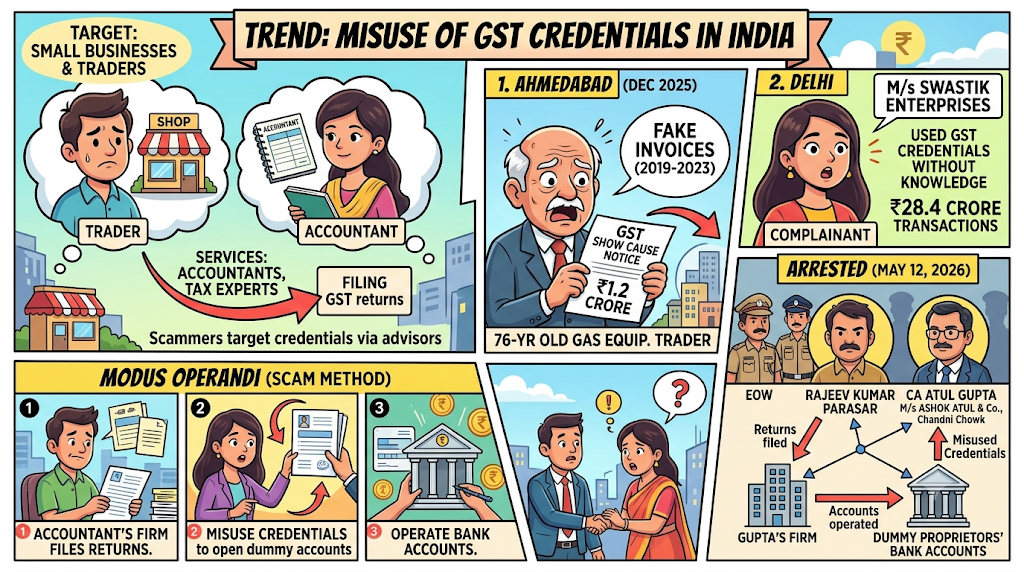
that are run by traders, which use the services of accountants and tax experts for filing their GST credentials. For instance, in Ahmedabad, a 76-year-old businessman dealing in industrial gas equipment was issued GST show cause notice in December 2025 asking for ₹1.2 crore for fake invoices filed from 2019 to 2023.
In Delhi, complainant Yashashwee Sharma alleged that the GST and VAT credentials of his firm, M/s Swastik Enterprises, had been used without his knowledge to conduct transactions worth nearly ₹28.4 crore. [Daily Pioneer] The EOW arrested Rajeev Kumar Parasar and CA Atul Gupta of M/s Ashok Atul & Co., Chandni Chowk, on May 12, 2026. GST returns for the suspect firms were filed through Gupta's firm, while bank accounts in the names of dummy proprietors were operated using the misused credentials.
In Greater Noida, a former accountant of a company named R.S. Infra logged into the firm's GST portal using saved credentials, created fake invoices, generated e-way bills, and routed ₹1.80 crore worth of transactions without any goods actually moving. The fraud was discovered only after the company received tax department notices long after the accountant had already quit.
In the Ahmedabad case, investigators found that the accused consultant had created and managed the trader's GST portal credentials in a way that gave him exclusive email-based control while leaving only the mobile number linked to the actual owner. This split access between mobile and email effectively locked the trader out of monitoring his own filings for over 4 years. The EOW also found that in Delhi, GST dues and penalties linked to suspect firms were deposited through personal accounts of employees and later reimbursed, raising suspicion about concealment of true beneficiaries.
The problem is systemic. Delhi's EOW is also investigating 3 separate GST identity theft complaints with total disputed transactions exceeding ₹141 crore. In 1 Delhi case from April 2026, a woman's 2013-defunct jewellery firm had its PAN used to avail ITC worth ₹99.8 crore. Another north Delhi businessman had his PAN used to open a fictitious firm and conduct transactions exceeding ₹32 crore. LoansJagat reports that ₹36,014 crore in financial frauds were recorded in 2023-24 alone, with complaint volumes on RBI's SACHET portal remaining high, indicating systemic gaps in document verification.
*T&C Apply
The Ahmedabad fraud probe highlighted 1 critical vulnerability: the trader never verified his own GST filings for over 4 years. Tax compliance experts say that business owners, regardless of size, must personally verify their GSTR-1, GSTR-2B, and GSTR-3B filings at least quarterly. The TaxConcept article confirms traders should “login to the GST portal, check your returns," and "ensure the email on the GST portal is your own.” All cases registered under cheating, criminal conspiracy, and forgery sections confirm that victims have legal recourse if they file an FIR promptly.
The complainants in the Delhi Karol Bagh case said publicly, “The name and PAN of our firm have been misused by unknown persons to create fictitious purchase entries, resulting in serious legal and reputational harm to us.” The GSTN has a clear process to revoke access: “Login > Authorised Signatories > Remove user or DSC > Update via DSC.” The Ministry of Finance also advised lenders to be strict with biometric checks in Aadhaar-based KYC and to report any mismatch immediately, as misused GST credentials also affect the business owner's ability to get future loans and trade credit.
GST credential fraud is no longer a rare or isolated event. From Ahmedabad to Delhi to Greater Noida, small traders are being left with crore-scale tax demands for filings they never authorised. With ₹36,014 crore in financial frauds recorded in 2023-24 alone, every business owner must personally own their GST portal access, verify filings quarterly, and ensure no third party holds exclusive control of their registered email ID.
Someone used my PAN to register a fake GST firm. What are the exact steps to cancel that registration and protect myself legally?
Go to gst.gov.in, click Services, then User Services, then Register Complaint, and select “Misuse of PAN” as the complaint category. Simultaneously file an FIR under Section 66C of the IT Act, 2000, which carries up to 3 years imprisonment, and report to cybercrime.gov.in.
What are the 3 most common GST-related small business scams in India that most people miss until it is too late?
First, fake vendors generating bogus invoices to fraudulently claim your Input Tax Credit. Second, tax consultants misusing client GSTINs, as seen in a ₹73.63 lakh case in Chhatrapati Sambhajinagar. Third, circular trading between shell companies to evade tax, which can expose genuine businesses to ED raids under PMLA, 2002.









.png&w=3840&q=75)



