
By continuing, you agree to LoansJagat's Credit Report Terms of Use, Terms and Conditions, Privacy Policy, and authorize contact via Call, SMS, Email, or WhatsApp
Disclaimer: The information published on LoansJagat is intended for general informational and educational purposes only and should not be considered financial, legal, or investment advice. Interest rates, loan terms, statistics, and other data may change over time and may vary by lender or source. Please verify the latest information and consult a qualified financial advisor or the respective Bank/NBFC before making any financial decisions.
Subscribe Now
About the author

LoansJagat Team
‘Simplify Finance for Everyone.’ This is the common goal of our team, as we try to explain any topic with relatable examples. From personal to business finance, managing EMIs to becoming debt-free, we do extensive research on each and every parameter, so you don’t have to. Scroll up and have a look at what 15+ years of experience in the BFSI sector looks like.
Related News
Simplify All Your Loans Into One Affordable EMI

Customers Served

Debt Consolidated

1200+ Reviews

Locations in India
Club all Loans & Credit Card Bills into Single EMI

Quick Apply Loan
Consolidate your debts into one easy EMI.

Takes less than 2 minutes. No paperwork.

10 Lakhs+
Trusted Customers

2000 Cr+
Loans Disbursed

4.7/5
Google Reviews

50+
Banks & NBFCs Offers
Other services mentioned in this article
Key Takeaways
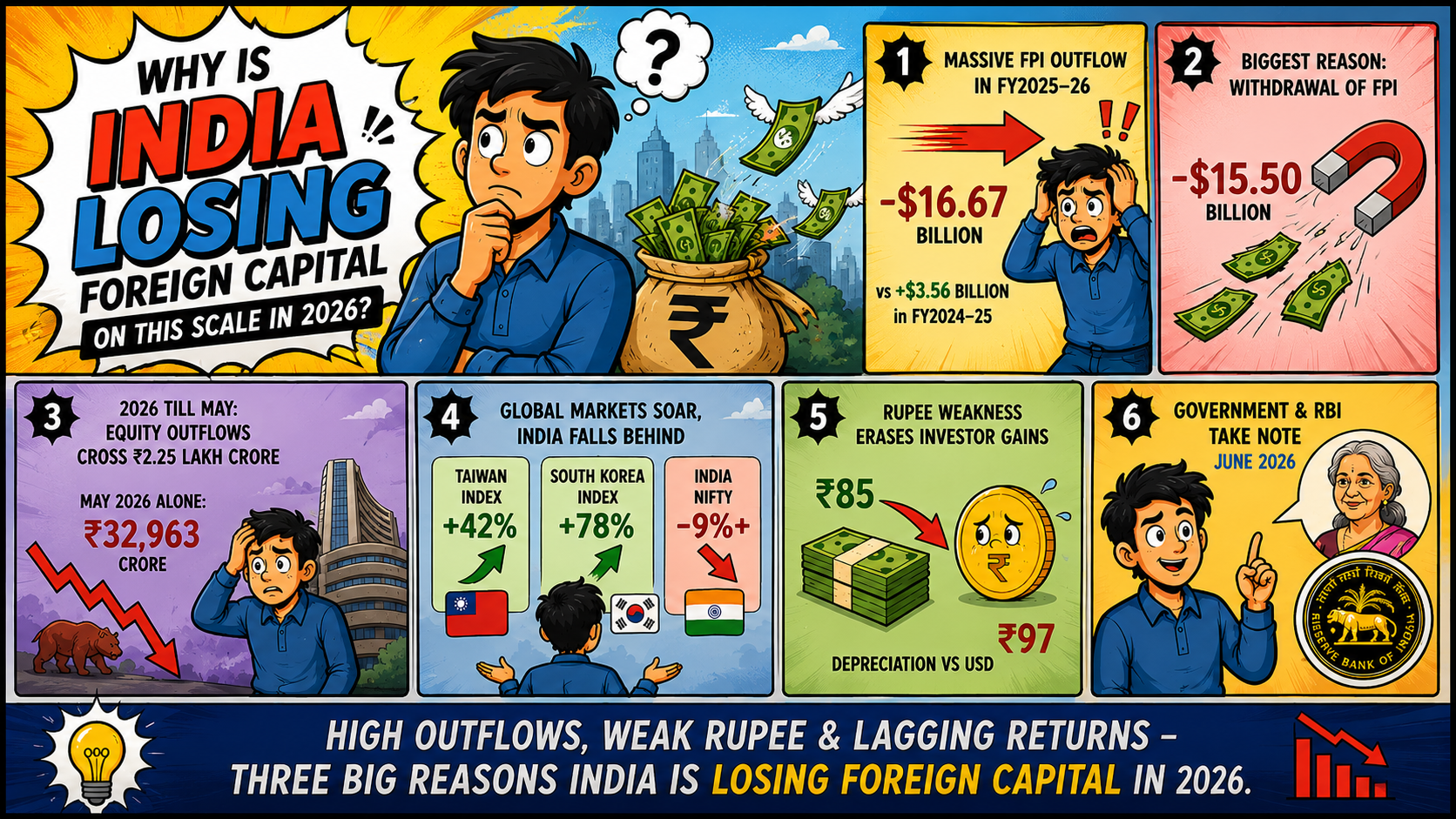
The net portfolio investments in India witnessed an outflow of $16.67 billion in FY2025-26 against the inflow of $3.56 billion in FY2024-25. The outflow of FPI in FY2025-26 was due to the withdrawal of FPI of $15.50 billion.
In calendar year 2026 till May, FPI outflows from the Indian equity market crossed ₹2.25 lakh crore, with an outflow of ₹32,963 crore in May itself.
The Taiwanese stock index registered a rise of 42% in 2025, and South Korea increased by 78%, while the Nifty of India decreased by more than 9%.
The rupee’s depreciation from ₹85 to ₹97 in relation to the dollar erased the gains made by those people who had made investments in the Indian market during the year 2024/2025. Finance minister Nirmala Sitharaman, together with the RBI, highlighted this situation in June 2026.
More than 80% of India’s energy requirements depend upon crude oil that is imported from other nations. Escalation in oil prices due to the conflict in West Asia has increased the import bill of India. This causes capital to flee from the Indian equity market into hard currency security, says Shambhu Ghatak, Senior Economist.
As a result of higher imports and a weaker Rupee, prices of necessities increase. In the Financial Stability Report released by Reserve Bank of India in June 2025, it has been observed that the average debt of an Indian family stands at ₹4.8 lakhs, while in March 2023, the average debt was ₹3.9 lakhs. Out of total debt, non-residential loans constitute 54.9%.
As per LoansJagat, applications for personal loans based on living expenses have increased by 31% from October 2024 to March 2026.
*T&C Apply
Rajesh Singla, CEO and Fund Manager at Alpha AMC, noted that India’s share of global institutional flows collapsed to just 0.4% at the November 2024 peak, against a 6.3% long-term average. This makes it difficult for policy measures alone to reverse the trend.
The RBI announced on June 5, 2026, a package of measures including full hedging cost support for FCNR(B) deposits raised by banks until September 30, 2026. The restoration of the 9-month export repatriation period, which signals that the acute crisis phase may be easing. However, economists also point to domestic fixes.
Curtailing the Liberalised Remittance Scheme for luxury and investment outflows, checking black economy-related capital flight, and reducing import-intensive luxury consumption are three specific steps that could preserve foreign exchange. Ghatak warned that raising the policy rate to prevent capital outflows risks dampening domestic investment and further reducing the morale of domestic institutional investors.
India’s capital outflow problem is rooted in a return differential, not a sentiment problem. India’s share of global institutional flows sits at just 0.4% against a 6.3% long-term average, meaning marginal policy steps will not close the gap. Structural fixes, including tighter LRS rules for non-essential outflows and a credible demand revival plan, matter more right now than rate signals alone.
Why did India record $16.67 billion in net FPI outflows in FY2025-26?
Yes. Foreign investors moved money to US, South Korean, and Taiwanese markets offering far higher returns. India’s Nifty fell 9% in 2025 while South Korea’s market rose 78%. The return gap, not sentiment, is driving the exit.
Can RBI’s June 5, 2026 measures reverse India's $16.67 billion FPI outflow and rupee depreciation?
Unlikely in the short term. The RBI’s June 5 package offers relief, but India’s 0.4% share of global institutional flows against a 6.3% long-term average shows the gap is structural. Demand revival and LRS curbs matter more than rate signals alone.









.png&w=3840&q=75)



