By continuing, you agree to LoansJagat's Credit Report Terms of Use, Terms and Conditions, Privacy Policy, and authorize contact via Call, SMS, Email, or WhatsApp
Disclaimer: The information published on LoansJagat is intended for general informational and educational purposes only and should not be considered financial, legal, or investment advice. Interest rates, loan terms, statistics, and other data may change over time and may vary by lender or source. Please verify the latest information and consult a qualified financial advisor or the respective Bank/NBFC before making any financial decisions.
Subscribe Now
About the author

LoansJagat Team
‘Simplify Finance for Everyone.’ This is the common goal of our team, as we try to explain any topic with relatable examples. From personal to business finance, managing EMIs to becoming debt-free, we do extensive research on each and every parameter, so you don’t have to. Scroll up and have a look at what 15+ years of experience in the BFSI sector looks like.
Related News
Simplify All Your Loans Into One Affordable EMI

Customers Served

Debt Consolidated

1200+ Reviews

Locations in India
Club all Loans & Credit Card Bills into Single EMI

Quick Apply Loan
Consolidate your debts into one easy EMI.

Takes less than 2 minutes. No paperwork.

10 Lakhs+
Trusted Customers

2000 Cr+
Loans Disbursed

4.7/5
Google Reviews

50+
Banks & NBFCs Offers
Other services mentioned in this article
India may bring back 400,000–600,000 barrels per day of Gulf crude by August, cutting voyage costs while shipping risks still hold back fuel-price relief.
Key Highlights
Reuters reported that Indian refiners may boost their imports of Middle Eastern crude by 400,000–600,000 barrels a day by August 2026, after the Strait of Hormuz starts operating normally. It is believed that the energy analytics firm Kpler sees buyers returning to Gulf suppliers in a gradual manner.
This involves Indian refiners and producers from the UAE, Saudi Arabia, and other Gulf countries. It may result in the shortening of delivery routes, reduction of freight costs, and easing of secured crude supply. The initial weeks may still be costly, though. The tanker availability, insurance premiums, and damage to regional energy infrastructure remain unchanged.
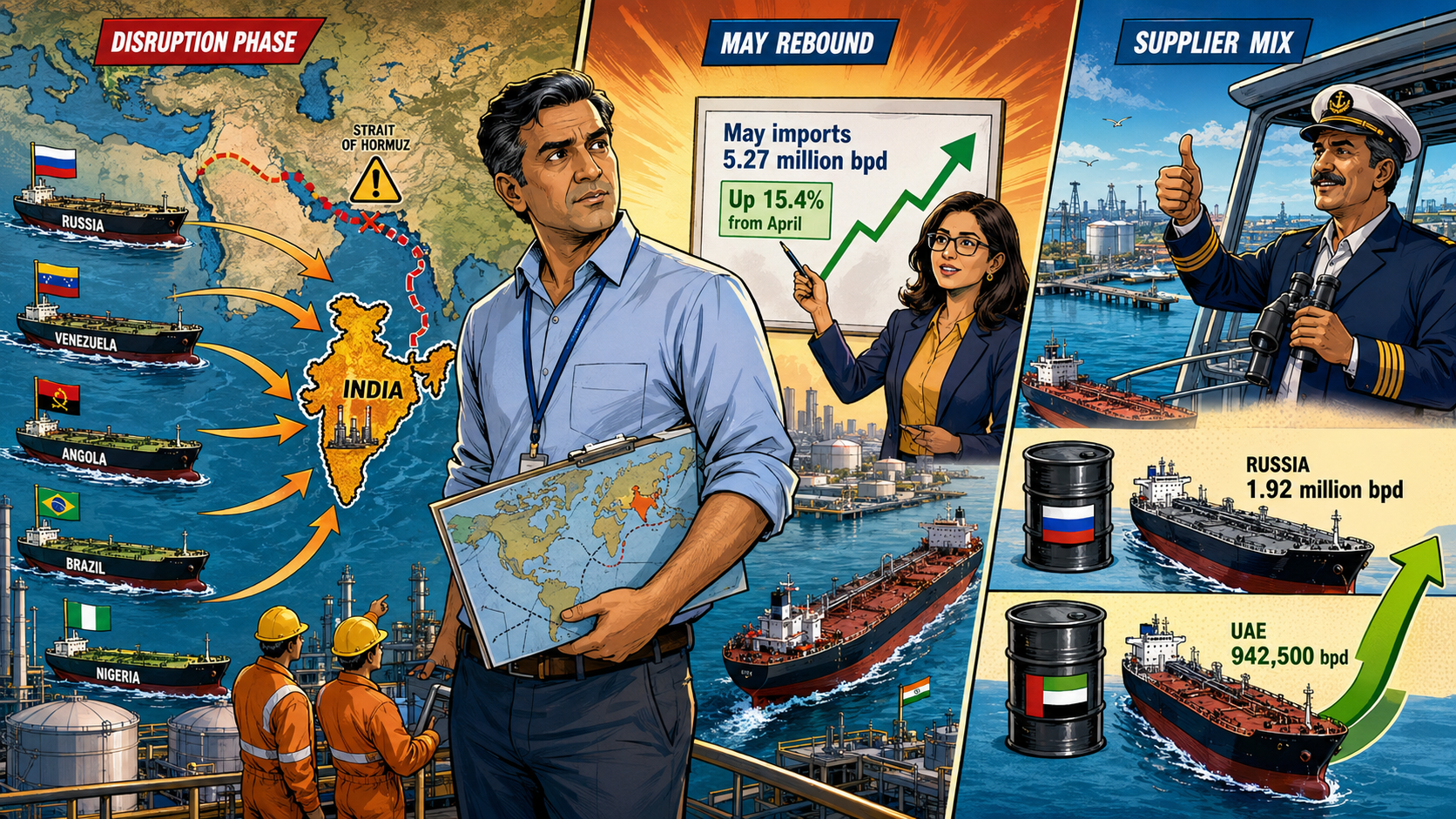
India leaned more heavily on Russia, Venezuela, Angola, Brazil, and Nigeria when Hormuz traffic became difficult. Refiners needed replacement cargoes, even when those barrels took longer to arrive.
May brought a sharp recovery. India imported 5.27 million bpd, up 15.4% from April, according to Reuters on June 18, 2026.
Russia still supplied 36.5% of India’s imported crude. UAE shipments, however, jumped nearly 41% month-on-month, pushing the country ahead of Saudi Arabia as India’s second-largest supplier.
According to Reuters reporting from June 8, 2026, before the oil supply disruption, over 40% of crude shipments and almost 90% of LPG shipments to India passed through the Strait of Hormuz. The numbers demonstrate how, even in a globalized economy, some of the most vital shipping lanes carry a direct cost for Indian consumers.
Price effects will lag. Retail prices are affected by central and state taxes, refinery margins, and oil marketing companies’ decisions, among other things. This means that, for a small reduction in crude prices, petrol prices will likely not move. However, a sustained reduction may reach households.

Large quantities of crude remain held aboard tankers or near Gulf ports. Their release could increase supply quickly and weaken regional crude premiums. Shipping schedules, though, are still being rebuilt.
Kpler expects India’s return to Middle Eastern barrels to unfold over several weeks rather than in one rush. Capital Economics economist Jason Tuvey estimated that around 80% of regional energy flows could resume by the end of Q3, while a full return may stretch into 2027, according to Fortune on June 15, 2026.
Before the disruptions, India received over 40% of its crude oil and 90% of its imported LPG through the Strait of Hormuz. As a result of the proximity of Gulf routes, the cost of transporting oil to refineries may go down, however, families may not see a reduction in the costs of petrol, diesel, or LPG anytime soon.
A June 17, 2026, LoansJagat report stated that the combination of high freight costs, low inventories, and damaged infrastructure could ensure crude oil remains expensive. When petrol and LPG costs increase, along with delivery costs, these families must allocate funds toward these increasing costs of living, leaving less money available for EMIs, school fees, and savings. A consistent reduction in the costs of imports and transport will be of greater benefit to families than a short-lived reduction in the costs of crude oil.
India’s return to Gulf crude could cut voyage costs and make supply planning easier for refiners. Lower household fuel bills remain possible, although the change may take several months to appear.
How Much Middle Eastern Oil Could India Consume?
According to Kpler, the oil consumption figures via the Middle East region will have increased by around 400,000–600,000 bpd by August 2026.
*T&C Apply
Probably not. A number of factors will determine gas prices, such as the crude oil supply, refinery margins, and the pricing policy of oil companies.
Why does India depend on the Strait of Hormuz?
Prior to the current disruption, this route provided over 40% of all crude oil imported by India and over 90% of all LPG.
How Long Will It Take for the Global Oil Market to Recover After Reopening the Strait of Hormuz?
A slow recovery is expected along with a gradual fall in prices, with freight and insurance margins as well as refinery margins causing the greatest delays.
What Impact Will Rising Oil Prices Have on LPG and Other Basic Household Expenses in India?
Petrol, LPG, and other basic expenses are expected to increase at a rapidly alarming rate.
Related News Updates | |||









.png&w=3840&q=75)



