
By continuing, you agree to LoansJagat's Credit Report Terms of Use, Terms and Conditions, Privacy Policy, and authorize contact via Call, SMS, Email, or WhatsApp
Disclaimer: The information published on LoansJagat is intended for general informational and educational purposes only and should not be considered financial, legal, or investment advice. Interest rates, loan terms, statistics, and other data may change over time and may vary by lender or source. Please verify the latest information and consult a qualified financial advisor or the respective Bank/NBFC before making any financial decisions.
Subscribe Now
About the author

LoansJagat Team
‘Simplify Finance for Everyone.’ This is the common goal of our team, as we try to explain any topic with relatable examples. From personal to business finance, managing EMIs to becoming debt-free, we do extensive research on each and every parameter, so you don’t have to. Scroll up and have a look at what 15+ years of experience in the BFSI sector looks like.
Related Blog Post
Simplify All Your Loans Into One Affordable EMI

Customers Served

Debt Consolidated

1200+ Reviews

Locations in India
Club all Loans & Credit Card Bills into Single EMI

Quick Apply Loan
Consolidate your debts into one easy EMI.

Takes less than 2 minutes. No paperwork.

10 Lakhs+
Trusted Customers

2000 Cr+
Loans Disbursed

4.7/5
Google Reviews

50+
Banks & NBFCs Offers
Other services mentioned in this article
Key Takeaways
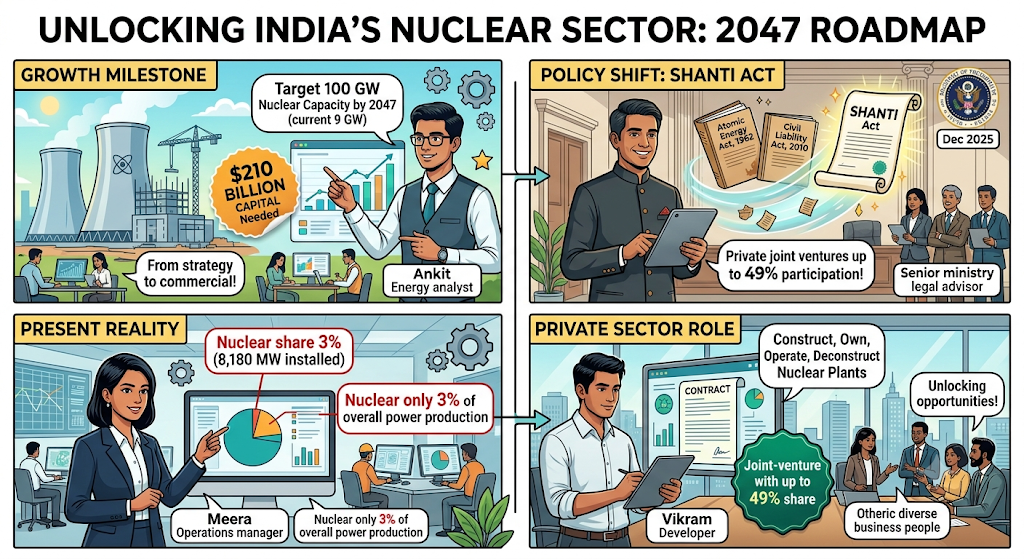
A new white paper titled “Unlocking India's Nuclear Sector,” released by consultancy firm YCP, shows India needs an estimated $210 billion in capital to expand nuclear capacity to 100 GW by 2047, more than 10 times its current base of 9 GW. Ankit Hoshing, Partner at YCP India, said, “India's nuclear sector is moving from a strategic programme to a commercial platform. The opportunity is clear, but its pace will depend on how quickly a viable investment ecosystem takes shape.”
This change is brought about by the approval of the SHANTI Act in December 2025, which was given the presidential sanction by President Droupadi Murmu and repealed both the Atomic Energy Act, 1962, and the Civil Liability for Nuclear Damage Act, 2010. It enables private companies from India to construct, own, operate, and deconstruct nuclear power plants, allowing up to 49 per cent participation in the form of a joint venture. At present, India’s installed nuclear capacity is 8,180 MW, accounting for only 3% of its overall power production.
This reform matters because public funding alone cannot deliver a tenfold capacity increase within 2 decades. According to government figures, an estimated 46 GW of nuclear capacity may be contributed in future through the participation of private companies, consortiums, as well as state-owned utility companies in addition to the public sector itself. India’s per capita electricity usage is likely to increase drastically from 1,460 kWh to 4,000 kWh by 2047.
For India's broader clean energy financing ecosystem, this nuclear push adds to existing momentum. LoansJagat notes that India's electric vehicle market alone is projected to grow from $2 billion in 2023 to over $7 billion by 2025, growing at a 49% CAGR, showing how fast capital can scale once policy clarity and PLI-style incentives are in place. The government has separately allocated ₹20,000 crore for R&D into 5 indigenous Small Modular Reactor designs, aimed at captive industrial use by factories and manufacturers.
*T&C Apply
YCP's report cautioned that legal reform alone will not guarantee investment, since challenges remain around tariff structures, financing mechanisms, supply chain readiness, regulatory clarity, insurance arrangements, and public acceptance. The report stated, “Whilst the SHANTI Act has opened the door to private participation in India by removing legal prohibitions, the full commercial scaffold required for success is not yet in place.”
The SHANTI Act's solution to one major hurdle, supplier liability, replaces the earlier flat operator liability cap of ₹1,500 crore with graded caps tied to reactor size, rising to ₹3,000 crore for large reactors, while removing open-ended supplier liability altogether. This directly addresses the legal uncertainty that had long kept global technology providers like US and French nuclear companies on the sidelines.
The $210 billion nuclear potential of India is one of the major milestones of energy sector reforms in the country after its liberation from colonial rule. However, whether the tariff regulations, financing mechanisms, and logistics can develop sufficiently fast enough to convert this $210 billion potential into real nuclear power plants remains the true challenge of the future.
Name some Indian private companies that are already getting involved in the nuclear industry after the SHANTI Act was implemented in December ?
The Adani Power Company has already created 2 entities related to the nuclear industry, Rawatbhata-Raj Atomic Energy Ltd and Coastal-Maha Atomic Energy Ltd. In addition, there was a visit by an American executive delegation from the USA to India consisting of 20 members in May 2026 for the same reason.
What are India's nuclear power targets and by what margin do they lag?
The nuclear power production capacity of India is 8880 MW as on today. India’s nuclear power capacity will reach 22,480 MW by 2031-32 and 100 GW by 2047. But with the State model, these target would not be achieved.









.png&w=3840&q=75)



