
By continuing, you agree to LoansJagat's Credit Report Terms of Use, Terms and Conditions, Privacy Policy, and authorize contact via Call, SMS, Email, or WhatsApp
Disclaimer: The information published on LoansJagat is intended for general informational and educational purposes only and should not be considered financial, legal, or investment advice. Interest rates, loan terms, statistics, and other data may change over time and may vary by lender or source. Please verify the latest information and consult a qualified financial advisor or the respective Bank/NBFC before making any financial decisions.
Subscribe Now
About the author

LoansJagat Team
‘Simplify Finance for Everyone.’ This is the common goal of our team, as we try to explain any topic with relatable examples. From personal to business finance, managing EMIs to becoming debt-free, we do extensive research on each and every parameter, so you don’t have to. Scroll up and have a look at what 15+ years of experience in the BFSI sector looks like.
Related News
Simplify All Your Loans Into One Affordable EMI

Customers Served

Debt Consolidated

1200+ Reviews

Locations in India
Club all Loans & Credit Card Bills into Single EMI

Quick Apply Loan
Consolidate your debts into one easy EMI.

Takes less than 2 minutes. No paperwork.

10 Lakhs+
Trusted Customers

2000 Cr+
Loans Disbursed

4.7/5
Google Reviews

50+
Banks & NBFCs Offers
Other services mentioned in this article
Key Takeaways
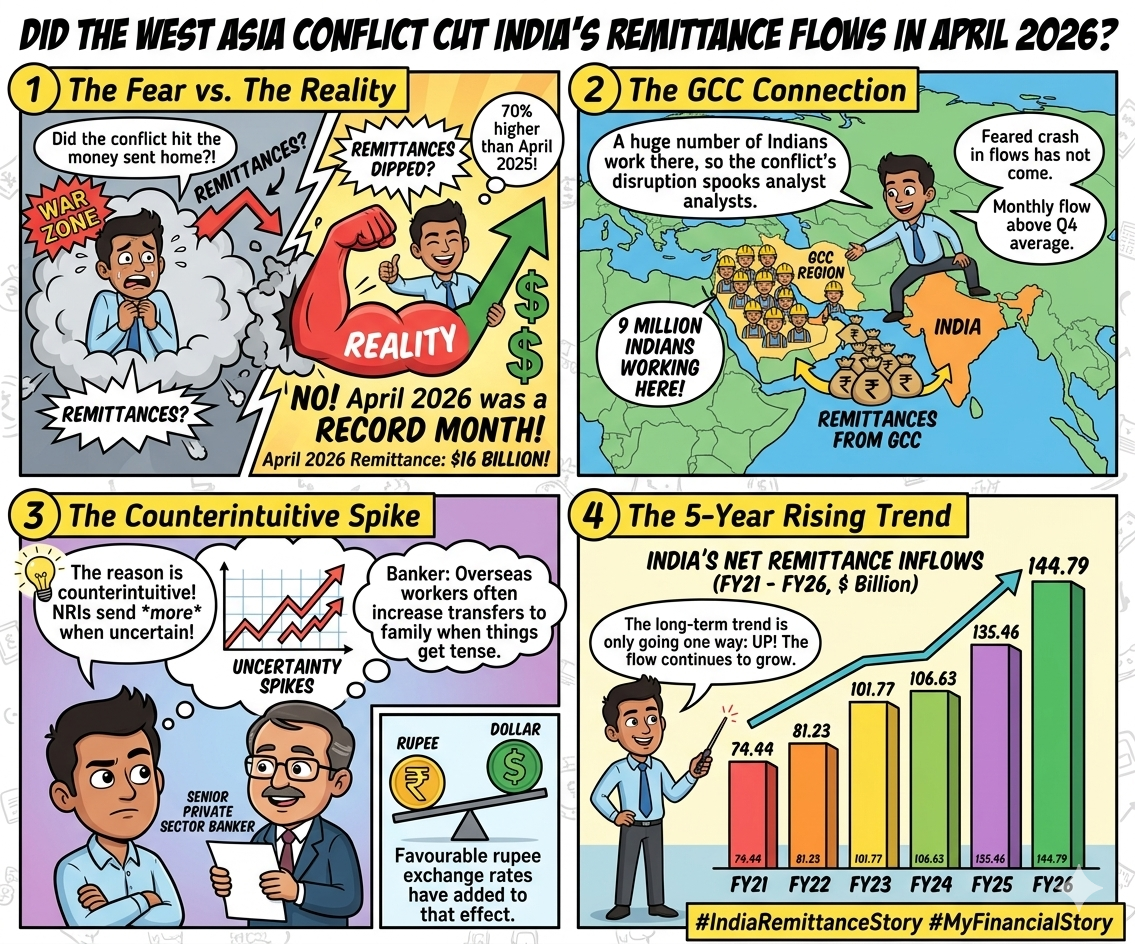
No. India got $16 billion in net remittance transfers in April 2026, per the Reserve Bank of India. That is 70% higher than the $9.4 billion received in April 2025. The amount of monthly flow has remained above the $13.7 billion average in Q4 FY26 until early June 2026. The GCC region has around 9 million Indians working there. Disruptions to GCC production activity had spooked analysts. But the feared crash in flows has not come.
The reason is counterintuitive. NRIs tend to send more money home, not less, when uncertainty spikes. A senior private sector banker told Business Standard on June 17, 2026, “The conflict has not had the adverse impact on remittances that many had feared. In periods of uncertainty, overseas workers often increase transfers to their families back home.” Favourable rupee exchange rates have added to that effect.
Here is the 5-Year Trend of India’s Net Remittance Inflows:
India is the world’s largest remittance recipient. Inflows now exceed 10% of India’s total current account receipts. The money goes straight into household budgets. Rural areas especially rely on it. Nearly 20% of rural Indian households depend on remittance income to supplement earnings.
As reported by LoansJagat, private transfer receipts hit $32 billion in Q4FY25 (January to March 2025), up 11.9% year-on-year. Higher remittances are flowing into real estate demand, not just household expenses. That said, a slowdown is not off the table.
Crisil projected India’s current account deficit at 2.2% of GDP in FY27, against 0.8% in FY26, partly flagging Gulf remittance risks. If GCC job markets weaken through 2026, the April surge may not repeat every month.
Gaura Sen Gupta, Chief Economist at IDFC First Bank, told Business Standard on June 17, 2026, “The data so far does not suggest any meaningful disruption. We do not expect a sharp decline in remittances for the year as a whole and have broadly maintained our FY27 remittance projections at FY26 levels.” She also pointed out that GCC reconstruction activity could create fresh jobs for Indian workers over the medium term.
The US now sends 27.7% of India’s gross remittance inflows. The UAE follows at 19.2%, the UK at 10.8%, Saudi Arabia at 6.7%, and Singapore at 6.6%. The GCC’s declining share over the post-COVID years means one regional shock now carries less weight. The RBI’s FCNR(B) swap window, launched in 2026, is expected to pull in additional NRI deposit inflows in the near term.
April 2026’s $16 billion figure put remittances well ahead of recent averages. FY26 ended at $144.79 billion, a record. For now, the war in West Asia has not broken the flow. Some normalisation is likely as tensions ease. But a sharp drop is not what the data currently points to.
1. Why did India get $81.23 billion in remittances in FY22?
Post-pandemic recovery from FY21 was on display when the funds that were held back by the NRI could now flow back to the home country. The improved working conditions of jobs in the US, UAE, United Kingdom push high remittances from Indians to India. It is seen that India witnessed the record high remittances for the first time in its history during fiscal year 2022, which is supposed to touch $144.79 billion Dollars as per the estimates of RBI.
2. What led to the $144.79 billion remittance mark by India in FY26, a new world record?
101.77
*T&C Apply
Related News Updates | |||









.png&w=3840&q=75)



