By continuing, you agree to LoansJagat's Credit Report Terms of Use, Terms and Conditions, Privacy Policy, and authorize contact via Call, SMS, Email, or WhatsApp
Disclaimer: The information published on LoansJagat is intended for general informational and educational purposes only and should not be considered financial, legal, or investment advice. Interest rates, loan terms, statistics, and other data may change over time and may vary by lender or source. Please verify the latest information and consult a qualified financial advisor or the respective Bank/NBFC before making any financial decisions.
Subscribe Now
About the author

LoansJagat Team
‘Simplify Finance for Everyone.’ This is the common goal of our team, as we try to explain any topic with relatable examples. From personal to business finance, managing EMIs to becoming debt-free, we do extensive research on each and every parameter, so you don’t have to. Scroll up and have a look at what 15+ years of experience in the BFSI sector looks like.
Related News
Simplify All Your Loans Into One Affordable EMI

Customers Served

Debt Consolidated

1200+ Reviews

Locations in India
Club all Loans & Credit Card Bills into Single EMI

Quick Apply Loan
Consolidate your debts into one easy EMI.

Takes less than 2 minutes. No paperwork.

10 Lakhs+
Trusted Customers

2000 Cr+
Loans Disbursed

4.7/5
Google Reviews

50+
Banks & NBFCs Offers
Other services mentioned in this article
India’s latest urea tender brought cheaper offers, giving short-term relief to imports while LNG costs and subsidy pressure still worry policymakers.
Key Highlights
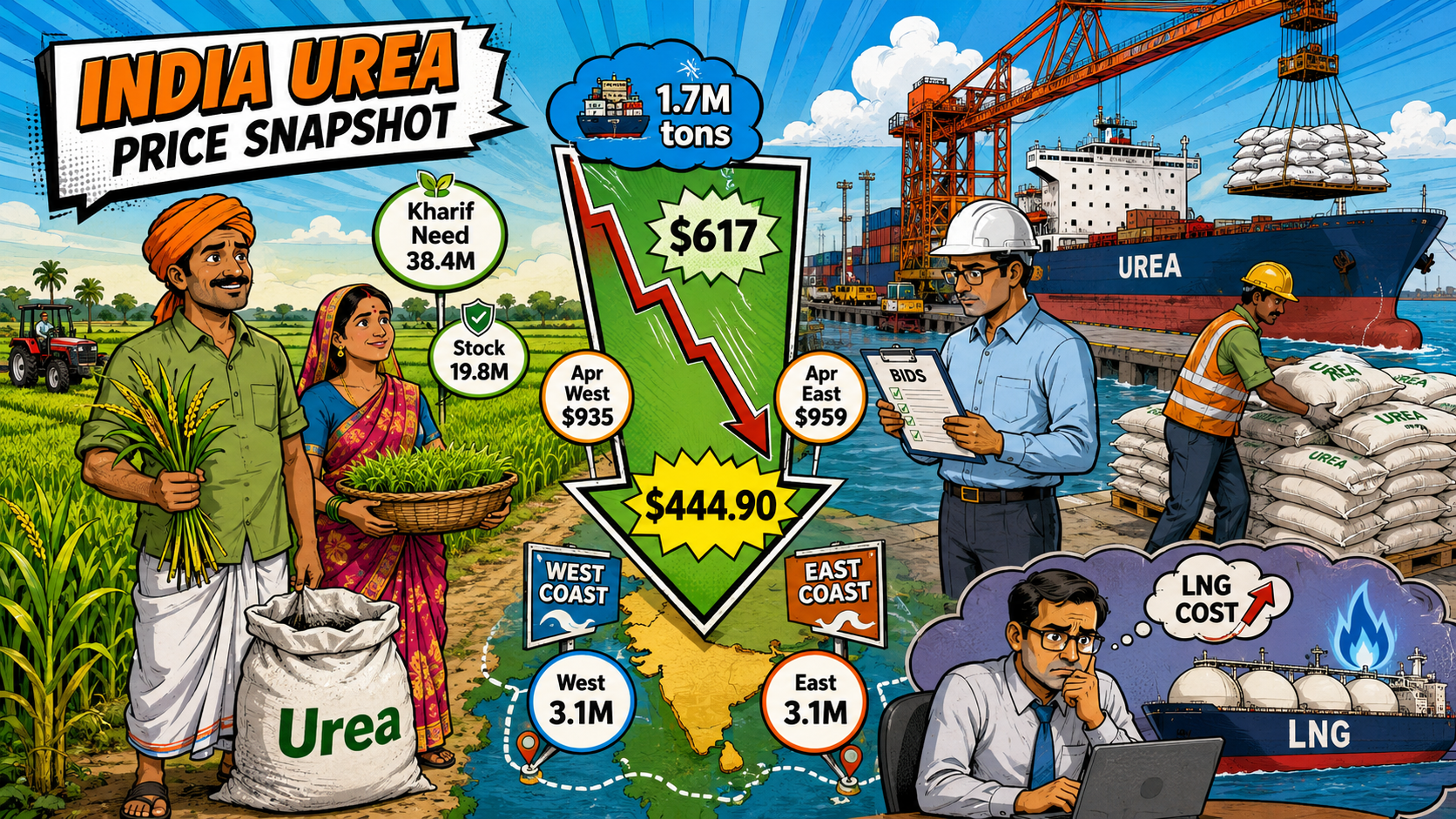
India received urea offers as low as $444.90 per ton in a 1.7 million ton tender floated by National Fertilizers Ltd, ThePrint reported on June 11, 2026, citing Bloomberg. NDTV Profit also reported the same Bloomberg story on June 11, 2026.
The news affects India because urea is a key fertiliser for paddy, corn, and soybean crops during the June to September monsoon season. Cheaper offers may help the government control import costs. The risk is that domestic urea plants still depend on LNG, and ThePrint reported spot LNG near $18 to $19 per million BTU against nearly $13 under long-term contracts.
Farmers may not see a direct price cut at shops because urea is already sold at subsidised prices. The bigger benefit is supply. If imports arrive on time, farmers get fertiliser during the main sowing window without panic buying.
The latest tender received more interest than the target. West Coast offers stood near 3.1 million tons against a 900,000-ton target. The East Coast also stood near 3.1 million tons against an 800,000-ton target.
This can also help food inflation indirectly. If fertiliser reaches farmers on schedule, crop input pressure reduces. But if LNG prices stay high or shipping disruption returns, the lower tender offers may not give lasting relief.

A senior fertiliser ministry official told Reuters on June 9, 2026, that the department had asked for doubling the fertiliser subsidy barely 3 months into the financial year. The Times of India reported the request at ₹3.42 lakh crore against the current ₹1.71 lakh crore FY27 allocation.
The solution is wider sourcing and stronger domestic output. Aparna Sharma, additional secretary in the Ministry of Chemicals and Fertilizers, told Reuters on March 30, 2026, that India had adequate stocks and was tapping alternative suppliers.
*T&C Apply
India’s June urea tender gives price relief after April’s import shock, but subsidy and LNG costs still need close watching. For more finance and economy updates, readers can visit LoansJagat.
Why did India’s urea offers fall in June 2026?
Offers fell after supply pressure eased, and sellers gave lower bids than April 2026 levels.
Will farmers pay less for urea now?
Not immediately, because urea retail prices are subsidised. The main benefit is better supply.
Why does India sell urea cheaply to farmers when imported urea costs much more?
India subsidises urea so farmers can afford crop inputs, while the government pays the gap between import cost and retail price.
Why does the government of India promote the use of neem-coated urea in agriculture?
Neem-coated urea is pushed because it releases slowly in fields, saves fertiliser, and helps stop black-market misuse.









.png&w=3840&q=75)



