By continuing, you agree to LoansJagat's Credit Report Terms of Use, Terms and Conditions, Privacy Policy, and authorize contact via Call, SMS, Email, or WhatsApp
Disclaimer: The information published on LoansJagat is intended for general informational and educational purposes only and should not be considered financial, legal, or investment advice. Interest rates, loan terms, statistics, and other data may change over time and may vary by lender or source. Please verify the latest information and consult a qualified financial advisor or the respective Bank/NBFC before making any financial decisions.
Subscribe Now
About the author

LoansJagat Team
‘Simplify Finance for Everyone.’ This is the common goal of our team, as we try to explain any topic with relatable examples. From personal to business finance, managing EMIs to becoming debt-free, we do extensive research on each and every parameter, so you don’t have to. Scroll up and have a look at what 15+ years of experience in the BFSI sector looks like.
Related Blog Post
Simplify All Your Loans Into One Affordable EMI

Customers Served

Debt Consolidated

1200+ Reviews

Locations in India
Club all Loans & Credit Card Bills into Single EMI

Quick Apply Loan
Consolidate your debts into one easy EMI.

Takes less than 2 minutes. No paperwork.

10 Lakhs+
Trusted Customers

2000 Cr+
Loans Disbursed

4.7/5
Google Reviews

50+
Banks & NBFCs Offers
Other services mentioned in this article
Key Takeaways
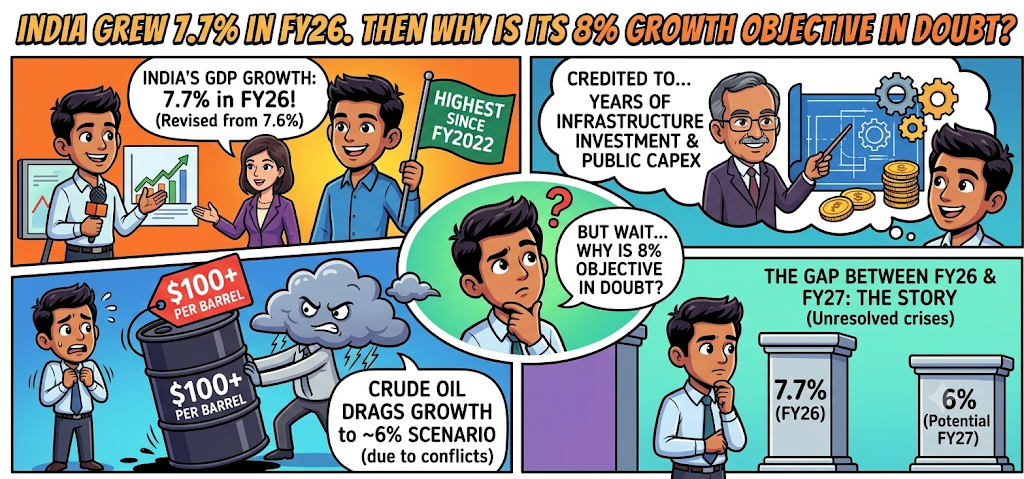
National Statistics Office of India reported a GDP growth of 7.7% during the fiscal year 2025-26 on June 5, 2026. This figure has been revised upwards from 7.6%. It is the highest GDP growth rate India experienced since FY2022.
The chief economic adviser of India, V Anantha Nageswaran attributed this achievement to 10-12 years of infrastructure investments. He credits the growth in public capital expenditures and supply-side reforms for keeping India’s economy stable despite the war in West Asia and the tariffs imposed by the US.
However, the issue here is FY2026-27. Nageswaran did not push back. “We have no reason to second-guess them at this point,” he told reporters. He also flagged crude oil above $100 per barrel as a scenario that could drag growth to 6%. The West Asia crisis has not resolved. That gap between 7.7% in FY26 and 6.6% in FY27 is the story.
Credit demand tracks GDP sentiment closely in India. Personal loan volumes reached ₹13.7 lakh crore in H1 FY2025, though year-on-year growth had already cooled to 13.8%, per TransUnion CIBIL data cited by LoansJagat.
It shows that loan enquiries from Tier-2 and Tier-3 cities pick up when income confidence rises, which is directly tied to how the macro story is read at the ground level.
Nageswaran pointed to rural automobile sales, steel and cement output, and MSME credit as holding firm in the January-to-April 2026 window, 2 months after the West Asia conflict broke out. The rate of unemployment in India dropped to 3.2%, down from 6%. The number of women in the labour force increased by about 18 percentage points. But these are lagged numbers. FY27 income data will be the real test.
*T&C Apply
Nageswaran said India must continue growing at an average of 8% in order to reach a stage of development nationhood under the Viksit Bharat plan. He further cautioned that any prolonged West Asia tensions or continued crude oil prices above the $100 per barrel mark may drag growth figures down to 6%. He named trade deals with the UK, EU, and US as export levers for FY27. None of the 3 deals are signed yet.
Shilan Shah of Capital Economics wrote that the GDP data “confirm that the economy is performing strongly” but added that this does not change the view that “the Reserve Bank’s easing cycle has come to an end.” That means borrowers should not expect rate cuts to push loan costs lower in FY27. Nageswaran also flagged monsoon uncertainty and a widening trade deficit as 2 domestic risks that could complicate the FY27 outlook further.
Nageswaran said India will start growing again at 7%-plus levels in FY2027-28, or even earlier if the environment eases up. FY26 at 7.7% is the strongest number in 4 years. But the RBI is at 6.6% for FY27, crude oil is a live risk, and no major trade deal is signed. The 8% mark exists on a timeline, not a guarantee.
Is 8% GDP growth achievable for India when it already grew by 7.7% in FY26?
India had 7.7% GDP growth in FY26, while the RBI forecasts 6.6% in FY27. However, the government thinks that it will be possible to have 8% growth eventually through reforms and favorable global conditions.
Why did India’s GDP grow to 7.7% in FY26?
Good public investments, increased private consumption, infrastructure investment, and stable growth in the manufacturing and service sector aided India’s growth rate to 7.7%.









.png&w=3840&q=75)



