
By continuing, you agree to LoansJagat's Credit Report Terms of Use, Terms and Conditions, Privacy Policy, and authorize contact via Call, SMS, Email, or WhatsApp
Disclaimer: The information published on LoansJagat is intended for general informational and educational purposes only and should not be considered financial, legal, or investment advice. Interest rates, loan terms, statistics, and other data may change over time and may vary by lender or source. Please verify the latest information and consult a qualified financial advisor or the respective Bank/NBFC before making any financial decisions.
Subscribe Now
About the author

LoansJagat Team
‘Simplify Finance for Everyone.’ This is the common goal of our team, as we try to explain any topic with relatable examples. From personal to business finance, managing EMIs to becoming debt-free, we do extensive research on each and every parameter, so you don’t have to. Scroll up and have a look at what 15+ years of experience in the BFSI sector looks like.
Related Blog Post
Simplify All Your Loans Into One Affordable EMI

Customers Served

Debt Consolidated

1200+ Reviews

Locations in India
Club all Loans & Credit Card Bills into Single EMI

Quick Apply Loan
Consolidate your debts into one easy EMI.

Takes less than 2 minutes. No paperwork.

10 Lakhs+
Trusted Customers

2000 Cr+
Loans Disbursed

4.7/5
Google Reviews

50+
Banks & NBFCs Offers
Other services mentioned in this article
Key takeaways
Finance Minister says government is open to stakeholder views on reducing capital gains tax on stock investments
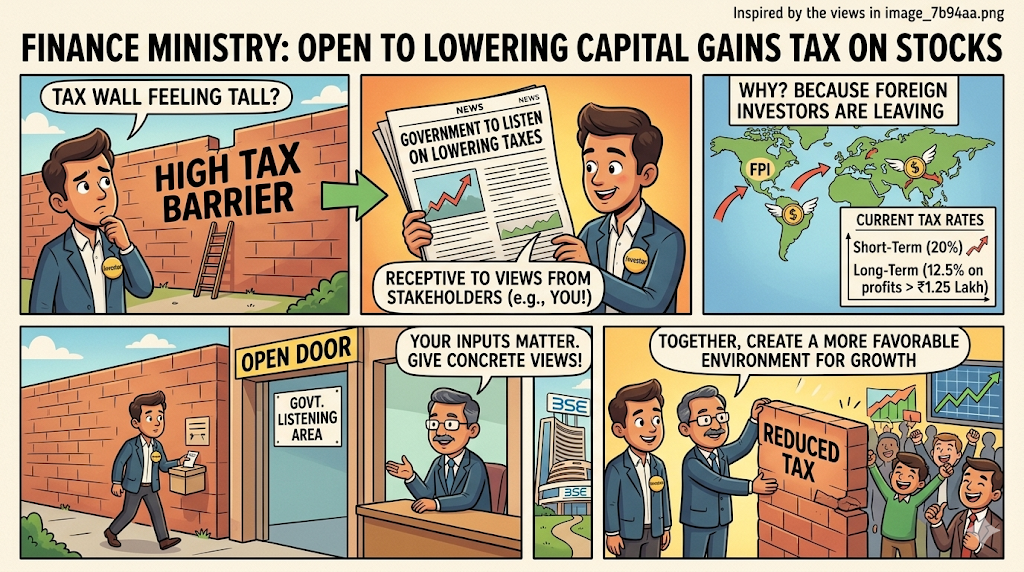
Finance Minister Nirmala Sitharaman on Monday said the government is receptive to views from stakeholders to lower capital gains tax.
“On this issue, as well as on every other issue, we are always ready to listen to people. We will take their inputs,” she said on the sidelines of an awards event by Cotton Textiles Export Promotion Council (TEXPROCIL) in Mumbai.
This situation arises when foreign portfolio investors are withdrawing funds from the country at a record pace. Short-term capital gains on stocks since July 2024 are taxed at 20%, whereas the long-term capital gains tax on profits above ₹1.25 lakh per annum is 12.5%.
A capital gains tax reduction would not just benefit foreign investors. Indian retail investors would also pay less tax on their stock market profits. This could encourage more people to invest in equities over time. More FPI participation also tends to stabilise markets and boost stock prices.
Here are the current capital gains tax rates on equities in India:
However, a tax cut means less money for the government. India already cut central excise duty on petrol and diesel by ₹10 per litre in March 2026. That alone is expected to cost the exchequer over ₹1 lakh crore in FY27. Another revenue giveaway will need careful planning.
Experts broadly support a tax reduction but warn it may not be enough on its own.
Nilesh Shah, Managing Director of Kotak Mahindra AMC, said, “Undoubtedly, lowering capital gains tax will increase post-tax returns for investors. However, only a reduction in taxes does not guarantee returns. Other measures may be needed to attract FPIs.”
*T&C Apply
Most market participants argue that foreign investors remain far more concerned about the weakening rupee, rising global bond yields, and elevated oil prices than tax rates alone.
Arvind Sanger, Managing Partner at Geosphere Capital Management, called the fund-level tax in India “punitive” and “uniquely an Indian problem,” recommending its removal alongside other LTCG reforms.
PwC India has also recommended levying either Securities Transaction Tax (STT) or capital gains tax on listed securities, not both, saying multiple taxes on the same transaction make Indian capital markets unattractive.
The government’s openness to reviewing the capital gains tax is a positive step. It shows responsiveness to market concerns. But experts agree that tax reform must come alongside rupee stability and broader policy predictability. The next move is now with stakeholders to submit concrete, data-backed suggestions.
1. Why are investors unhappy with India’s capital gains tax and stock market charges?
Many investors believe stock market taxation in India has become too high. Apart from short-term and long-term capital gains tax, investors also pay STT, stamp duty, GST, and other transaction-related charges. Experts in the article also said that multiple taxes on the same transaction make Indian markets less attractive, especially for foreign investors.
2. Can investors legally reduce or defer capital gains tax in India?
Yes, investors can reduce their tax burden in legal ways. Investors who keep equity investments for a long duration of more than 12 months qualify for the long-term capital gains tax (LTCG). They can avail the ₹1.25 lakh exemption in a year, along with the possibility to adjust their capital losses from the long-term gains.









.png&w=3840&q=75)



