
By continuing, you agree to LoansJagat's Credit Report Terms of Use, Terms and Conditions, Privacy Policy, and authorize contact via Call, SMS, Email, or WhatsApp
Disclaimer: The information published on LoansJagat is intended for general informational and educational purposes only and should not be considered financial, legal, or investment advice. Interest rates, loan terms, statistics, and other data may change over time and may vary by lender or source. Please verify the latest information and consult a qualified financial advisor or the respective Bank/NBFC before making any financial decisions.
Subscribe Now
About the author

LoansJagat Team
‘Simplify Finance for Everyone.’ This is the common goal of our team, as we try to explain any topic with relatable examples. From personal to business finance, managing EMIs to becoming debt-free, we do extensive research on each and every parameter, so you don’t have to. Scroll up and have a look at what 15+ years of experience in the BFSI sector looks like.
Related News
Simplify All Your Loans Into One Affordable EMI

Customers Served

Debt Consolidated

1200+ Reviews

Locations in India
Club all Loans & Credit Card Bills into Single EMI

Quick Apply Loan
Consolidate your debts into one easy EMI.

Takes less than 2 minutes. No paperwork.

10 Lakhs+
Trusted Customers

2000 Cr+
Loans Disbursed

4.7/5
Google Reviews

50+
Banks & NBFCs Offers
Other services mentioned in this article
Key Takeaways
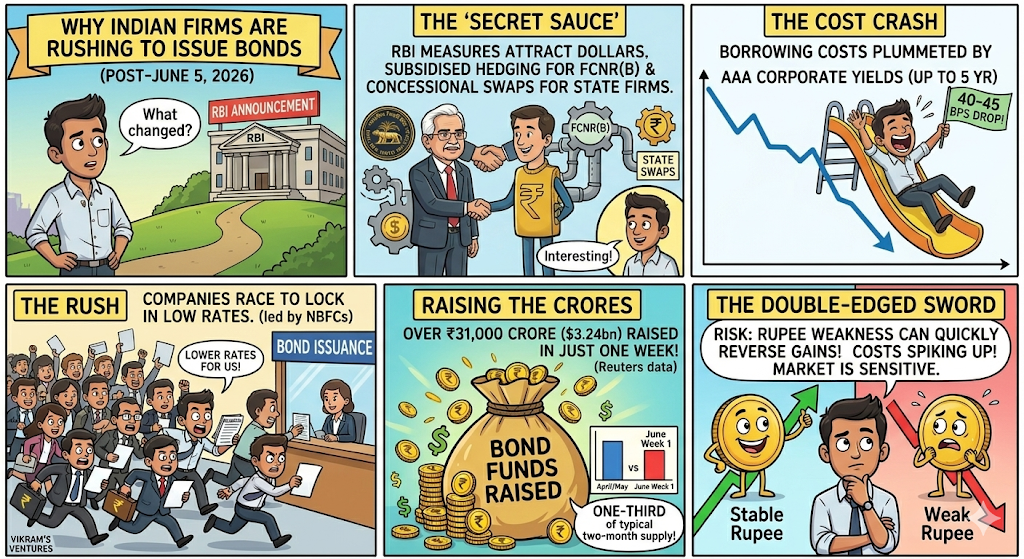
On June 5, 2026, the RBI announced a package of measures to attract dollars into India. These included subsidised hedging costs for fresh 3-5 year FCNR(B) deposits and a concessional swap window for state-owned firms to raise money abroad.
This pushed corporate borrowing costs lower by 40-45 basis points, per LSEG benchmark AAA-rated corporate bond yields of up to five years, while the spread over government bonds has narrowed. Companies moved fast to lock in these lower rates.
Indian companies, led by non-banking financial firms, are raising more than ₹31,000 crore ($3.24 billion) through up to five-year bonds this week. The supply is one-third of what was raised in April and May, according to Reuters data.
The speed of this response shows how rate-sensitive India’s debt markets have become. However, this also signals a risk that if the rupee weakens again, these gains can reverse just as quickly.
NBFCs are at the centre of this bond rush. They now handle 41% of new personal loan disbursements by value in India, up from 27% two years earlier, according to data cited by LoansJagat. When their borrowing costs fall, retail loan rates tend to follow. A 40-45 basis point drop in funding costs is material for this segment.
The impact is especially significant for younger borrowers. As per data cited by LoansJagat, 60% of NBFC borrowers are under 35. This age group relies heavily on NBFCs for personal loans, consumer durables financing, and home loans. A rate pass-through from NBFCs in July or August 2026 would directly benefit this segment.
Here are the major bond issuances this week:
*T&C Apply
NABARD raised funds for three years at 7.34% after cancelling a similar issue in May, where rates could have touched nearly 8%. That is a saving of roughly 66 basis points in one month.
Ajay Marwaha, Head of Fixed Income Markets at Nuvama, said a rise in overseas borrowings could reduce the need for local debt supply, leading to a rally in bonds below five years. This means yields on short-term bonds could fall further.
Puneet Pal, Head of Fixed Income at PGIM India Asset Management, said investors with a horizon of over 18 months should consider corporate bond funds. He called this “an attractive investment opportunity from a relative risk-reward perspective.” This is a useful signal to compare returns for retail investors parked in fixed deposits.
The RBI’s June 5 package has directly cut borrowing costs for India’s top companies by up to 45 basis points in under a week. ₹31,000 crore in fresh bond supply in a single week reflects genuine market confidence. Indian bond yields may soften further through Q2 of FY27 if overseas dollar inflows follow as expected. Retail borrowers should watch NBFC lending rate announcements in July 2026 for any pass-through benefit.
Why did the stock prices of REC and NABARD fail to move up despite raising money through bonds at reduced interest rates this week?
Companies that raise money via bonds incur debts. At times, investors view these bonds as an indication of cash shortages. For NABARD and REC, the 7.34% coupon on the bond indicates that rates will go down further.
How are Indian banks using the RBI’s June 5 measures to raise money from abroad?
RBI's June 5 package lets state-run companies and banks raise funds overseas at subsidised hedging costs. This reduces dependence on domestic bond markets. As more foreign capital enters, local bond supply tightens, and short-term yields fall further for Indian borrowers.









.png&w=3840&q=75)



