
By continuing, you agree to LoansJagat's Credit Report Terms of Use, Terms and Conditions, Privacy Policy, and authorize contact via Call, SMS, Email, or WhatsApp
Disclaimer: The information published on LoansJagat is intended for general informational and educational purposes only and should not be considered financial, legal, or investment advice. Interest rates, loan terms, statistics, and other data may change over time and may vary by lender or source. Please verify the latest information and consult a qualified financial advisor or the respective Bank/NBFC before making any financial decisions.
Subscribe Now
About the author

LoansJagat Team
‘Simplify Finance for Everyone.’ This is the common goal of our team, as we try to explain any topic with relatable examples. From personal to business finance, managing EMIs to becoming debt-free, we do extensive research on each and every parameter, so you don’t have to. Scroll up and have a look at what 15+ years of experience in the BFSI sector looks like.
Related News
Simplify All Your Loans Into One Affordable EMI

Customers Served

Debt Consolidated

1200+ Reviews

Locations in India
Club all Loans & Credit Card Bills into Single EMI

Quick Apply Loan
Consolidate your debts into one easy EMI.

Takes less than 2 minutes. No paperwork.

10 Lakhs+
Trusted Customers

2000 Cr+
Loans Disbursed

4.7/5
Google Reviews

50+
Banks & NBFCs Offers
Other services mentioned in this article
Key Takeaway:
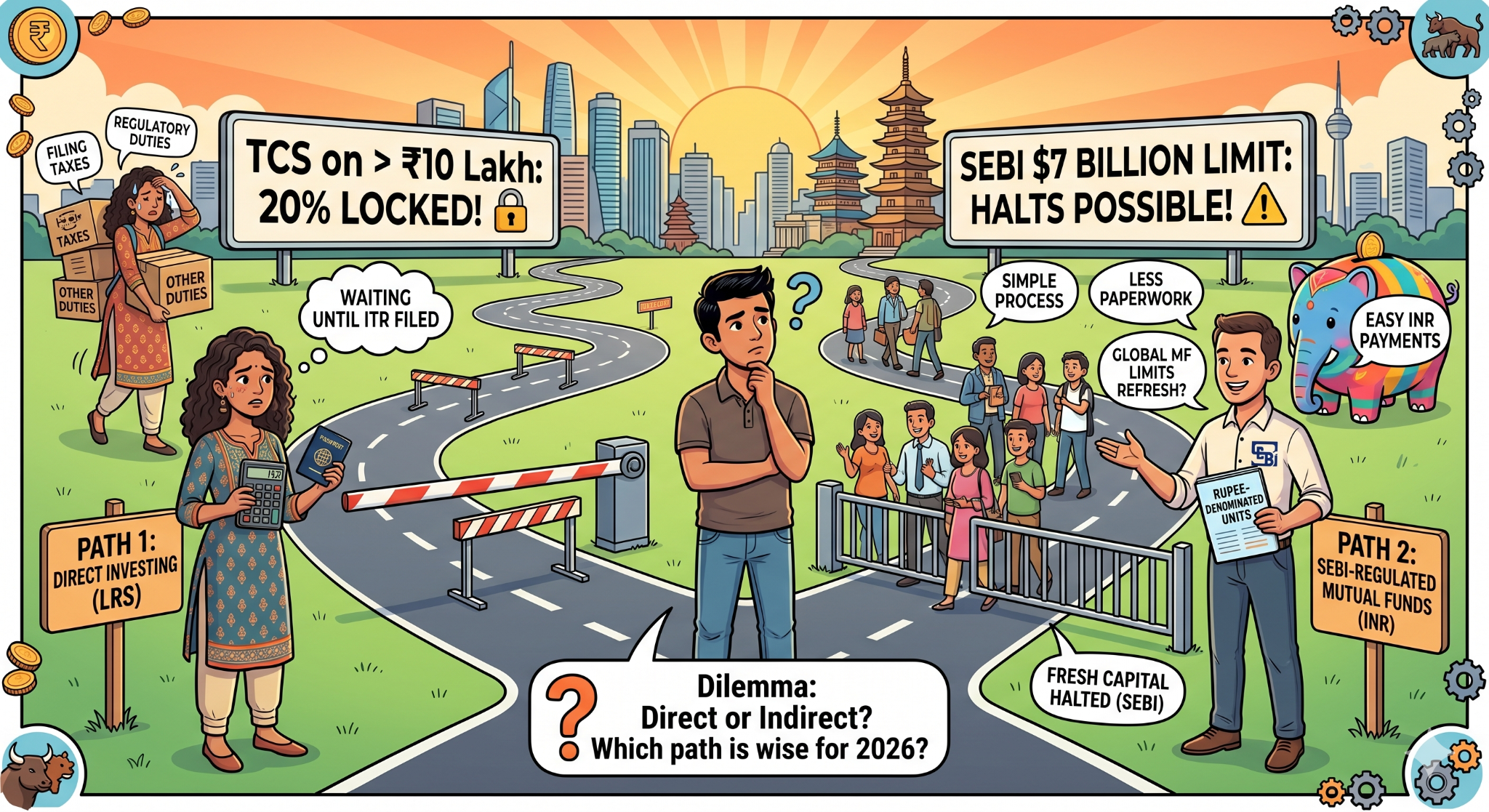
Today, Indian investors have two options for making money from investments in the Asian Market in 2026. The first option is direct investing through the Liberalised Remittance Scheme, which is under RBI regulation.
Second option is involves buying units of SEBI-regulated mutual funds in Rupees. These two methods became more evident in early 2026, after some asset management companies halted the receipt of fresh capital in international mutual funds owing to SEBI’s $7 billion foreign MFs limit getting exhausted.
Wrong decision-making might prove costly for the investors. According to the LRS provisions, the TCS on any amount exceeding ₹10 lakh stands at 20%. The capital is restricted until the investor files his ITR and claims the TCS credit, per the report by Finnovate (August 2025). The investors who invest directly in Asian markets have other duties as well.
The mutual fund route is easier and cheaper for Indian retail investors compared to others. There will be no need to convert money from INR to USD, no need to fill an LRS application form, and no TCS deduction. Franklin Asian Equity Fund (Direct Plan), which invests in Asian stocks except Japanese stocks, has assets under management of ₹521 crores as of May 2026, an expense ratio of 1.4%, and a 1-year CAGR return of 53.79%.
As an investor sending funds below ₹10 lakh annually, you may consider the domestic international mutual fund structure as the better choice since you won’t have LRS remittance, Schedule FA, or TCS. In the opinion of Finnovate (August 2025), GIFT City structures come into play only when investors want to invest large amounts in dollars.
SEBI itself has mentioned in one of its consultations that the direct investment in Indian as well as foreign equities made by an Indian investor is relatively cheaper than the investment made via a foreign fund-of-funds scheme offered by Indian mutual funds. However, in the case of Asian markets, mutual funds are still considered better than equity investing.
Asian mutual funds through SIP can be used by Indian retail investors with smaller investments of ₹500, whereas those with an investment portfolio exceeding ₹10 lakh and having the capacity for compliance issues can adopt LRS direct stocks after studying its TCS and tax treaties.
Would it even be worthwhile to invest in Indian equities in 2026?
The answer is yes, because the Indian economy keeps growing and earns money consistently for business firms, which have good economic systems.
High (varies by broker)
*T&C Apply
Mutual fund business still exists and remains one of the methods through which people create money in India. But there are better ways to go about investment.
Related News Updates | |||









.png&w=3840&q=75)



