
By continuing, you agree to LoansJagat's Credit Report Terms of Use, Terms and Conditions, Privacy Policy, and authorize contact via Call, SMS, Email, or WhatsApp
Disclaimer: The information published on LoansJagat is intended for general informational and educational purposes only and should not be considered financial, legal, or investment advice. Interest rates, loan terms, statistics, and other data may change over time and may vary by lender or source. Please verify the latest information and consult a qualified financial advisor or the respective Bank/NBFC before making any financial decisions.
Subscribe Now
About the author

LoansJagat Team
‘Simplify Finance for Everyone.’ This is the common goal of our team, as we try to explain any topic with relatable examples. From personal to business finance, managing EMIs to becoming debt-free, we do extensive research on each and every parameter, so you don’t have to. Scroll up and have a look at what 15+ years of experience in the BFSI sector looks like.
Related News
Simplify All Your Loans Into One Affordable EMI

Customers Served

Debt Consolidated

1200+ Reviews

Locations in India
Club all Loans & Credit Card Bills into Single EMI

Quick Apply Loan
Consolidate your debts into one easy EMI.

Takes less than 2 minutes. No paperwork.

10 Lakhs+
Trusted Customers

2000 Cr+
Loans Disbursed

4.7/5
Google Reviews

50+
Banks & NBFCs Offers
Other services mentioned in this article
India’s FY27 growth outlook has weakened as oil prices, rupee pressure, foreign outflows, jobs and slower investment test Modi’s third-term economy.
Key Highlights
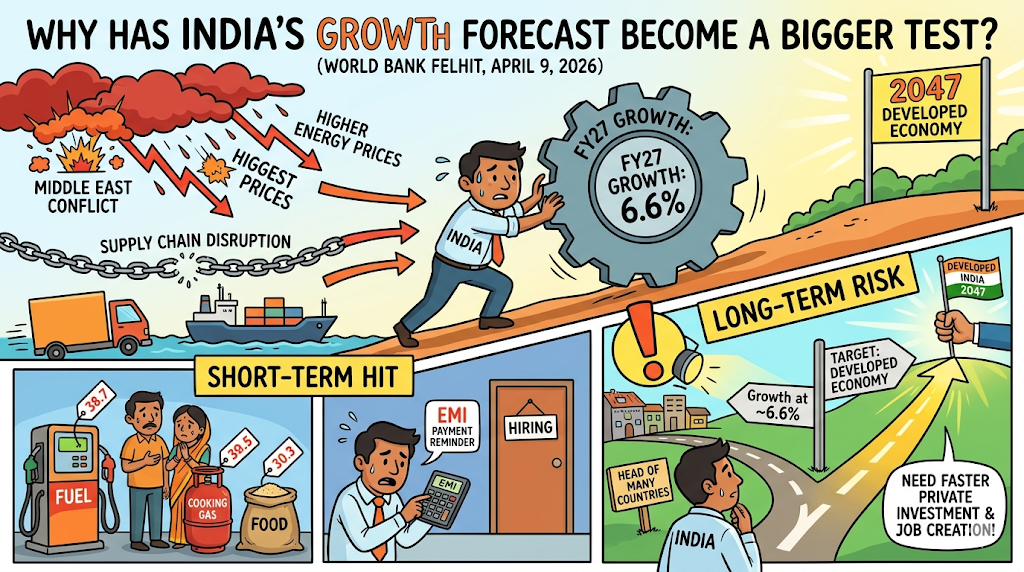
The World Bank said on April 9, 2026 that India’s FY27 growth is projected at 6.6%, mainly due to higher energy prices from the Middle East conflict and supply chain disruption. The forecast involves India, Prime Minister Narendra Modi’s third-term government, consumers, investors and businesses. The pressure is showing in New Delhi’s economic planning, household budgets and financial markets.
The short-term hit may come through fuel, food transport, cooking gas, EMIs and hiring. The long-term risk is sharper. If growth stays near 6.5% to 6.6%, India may remain ahead of many countries, but the 2047 developed-economy target could need faster private investment and job creation.
The data below shows why the growth story now has more pressure than last year. GDP is still high, but oil, trade and foreign flows are turning heavier.
These figures do not show an economic breakdown. They show a tougher phase where India must protect growth while handling expensive imports, job pressure and cautious investors.
For families, oil is the first pain point. Reuters reported on April 9, 2026 that India imports around 90% of its oil. If crude remains high, petrol, diesel, LPG, freight and food delivery costs can rise. Small traders, salaried workers and rural buyers may feel it first.
There is still a positive side. FY26 growth at 7.7% shows that agriculture, construction, private investment and rural spending helped the economy. A LoansJagat analysis dated May 25, 2026 said renewable energy, rural infrastructure and tax support can soften FY27 pressure if used quickly.
India entered FY27 with better numbers. Reuters reported on June 5, 2026 that GDP grew 7.8% in January-March 2026 and 7.7% in FY26. That gave the government a firmer base before crude prices, capital outflows and currency pressure became louder.
Then the import bill jumped. Reuters reported on May 15, 2026 that India’s April merchandise trade deficit widened to $28.38 billion. Oil imports rose 53% in April to $18.63 billion from $12.18 billion in March.
*T&C Apply
The earlier story was about India beating growth estimates. The new story is whether that growth can survive a bigger import bill and weaker investor appetite.
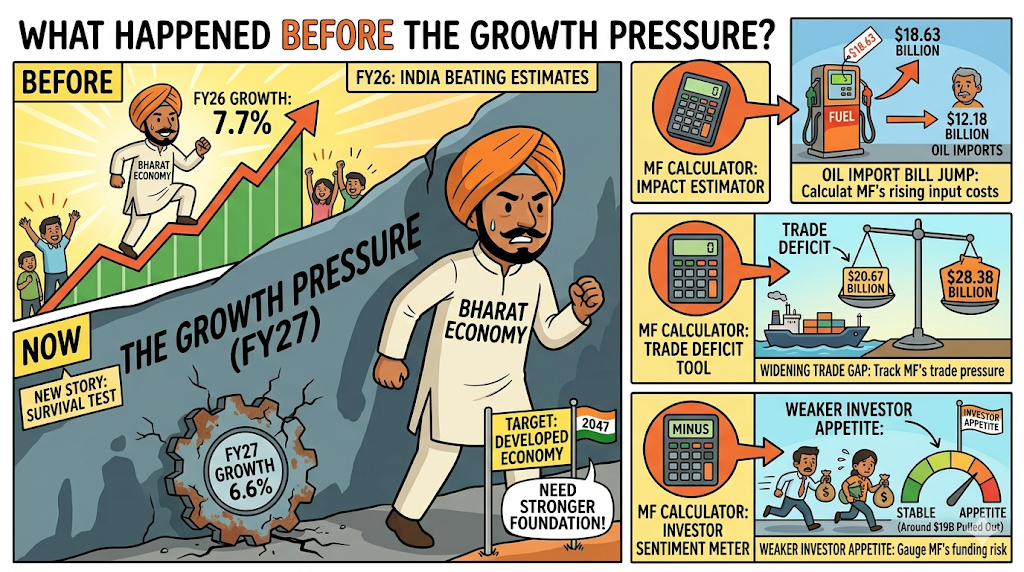
Garima Kapoor of Elara Securities told Economic Times on June 10, 2026 that India’s 6.5% growth is real, but not enough for Viksit Bharat without stronger private capex. Reuters also reported on June 9, 2026 that Congress asked the government to absorb the oil price shock instead of passing it fully to consumers.
The solution is practical: reduce oil dependence, speed up renewables, support rural demand, push private investment, improve exports and create better jobs. GDP alone will not settle the debate if fuel, wages and hiring stay under pressure.
India’s growth story is still alive, but Modi’s third term faces a harder economic test. The next year may show whether GDP growth can turn into cheaper living costs, better jobs and stronger investment.
What Is India’s FY27 Growth Forecast?
The World Bank projected India’s FY27 growth at 6.6% on April 9, 2026.
Why Are Oil Prices A Risk For India?
India imports around 90% of its oil, so crude shocks can raise fuel, freight and food costs.
Will India’s bigger economy actually put more money in people’s pockets?
Not by itself. People feel growth only when jobs pay better, small businesses earn more, factories hire, and daily costs do not eat the salary.
What could push India’s GDP growth higher again?
India’s GDP may rise faster when companies start investing more, hiring improves, exports pick up, people spend more, and oil prices stay manageable.









.png&w=3840&q=75)



