By continuing, you agree to LoansJagat's Credit Report Terms of Use, Terms and Conditions, Privacy Policy, and authorize contact via Call, SMS, Email, or WhatsApp
Disclaimer: The information published on LoansJagat is intended for general informational and educational purposes only and should not be considered financial, legal, or investment advice. Interest rates, loan terms, statistics, and other data may change over time and may vary by lender or source. Please verify the latest information and consult a qualified financial advisor or the respective Bank/NBFC before making any financial decisions.
Subscribe Now
About the author

LoansJagat Team
‘Simplify Finance for Everyone.’ This is the common goal of our team, as we try to explain any topic with relatable examples. From personal to business finance, managing EMIs to becoming debt-free, we do extensive research on each and every parameter, so you don’t have to. Scroll up and have a look at what 15+ years of experience in the BFSI sector looks like.
Related News
Simplify All Your Loans Into One Affordable EMI

Customers Served

Debt Consolidated

1200+ Reviews

Locations in India
Club all Loans & Credit Card Bills into Single EMI

Quick Apply Loan
Consolidate your debts into one easy EMI.

Takes less than 2 minutes. No paperwork.

10 Lakhs+
Trusted Customers

2000 Cr+
Loans Disbursed

4.7/5
Google Reviews

50+
Banks & NBFCs Offers
Other services mentioned in this article
Key Takeaways
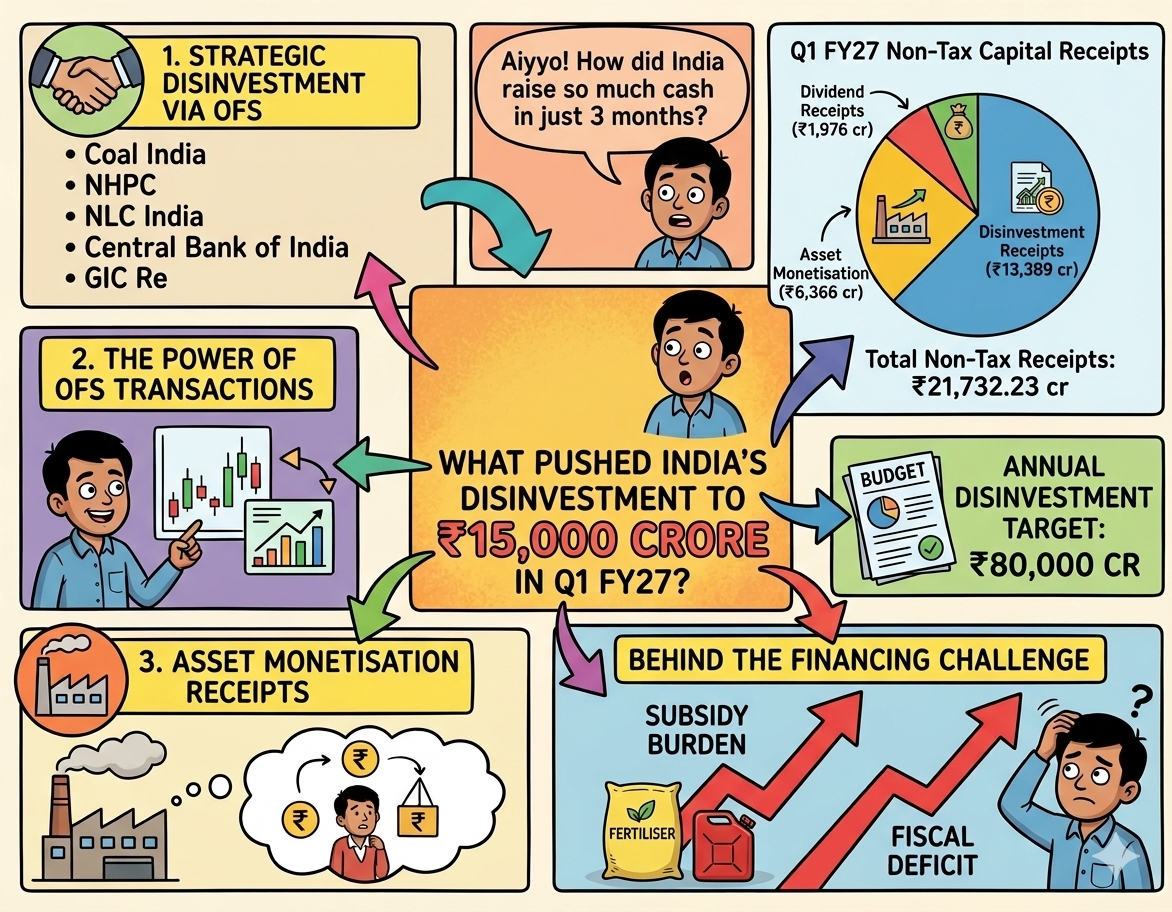
The Indian government raised over ₹15,000 crore from public sector stake sales in Q1 FY27. The Centre conducted these sales through Offer for Sale (OFS) transactions in Coal India, NHPC, NLC India, Central Bank of India, and GIC Re.
The Centre had mobilised ₹21,732.23 crore in total non-tax capital receipts as of Q1 FY27. Disinvestment receipts were at ₹13,389.42 crore. Receipts from asset monetisation were ₹6,366.93 crore, while dividend receipts were ₹1,975.88 crore. Disinvestment receipts target for the year is ₹80,000 crore for FY27, according to the Union Budget 2026-27.
Nonetheless, ICRA pointed out that the first quarter of FY27 began with weak finances as the fiscal deficit increased to ₹3.6 trillion in April 2026 compared to ₹1.9 trillion last year. The growing subsidy burden due to fertiliser and fuel remains a challenge in government financing.
Yes, but to some extent.
When the government makes a profit through the disinvestment or partial sale of its stake in the state-owned company, it helps in bridging the revenue and expenditure gap. It results in reduced borrowing requirements, thereby ensuring stability in the economic environment and market. Reduced borrowing will enable the banks to lend money to individuals and firms.
The budget for FY27 targets a fiscal deficit of 4.3% compared to 4.4% for FY26. Besides this, the government’s capital budget has been set at ₹12.2 lakh crore, and there has been an increase in dependence on non-revenue sources of finance, such as disinvestment and more.
The government-owned banks, which are the entities to be partially privatized in the process of disinvestment, play a pivotal role in providing loans to Indian households.
For example, the market share of PSU banks in providing loans to households stands at 46.4% at the end of FY25, higher than 45.1% during the previous fiscal year. The LoansJagat figures indicate that the market share of PSU banks’ credit disbursal in India was 53.5% in 2024.
On the flip side, the process of OFS could lead to low supply and a decline in the share price of such listed PSUs.
Aditi Nayar, Chief Economist at ICRA, noted that the GoI started FY27 on a weaker note, with year-on-year dips in tax and non-tax revenues and sharp expansion in both revenue and capital spending. These were higher than estimated fertiliser and LPG subsidies, a shortfall in excise duties, and weak dividends from oil marketing companies.
According to ICRA, the fiscal deficit may touch 4.7% of the GDP in FY27, assuming crude oil prices at around $95 per barrel. The fiscal deficit would reach 5% of GDP if crude prices average $105 per barrel during FY27.
The pipeline ahead includes the strategic sale of IDBI Bank and possible further dilution in LIC. As of June 10, 2026, government officials stated no fresh borrowing is required, with divestment proceeds already exceeding ₹18,500 crore, around 25% of the full-year target.
India’s Q1 FY27 disinvestment of over ₹15,000 crore provides early momentum toward the ₹80,000 crore full-year target. The OFS-driven stake sales in 5 major PSUs are supporting the 4.3% fiscal deficit goal for FY27. But with crude oil above $95, subsidies rising, and ICRA flagging a potential slippage to 4.7%, disinvestment alone cannot carry the fiscal arithmetic. The IDBI Bank sale and any LIC dilution in the coming quarters will be critical numbers to watch.
What public sector units were sold by the government to fetch ₹15,000 crore in Q1 FY27?
These five PSUs have been sold by the government: Coal India, NHPC, NLC India, Central Bank of India, and GIC Re. The sale was made through the Offer for Sale method. Disinvestment revenues for Q1 FY27 touched ₹15,000 crore.
Is India’s fiscal deficit expected to be pegged at 4.3% in FY27 despite higher oil prices?
Possibly not. As per ICRA’s Aditi Nayar, the deficit may shoot up to 4.7% if the crude price is $95 per barrel. Fertilizer subsidy costs are the biggest threat to the targeted fiscal deficit of 4.3%.
*T&C Apply









.png&w=3840&q=75)



