
By continuing, you agree to LoansJagat's Credit Report Terms of Use, Terms and Conditions, Privacy Policy, and authorize contact via Call, SMS, Email, or WhatsApp
Disclaimer: The information published on LoansJagat is intended for general informational and educational purposes only and should not be considered financial, legal, or investment advice. Interest rates, loan terms, statistics, and other data may change over time and may vary by lender or source. Please verify the latest information and consult a qualified financial advisor or the respective Bank/NBFC before making any financial decisions.
Subscribe Now
About the author

LoansJagat Team
‘Simplify Finance for Everyone.’ This is the common goal of our team, as we try to explain any topic with relatable examples. From personal to business finance, managing EMIs to becoming debt-free, we do extensive research on each and every parameter, so you don’t have to. Scroll up and have a look at what 15+ years of experience in the BFSI sector looks like.
Related News
Simplify All Your Loans Into One Affordable EMI

Customers Served

Debt Consolidated

1200+ Reviews

Locations in India
Club all Loans & Credit Card Bills into Single EMI

Quick Apply Loan
Consolidate your debts into one easy EMI.

Takes less than 2 minutes. No paperwork.

10 Lakhs+
Trusted Customers

2000 Cr+
Loans Disbursed

4.7/5
Google Reviews

50+
Banks & NBFCs Offers
Other services mentioned in this article
Extreme summers are no longer only a health crisis. They are cutting India’s work hours, farm output, power stability and household incomes.
Key Takeaways
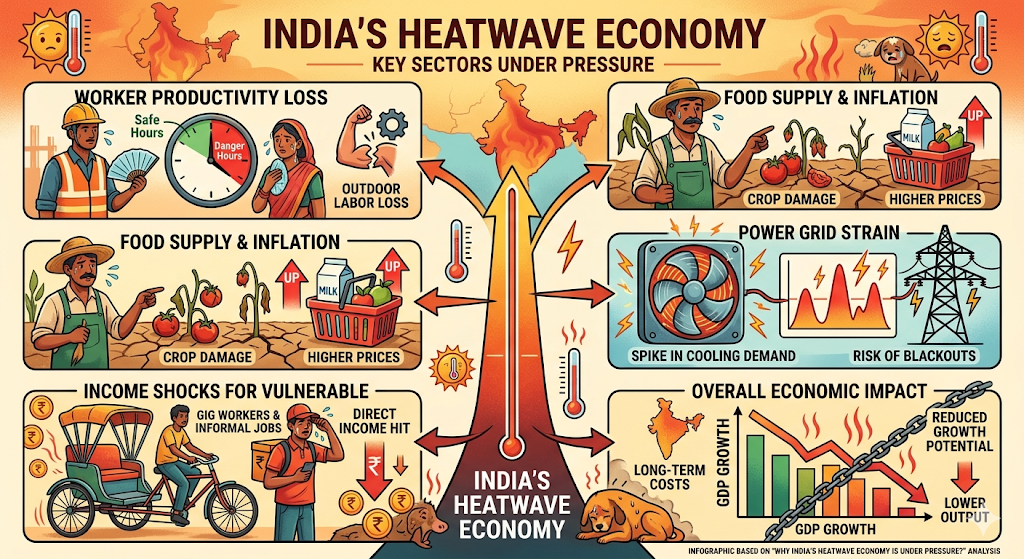
India’s extreme summers are now hitting the economy through labour, food and electricity. Outdoor workers lose safe working hours, farmers face crop damage, and households pay more for cooling, medicines and food.
The long-term cost can be bigger. India’s growth depends heavily on agriculture, construction, logistics, gig work and informal jobs. These workers cannot always shift indoors or buy cooling. That makes heat a direct income shock.
Extreme heat first hits workers and farms. Then food prices rise, cooling demand jumps, power plants face stress and small businesses absorb higher costs. The final impact reaches GDP, wages and inflation.
This shows why heat is now a growth variable. When work slows, electricity use rises and food output falls, the economy pays through lower productivity and higher costs.
For households, the first hit is income. The Guardian reported on 26 May 2026 that nearly 80% of 2,200 internal migrants surveyed faced heat-linked livelihood disruption. It also reported that informal workers form about 90% of India’s labour force.
There is one positive side. Heat action plans, shaded work areas, water points, cool roofs and staggered work shifts can reduce wage loss. For gig workers, construction labourers and street vendors, even basic cooling support can protect daily earnings.
Farm losses are already visible. Reuters reported on 3 March 2023 that India’s 2022 March heatwave cut wheat output to 100 million tonnes against local consumption of 103.6 million tonnes.
*T&C Apply
Food inflation hurts lower-income families faster because food takes a bigger share of their monthly budget. Heat-damaged crops also hurt farmers, exporters, cold-chain firms and small transport operators.
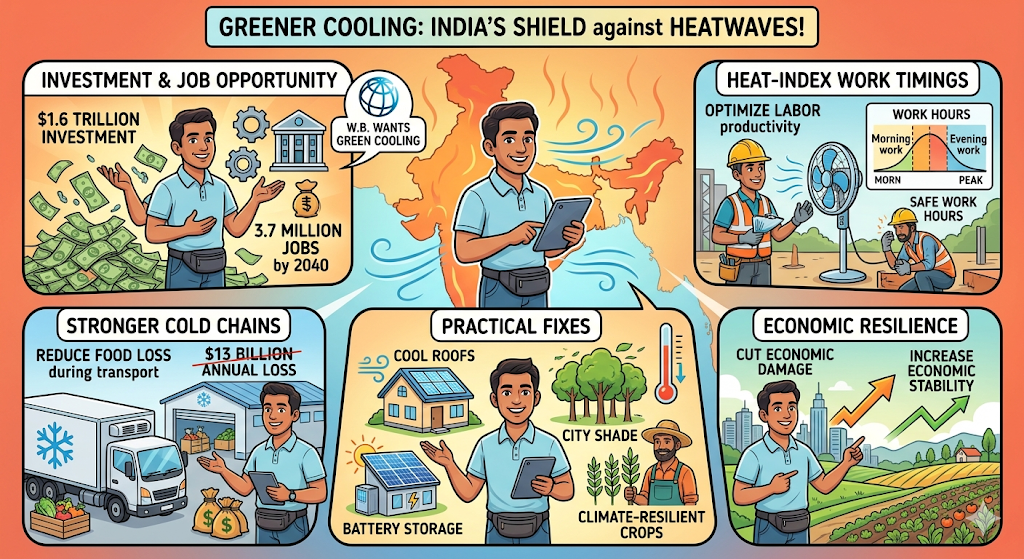
The World Bank said on 30 November 2022 that greener cooling can create a $1.6 trillion investment opportunity by 2040 and nearly 3.7 million jobs. It also warned that heat-linked food loss during transport is close to $13 billion annually.
Experts point to practical fixes: cool roofs, stronger cold chains, heat-index work timings, city shade, battery storage and climate-resilient crops. India cannot stop every heatwave, but it can cut the economic damage.
Extreme heat is now linked to India’s jobs, food prices, power demand and GDP outlook.
The next growth push will need climate-proof workplaces, farms, cities and electricity systems.
Will India’s heatwaves hurt jobs and daily life in the coming years?
Yes, and it is already happening in many cities. People who work outside, like delivery riders, construction workers, farmers, traffic police and street vendors, face the worst of it. When the temperature goes too high, they either slow down or lose work hours.
That means less income. Heat also damages crops, so vegetables, wheat and fruits can become costlier. Power cuts may also rise because more people use fans and ACs. India needs more shade, water points, better work timings and cheaper cooling before this becomes harder to control.
Is India’s economy still facing a slowdown?
India is not really in an “economic winter”, but it is also not a smooth growth story for everyone. World Bank said on 9 April 2026 that India remains one of the fastest-growing major economies, with FY27 growth projected at 6.6%.
Reuters reported on 28 April 2026 that economists expected GDP growth at around 6.7% this fiscal year. Still, many people do not feel that strength in daily life. Informal workers, small shops and households are dealing with food inflation, heatwave losses, weak income growth and higher costs. So, India is growing, but pressure is still there.









.png&w=3840&q=75)



