By continuing, you agree to LoansJagat's Credit Report Terms of Use, Terms and Conditions, Privacy Policy, and authorize contact via Call, SMS, Email, or WhatsApp
The information published on LoansJagat is intended for general informational and educational purposes only and should not be considered financial, legal, or investment advice. Interest rates, loan terms, statistics, and other data may change over time and may vary by lender or source. Please verify the latest information and consult a qualified financial advisor or the respective Bank/NBFC before making any financial decisions.
Subscribe Now
About the author

LoansJagat Team
‘Simplify Finance for Everyone.’ This is the common goal of our team, as we try to explain any topic with relatable examples. From personal to business finance, managing EMIs to becoming debt-free, we do extensive research on each and every parameter, so you don’t have to. Scroll up and have a look at what 15+ years of experience in the BFSI sector looks like.
Related News
Simplify All Your Loans Into One Affordable EMI

Customers Served

Debt Consolidated

1200+ Reviews

Locations in India
Club all Loans & Credit Card Bills into Single EMI

Quick Apply Loan
Consolidate your debts into one easy EMI.

Takes less than 2 minutes. No paperwork.

10 Lakhs+
Trusted Customers

2000 Cr+
Loans Disbursed

4.7/5
Google Reviews

50+
Banks & NBFCs Offers
Other services mentioned in this article
India’s FY26 GDP grew 7.7%, giving the BJP a fresh economic talking point as households watch jobs, prices and income prospects closely.
Key Takeaways
India’s economy expanded 7.8% in January-March 2026, while full-year FY26 growth stood at 7.7%, according to government data reported by Reuters on June 5, 2026. The BJP linked the numbers to Prime Minister Narendra Modi’s economic policies, while economists said the next test will come from oil prices, inflation and global tension.
In the short term, stronger output can help jobs, business orders and tax collections. In the long term, the gain will count more if private consumption, rural income and investment stay steady. The negative side is simple: if crude oil rises or monsoon pressure returns, household budgets may still feel tight.
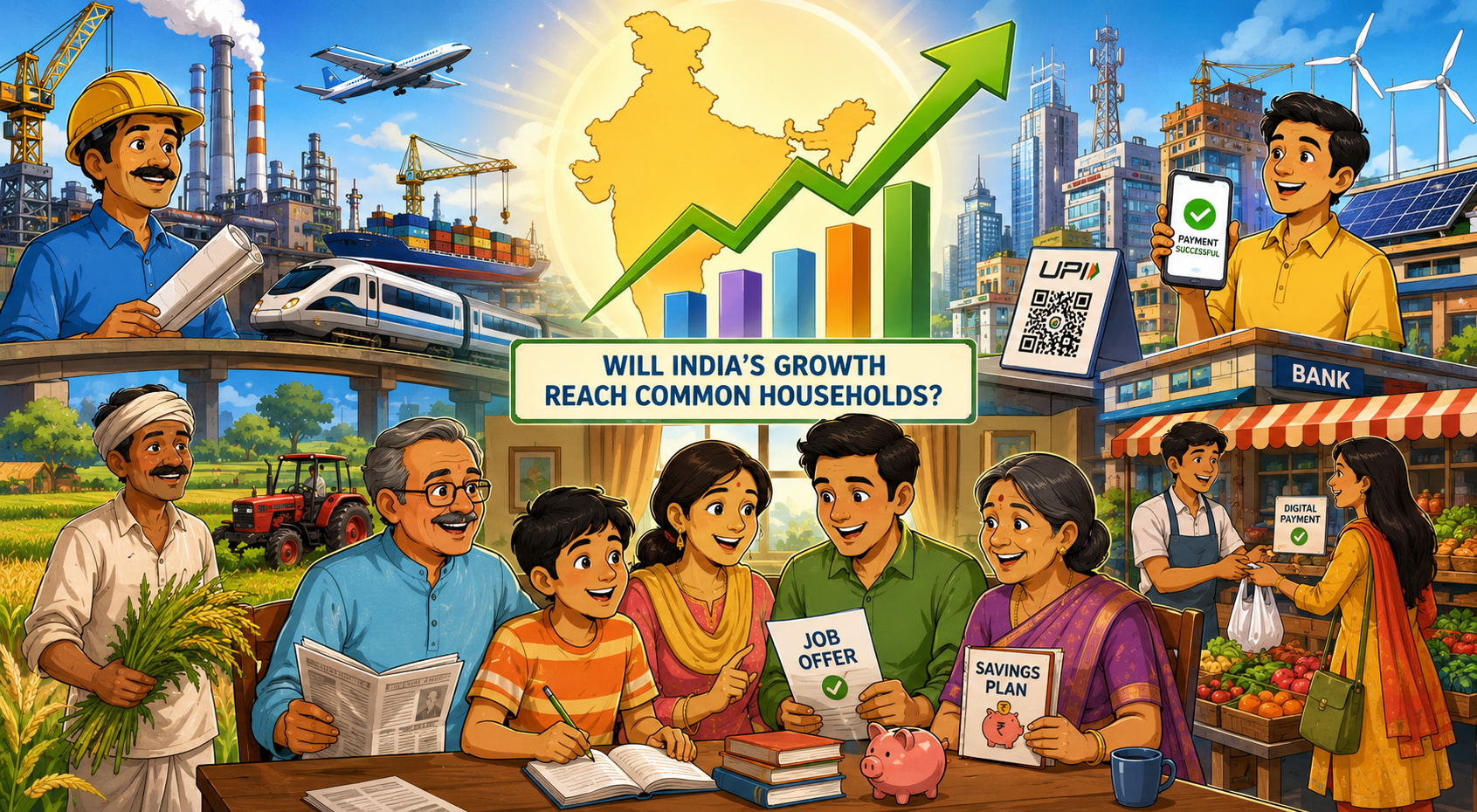
For ordinary Indians, the GDP number connects with jobs, business cash flow and lending activity. Reuters reported that private investment grew 10.8%, the highest under the new series, while private consumption grew 7.1% and formed 57% of GDP.
Before the table, the core numbers show why the government has called the latest data strong despite external pressure.
After the table, the signal is positive for construction, farming-linked demand, manufacturing and local services. Still, a GDP rise does not cut grocery bills overnight. Families will feel the effect only when hiring improves and inflation stays softer.
Union Home Minister Amit Shah said on June 5, 2026 that India continued as the fastest-growing major economy with 7.7% growth, and credited Modi government reforms for this performance. PIB also quoted him saying India had outpaced major economies despite global challenges.
Reuters quoted HDFC Bank economist Sakshi Gupta saying the West Asia conflict had limited impact on economic momentum, but growth may moderate from the April-June quarter. Oxford Economics’ Alexandra Hermann Prasad said stronger investment offset weaker private consumption.
Before the second table, the concern is not the FY26 number. The concern is whether FY27 can carry the same speed.
7.1%
*T&C Apply
After the table, the solution looks direct: protect rural demand, keep infrastructure spending active, support private investment and reduce imported fuel stress where possible.
India’s 7.7% GDP growth has strengthened the BJP’s economic argument under PM Modi. The next big question is whether this growth can survive FY27’s oil, inflation and monsoon risks.
Why does India’s fast GDP growth not feel visible in everyday income and expenses?
A growing economy and a growing wallet are not always the same thing. GDP can rise because factories produce more, companies invest more, or large projects move faster. That does not automatically put extra money in every household’s pocket.
Take a typical family. Their grocery bill, school fees, rent and medical expenses may have gone up over the last few years. If their salary increased only a little, they will not feel much relief even when the economy posts strong growth numbers.
Economic growth is usually seen first in business activity and investment. For most people, the real test is simpler: Are jobs improving? Are incomes rising faster than expenses? Until that happens, strong GDP figures can feel quite distant from daily life.
Is India's economy really growing under the leadership of Narendra Modi? And is India developing?
India has grown under Narendra Modi, yes. You can see it in highways, metro work, UPI at tea stalls, faster online services and more talk around manufacturing. Even in smaller cities, digital payments have become normal.
But development has not reached every pocket equally. A salaried person may still worry about rent. A fresher may still struggle for a stable job. A family may still cut expenses because school fees and food bills have gone up. So India is moving ahead, but not every Indian feels the same speed at home.









.png&w=3840&q=75)



