
By continuing, you agree to LoansJagat's Credit Report Terms of Use, Terms and Conditions, Privacy Policy, and authorize contact via Call, SMS, Email, or WhatsApp
Disclaimer: The information published on LoansJagat is intended for general informational and educational purposes only and should not be considered financial, legal, or investment advice. Interest rates, loan terms, statistics, and other data may change over time and may vary by lender or source. Please verify the latest information and consult a qualified financial advisor or the respective Bank/NBFC before making any financial decisions.
Subscribe Now
About the author

Arshathul Afia
Arshathul Afia is a journalism graduate and fintech content writer with 4+ years of experience in digital publishing and research-led writing. She has written 200+ articles covering personal finance, lending, banking, digital payments, credit, insurance, and major financial developments in India. At LoansJagat, she focuses on simplifying complex fintech news, RBI updates, loan-related changes, policy developments, and industry trends for everyday readers. Her journalism background helps her approach stories with research, context, and clarity, while her SEO experience ensures content remains discoverable and relevant. She aims to make financial news easier to understand, practical, and useful for readers across India.
Related Blog Post
Simplify All Your Loans Into One Affordable EMI

Customers Served

Debt Consolidated

1200+ Reviews

Locations in India
Club all Loans & Credit Card Bills into Single EMI

Quick Apply Loan
Consolidate your debts into one easy EMI.

Takes less than 2 minutes. No paperwork.

10 Lakhs+
Trusted Customers

2000 Cr+
Loans Disbursed

4.7/5
Google Reviews

50+
Banks & NBFCs Offers
Other services mentioned in this article
The 2026 ITR forms require taxpayers to report every non-dormant Indian bank account held during FY 2025-26 and select at least 1 refund account separately.
Key Highlights
CBDT has retained the bank-account disclosure rule for AY 2026-27. Taxpayers must report every Indian bank account held during FY 2025-26, except accounts marked dormant by the bank. Missing an old salary account, a joint account or interest from a secondary account can leave the return incomplete. It may also delay a refund if the selected bank details are outdated or invalid.
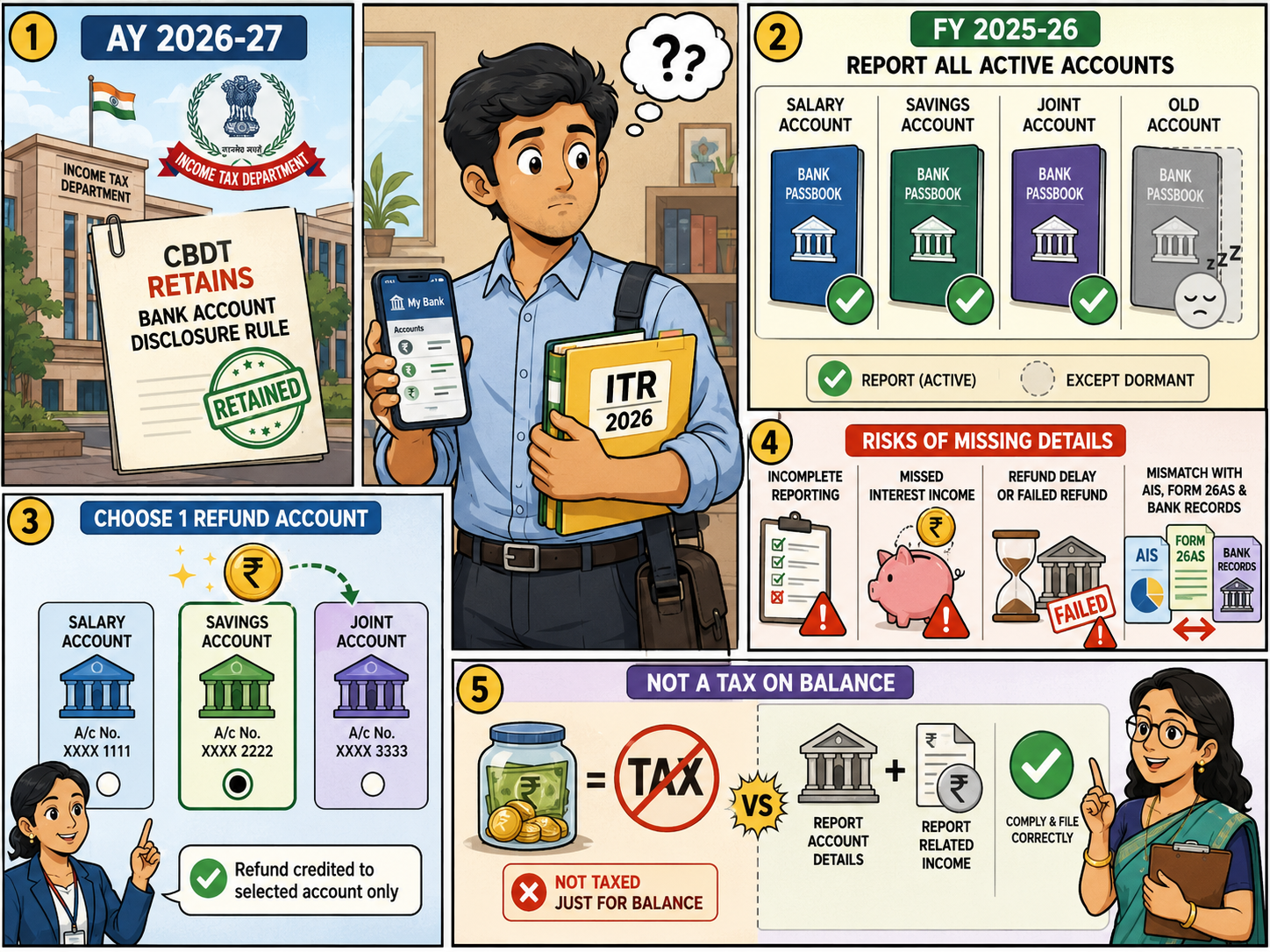
CBDT has retained a direct bank-account disclosure rule for AY 2026-27. Under the Income Tax Department’s Notification No. 45/2026, issued in New Delhi on 30 March 2026, ITR-1 asks taxpayers to report all bank accounts held in India at any time during FY 2025-26, apart from dormant accounts. At least 1 account must also be selected for the refund credit.
The immediate risk comes from incomplete reporting, missed interest income or a refund request tied to a closed or unsuitable account. Later, a difference between the return, AIS, Form 26AS, and bank records can force the filer to revisit the return. The rule does not tax the money lying in an account. It requires correct account details and proper reporting of income linked with those accounts.
Salaried employees may have an old payroll account left open after a job change. Pensioners often keep separate accounts for pension credit and household spending. A family may use a joint account for rent, school fees or medical bills. Each account needs a review when the taxpayer held it at any point between 1 April 2025 and 31 March 2026.
The review can also work in the taxpayer’s favour. It may uncover savings interest, fixed-deposit interest or small receipts that were missed while preparing the return from Form 16 alone. It also gives the filer time to replace an old refund account, correct an IFSC changed after a bank merger, or check whether the account is linked with PAN.
Tax advisers usually start with a simple account inventory. The filer can check mobile banking apps, passbooks, old cheque books, salary records and account-closure messages. Each account should then be marked as operating, dormant or closed. A rarely used account should not be treated as dormant merely because the balance is low. The recorded bank status should decide that point.
The next step is a 3-way check. Bank statements and interest certificates should be matched with AIS and Form 26AS, followed by the bank schedule inside the ITR. Where a deposit earned interest, the full taxable amount needs review even when tax was deducted by the bank. TDS is a tax credit entry. It does not replace reporting of the related income.
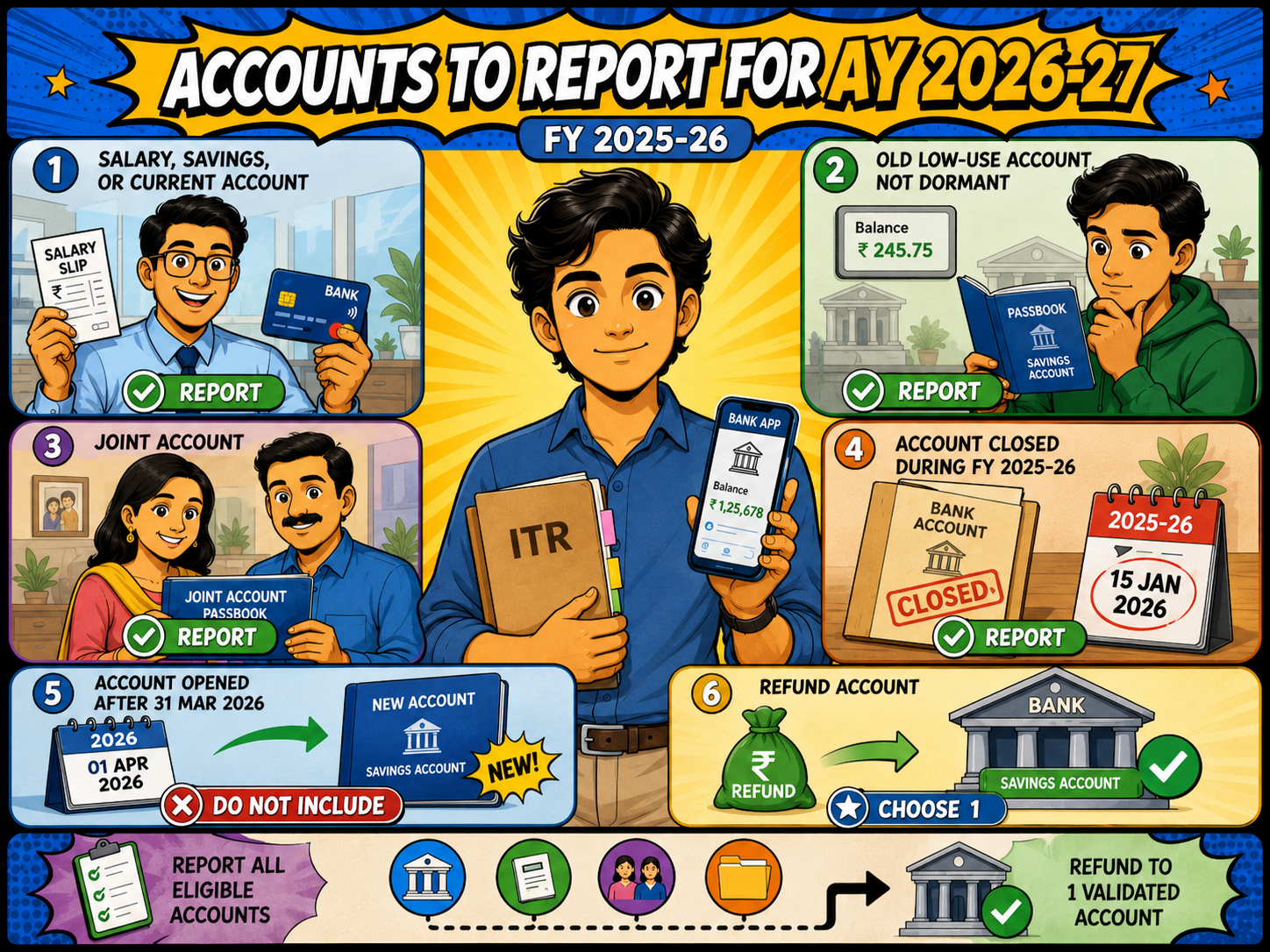
The phrase used in the notified form is “held at any time during the previous year." That wording reaches beyond accounts that remained open on 31 March 2026. A bank account closed during the year was still held for part of FY 2025-26. An account opened from 1 April 2026 onwards belongs outside this reporting period.
Reporting and refund nomination are separate jobs. A taxpayer may report several accounts but select only an eligible account for the refund credit. If several accounts are selected, the notification form says CPC may credit the refund to 1 validated account after the return is processed. An account with wrong details can slow that process.
A bank account is often connected with more than a balance. It can receive salary, pension, rent, freelance income, savings interest or deposit interest. If the account is missed, the income credited there may also be overlooked. That is the larger filing risk.
AIS and Form 26AS can help, though neither should replace the taxpayer’s own records. A small interest entry may appear in AIS after the bank reports it. Another receipt may need to be identified from the statement itself. The filer remains responsible for checking the return before verification.
The notified form does not state a separate fixed penalty merely for omitting 1 account. Trouble grows when the omission also leaves taxable income unreported or produces incorrect information in the return. A taxpayer who discovers an error should review the linked income and use the applicable correction route without waiting for a departmental message.
The bank disclosure is not a new demand introduced only for 2026. Earlier, ITR-1 and ITR-4 forms also required details of Indian bank accounts held during the year, excluding dormant accounts. They also separated full reporting from the account chosen for the refund credit. The latest forms continue that approach.
There is, however, a wider tax-law transition in the background. The Income Tax Act, 2025, took effect on 1 April 2026 and introduced the term “Tax Year." The return discussed here still concerns income earned from 1 April 2025 to 31 March 2026 and is filed as AY 2026-27 under the form notified by CBDT. Filers should not add receipts earned after 31 March 2026 merely because they entered the same bank account.
CBDT’s instructions are brief. All bank accounts held at any time are to be reported, except dormant accounts, and at least 1 account should be selected for refund credit. The Income Tax Department has also told taxpayers to use PAN-linked, validated bank accounts when they expect a refund. These are separate checks, though filers often combine them while preparing the return.
A LoansJagat report published on 30 June 2026 cited tax professionals advising taxpayers to compare Form 26AS, AIS and bank interest certificates before correcting omitted FD interest. Their advice applies equally before submission. The better fix is early review, while statements and certificates are still at hand.
A salaried taxpayer may receive salary in 1 account, earn fixed-deposit interest through another and choose a third for the tax refund. LoansJagat’s view is that the ITR should bring these records together, with every covered account and its taxable income reported correctly. Listing only the refund account can leave gaps in the return.
Those gaps may appear again during a loan application. Banks and NBFCs can compare ITRs, bank statements and income documents, particularly for self-employed borrowers. A properly filed return does not guarantee approval, though mismatched records may lead to more questions, extra paperwork and slower verification.
AY 2026-27 filers should not treat the refund account as the full bank disclosure. Old salary accounts, joint accounts, secondary savings accounts and accounts closed during FY 2025-26 all need a final review. Dormant accounts remain the stated exception.
The safest filing order is plain: prepare the account list, confirm each account’s bank status, match interest and receipts, fill the bank schedule, and then select the refund account. That small check can prevent a longer correction later.
Must every active bank account be reported in ITR 2026?
Every Indian account held during FY 2025-26 should be reported, apart from dormant accounts.
Does a zero-balance account need to be included?
Yes, when it was held during the year and the bank did not classify it as dormant.
Should an account closed during FY 2025-26 be reported?
Yes. The form covers accounts held at any time during the previous year.
Must every reported account be selected for a refund credit?
No. At least 1 suitable account should be selected for receiving the refund.
What should a taxpayer do after missing an account?
The taxpayer should check linked income and correct the return through the applicable filing route promptly.









.png&w=3840&q=75)


