
By continuing, you agree to LoansJagat's Credit Report Terms of Use, Terms and Conditions, Privacy Policy, and authorize contact via Call, SMS, Email, or WhatsApp
Disclaimer: The information published on LoansJagat is intended for general informational and educational purposes only and should not be considered financial, legal, or investment advice. Interest rates, loan terms, statistics, and other data may change over time and may vary by lender or source. Please verify the latest information and consult a qualified financial advisor or the respective Bank/NBFC before making any financial decisions.
Subscribe Now
About the author

LoansJagat Team
‘Simplify Finance for Everyone.’ This is the common goal of our team, as we try to explain any topic with relatable examples. From personal to business finance, managing EMIs to becoming debt-free, we do extensive research on each and every parameter, so you don’t have to. Scroll up and have a look at what 15+ years of experience in the BFSI sector looks like.
Related Blog Post
Simplify All Your Loans Into One Affordable EMI

Customers Served

Debt Consolidated

1200+ Reviews

Locations in India
Club all Loans & Credit Card Bills into Single EMI

Quick Apply Loan
Consolidate your debts into one easy EMI.

Takes less than 2 minutes. No paperwork.

10 Lakhs+
Trusted Customers

2000 Cr+
Loans Disbursed

4.7/5
Google Reviews

50+
Banks & NBFCs Offers
Other services mentioned in this article
Key Takeaways
Auto-renewed FDs are one of the most common reasons taxpayers land in tax trouble. When a deposit renews on its own, most people assume nothing has changed. However, the interest continues to accrue. It is considered as taxable income for every financial year and not only at the maturity of the FD as per the Income Tax Act, 1961. Due to that, there were many taxpayers who did not include the FD interest while filing their AY 2025-26 ITR.
The last date for revising that ITR was 31st December 2025. The time for that has expired. However, Section 139(8A) of the Income Tax Act provides an opportunity. You can file an updated ITR or ITR-U within 4 years after the end of the assessment year. The period started on 1st April 2026 in the case of AY 2025-26
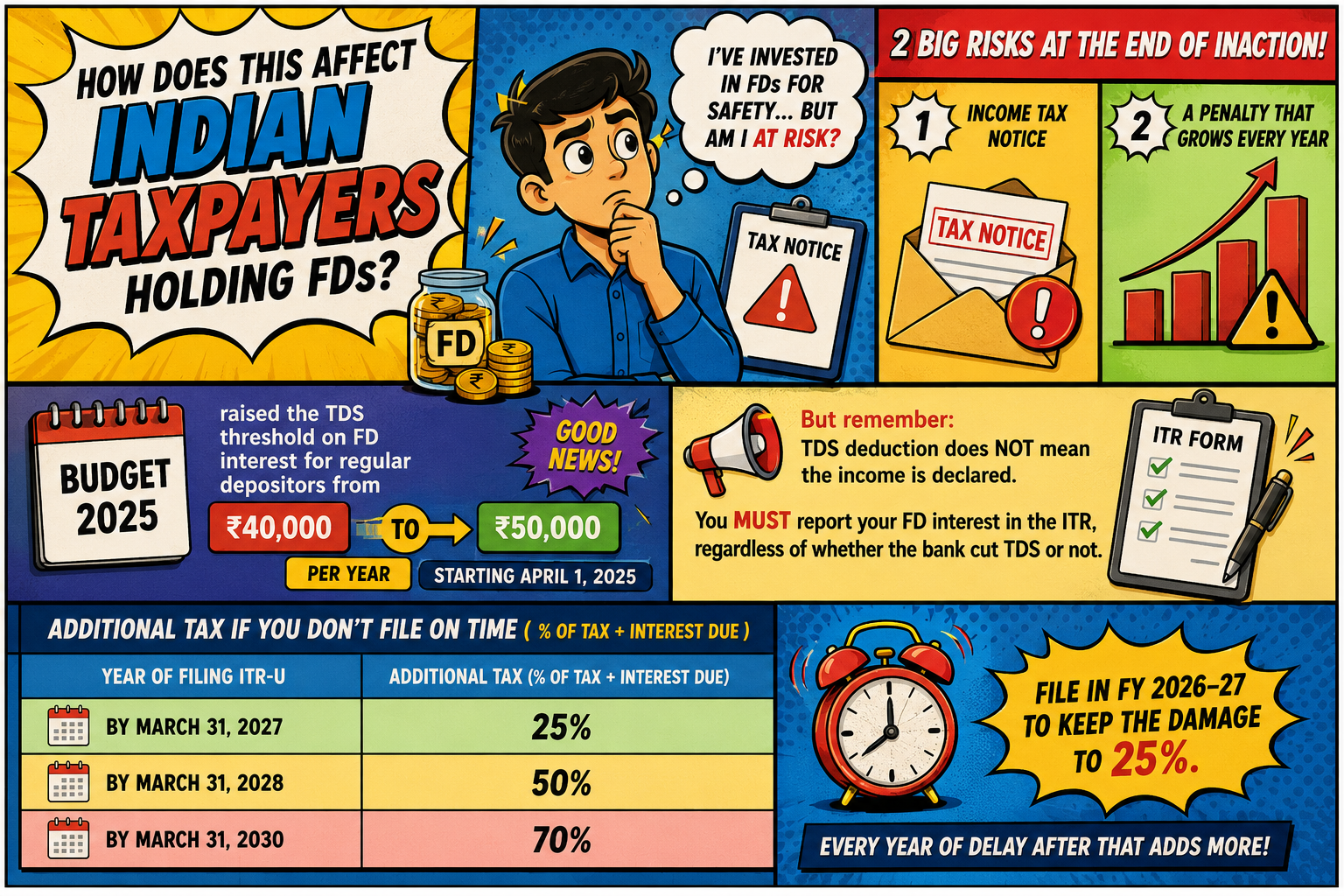
Two risks sit at the end of inaction: an income tax notice, and a penalty that grows every year. LoansJagat notes that Budget 2025 raised the TDS threshold on FD interest for regular depositors from ₹40,000 to ₹50,000 per year, starting April 1, 2025. But TDS deduction does not mean the income is declared. A taxpayer still has to report FD interest in the ITR, regardless of whether the bank cut TDS or not.
25% damage will be maintained by filing in 2026-27 financial year. Every year of delay after that adds more.
CA Balwant Jain, speaking to Network18’s Wallet-Wise, put it plainly, “Since the window for filing the revised ITR for AY 2025-2026 closed on December 31, 2025, a new window to file an updated ITR has opened from April 1, 2026.” He confirmed the additional tax stands at 25% of total tax and interest for those filing in the first year.
The fix involves 3 steps:
*T&C Apply
Jain also flagged the root cause, “If you had referred to the AIS while filing your ITR for AY 2025-26, you would have noticed the interest income of an auto-renewed FD reported by the bank.”
The ITR-U route under Section 139(8A) is the only self-correction option left for AY 2025-26. Filing before March 31, 2027 caps the extra tax at 25%. Checking the AIS before filing any future ITR is what keeps taxpayers out of this situation in the first place.
I have submitted my ITR for AY 2025-26 without reporting FD and savings account interest income. What is the penalty imposed by the Income Tax Department on this issue?
The Income Tax Department compares your ITR with your AIS for FY 2024-25. The discrepancy leads to an issue notice under Section 143(2). You must pay the outstanding tax, interest calculated under Section 234B, and penalties. Filing ITR-U until March 31, 2027, reduces this charge to 25%.
I have not reported the FD interest for FY 2024-25 in my ITR although it shows in my AIS. How can I avoid receiving a notice and resolve this issue?
Yes. You may download your AIS from incometax.gov.in, calculate the interest amount, and submit ITR-U under Section 139(8A). Doing so by March 31, 2027, will reduce this excess to 25%.









.png&w=3840&q=75)



