
By continuing, you agree to LoansJagat's Credit Report Terms of Use, Terms and Conditions, Privacy Policy, and authorize contact via Call, SMS, Email, or WhatsApp
Disclaimer: The information published on LoansJagat is intended for general informational and educational purposes only and should not be considered financial, legal, or investment advice. Interest rates, loan terms, statistics, and other data may change over time and may vary by lender or source. Please verify the latest information and consult a qualified financial advisor or the respective Bank/NBFC before making any financial decisions.
Subscribe Now
About the author

LoansJagat Team
‘Simplify Finance for Everyone.’ This is the common goal of our team, as we try to explain any topic with relatable examples. From personal to business finance, managing EMIs to becoming debt-free, we do extensive research on each and every parameter, so you don’t have to. Scroll up and have a look at what 15+ years of experience in the BFSI sector looks like.
Related News
Simplify All Your Loans Into One Affordable EMI

Customers Served

Debt Consolidated

1200+ Reviews

Locations in India
Club all Loans & Credit Card Bills into Single EMI

Quick Apply Loan
Consolidate your debts into one easy EMI.

Takes less than 2 minutes. No paperwork.

10 Lakhs+
Trusted Customers

2000 Cr+
Loans Disbursed

4.7/5
Google Reviews

50+
Banks & NBFCs Offers
Other services mentioned in this article
JK Cement’s GST exposure has dropped sharply after appellate relief, but the company will still challenge the remaining demand before GSTAT.
Key Takeaways
JK Cement has received major relief in two GST appeal cases after the additional commissioner of appeals, state tax, Kota, partly allowed the company’s appeals. According to the company’s NSE India filing dated July 4, 2026, the confirmed tax demand now stands at ₹10.49 lakh, against the earlier combined GST demand of ₹10.28 crore. The orders were received by the company on July 3, 2026, at around 9:30 PM.
The short-term impact is positive for JK Cement because a large tax claim has been cut to a much smaller disputed amount. The long-term signal is more important for corporate India. GST audits are now strongly tied to invoice matching, supplier filings and GSTR-2B records. The negative part remains. JK Cement has not accepted even the reduced demand and plans to file an appeal before GSTAT within the statutory timeline.
This order will not reduce the price of cement bags for retail buyers. It is not a GST rate cut. It is a company-specific appeal order linked to input tax credit claims. Still, it has a wider link with construction buyers because cement companies operate on large vendor chains, transport bills, raw material purchases and service invoices. A big tax dispute can take up legal time and compliance attention, even when the company finally gets relief.
For investors, the update is more direct. JK Cement has said the orders do not have a major financial impact on the company. That reduces pressure around this specific tax exposure. The bigger lesson is for listed companies and large businesses. GST compliance now depends heavily on whether purchase books, supplier filings and auto-drafted ITC statements match month after month.
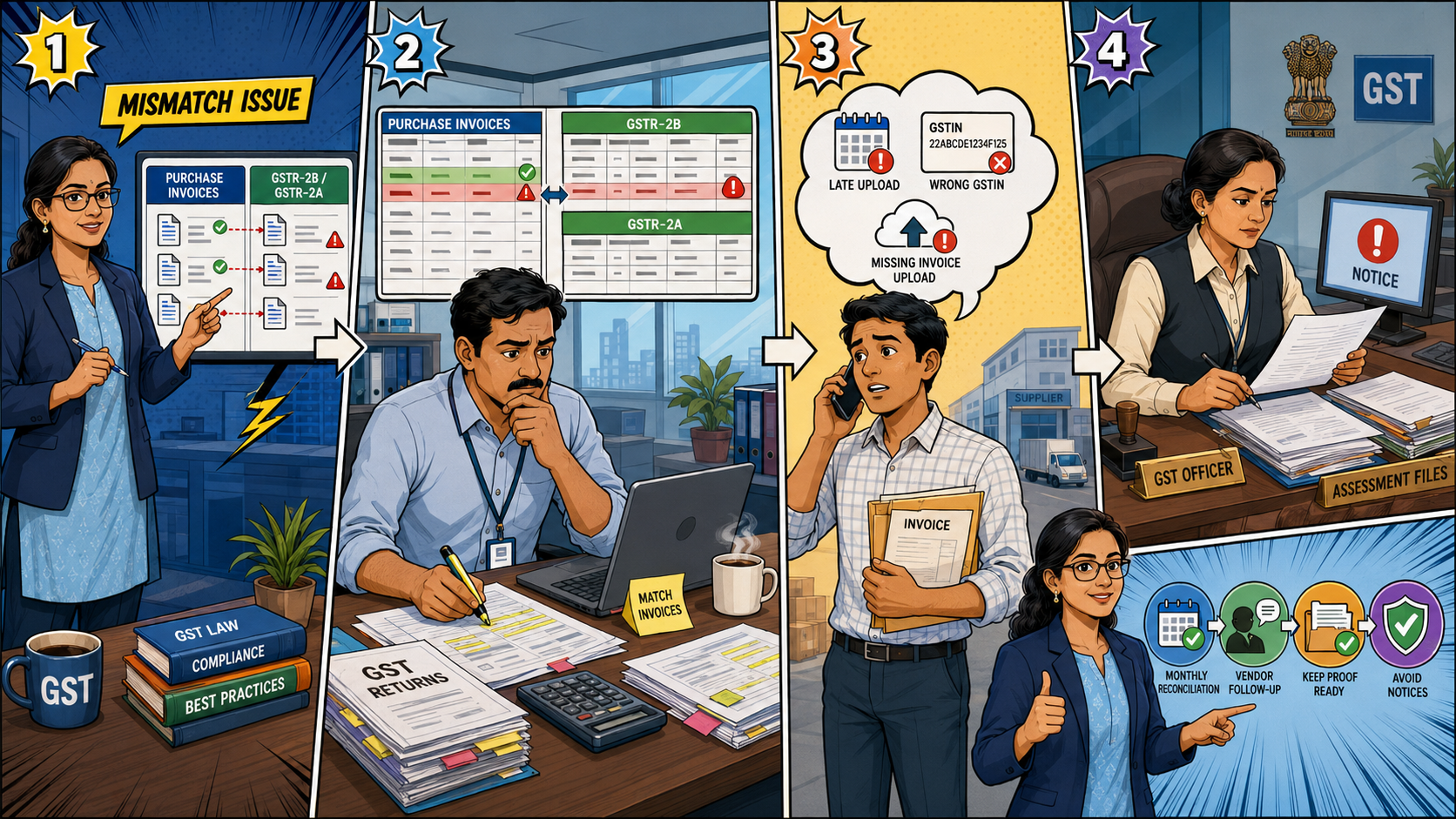
Tax experts usually treat GSTR-2B mismatches as a process problem before they become a legal problem. A buyer may have the invoice, payment proof and goods receipt, but the credit can still be questioned if the supplier has not reported the invoice properly. That is why procurement teams and tax teams cannot work in separate corners anymore.
The GST Portal says GSTR-2B is an auto-drafted ITC statement generated from supplier filings. It also says taxpayers should use GSTR-2B to take the right input tax credit in GSTR-3B. LoansJagat’s GSTR-2B guide explains this in simpler terms for businesses, saying GSTR-2B helps taxpayers verify eligible input tax credit and avoid mismatch-led notices.
The JK Cement order points to a quiet risk that many large companies still treat as routine paperwork: supplier compliance. In GST, a buyer can have a valid invoice and payment record, but the credit may still be questioned if the vendor filing does not reflect the same transaction. That gap can travel from accounts payable to a tax notice very quickly.
For cement makers, this risk grows because operations run across mines, plants, depots, transporters, repair vendors and contractors. Each location creates invoices. Each invoice needs correct GST reporting. A missed upload by one supplier can force the buyer to explain the claim later.
Boards and audit committees should now ask for vendor-wise ITC ageing, pending mismatch values and monthly closure reports. This keeps GST risk visible before it reaches appellate orders, penalties or interest claims.
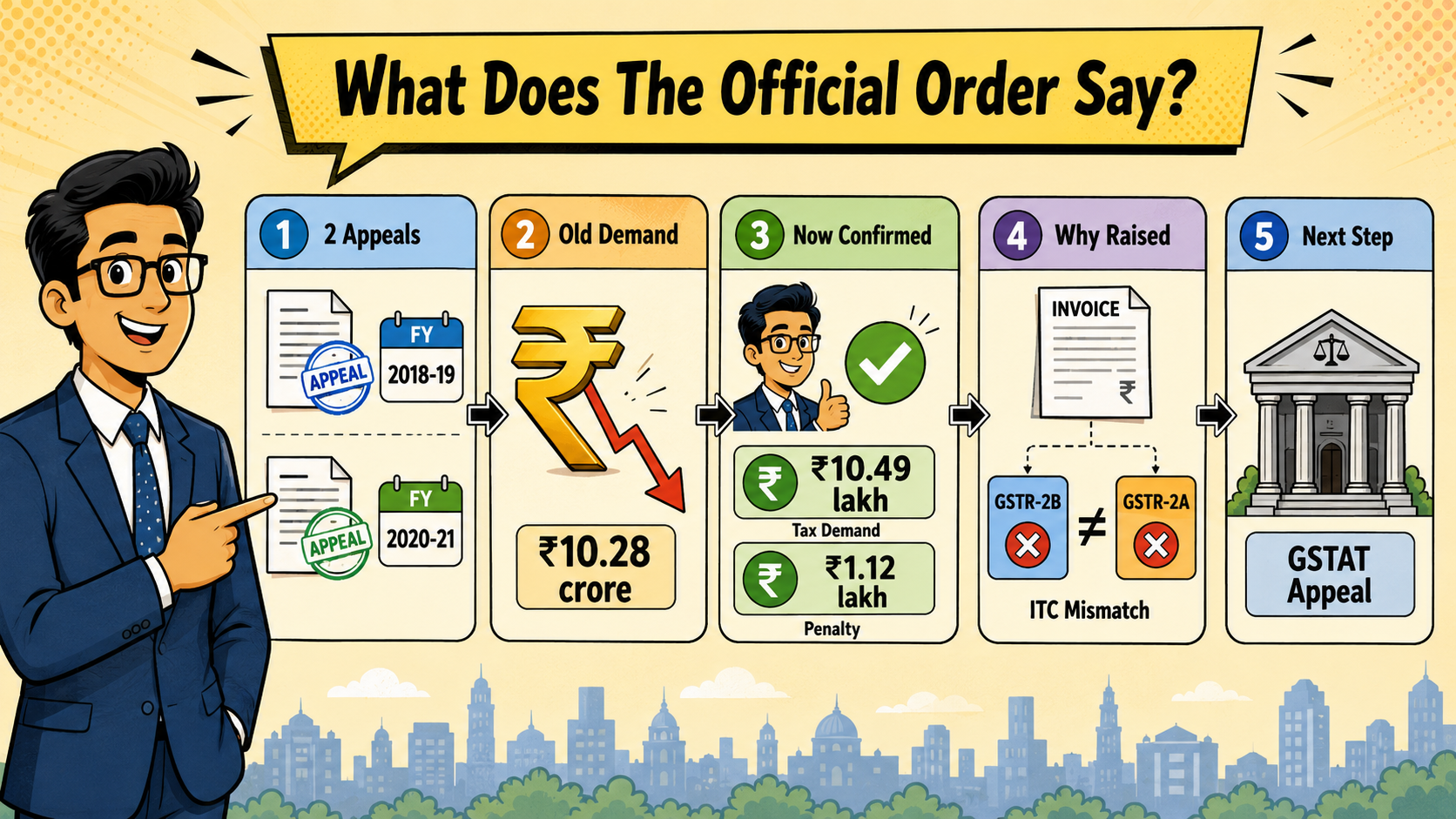
JK Cement’s filing gives 2 separate appeal updates. One order relates to FY 2018-19. The other relates to FY 2020-21. In both cases, the appeal authority dropped most of the tax demand and confirmed only a smaller portion.
The table below captures the main figures and source-backed points from the company filing and official GST records.
The reduction is sharp, but the file is not shut. JK Cement has stated that it does not agree with the remaining demand. The company also said it believes it has a strong case on the merits and will appeal before GSTAT.
The earlier demand orders came from the Deputy Commissioner-A, Business Audit Wing, Rajasthan, Jaipur. For FY 2018-19, the audit order was dated March 28, 2024. For FY 2020-21, the audit order was dated February 17, 2025. Both orders alleged wrong availment of input GST because the credit did not match GSTR-2B/2A.
Such disputes are common in sectors with large supplier networks. Cement companies deal with raw material vendors, logistics providers, maintenance contractors and service suppliers. One missing invoice upload by a supplier can create a mismatch for the buyer. That is why large companies now need stronger monthly checks instead of waiting for a year-end review.
The fix starts with monthly reconciliation. Companies must match purchase registers with GSTR-2B before claiming credit in GSTR-3B. They should also keep a supplier-wise mismatch tracker and follow up before return filing deadlines. It sounds basic. Many tax disputes begin because this basic work gets delayed.
Businesses also need stronger documentation. Invoice copies, e-way bills, goods receipt records, payment proof and vendor communication should be kept together. If a tax notice comes later, the company should not search across 5 teams for proof. For large manufacturers, this is now a core compliance task, not a back-office formality.
*T&C Apply
JK Cement has kept its stand firm. The company said the orders do not have a major financial impact. It also said the contentions imposing the demand are not agreed upon and that it believes it has a strong case on the merits. The company plans to appeal before GSTAT within the statutory timeline.
The government has presented GSTAT as the next key forum for indirect tax disputes. At the GSTAT launch in New Delhi on September 24, 2025, Finance Minister Nirmala Sitharaman said the tribunal should reduce legal friction, improve simplicity and support faster cash flows for MSMEs and exporters. That statement becomes relevant here because JK Cement has named GSTAT as its next appeal forum.
JK Cement has received strong relief in a GST case that earlier carried a ₹10.28 crore tax demand. The confirmed amount now stands at ₹10.49 lakh, plus ₹1.12 lakh penalty and applicable interest.
The next update will depend on the GSTAT appeal. For Indian businesses, this case sends a plain warning. GSTR-2B checks, supplier follow-ups and invoice records cannot be pushed to the end of the year.
What happened in the JK Cement GST case?
JK Cement received partial relief in 2 GST appeal orders, reducing the confirmed tax demand to ₹10.49 lakh.
Who passed the latest orders?
The Additional Commissioner, Appeals, State Tax, Kota, passed the orders in the 2 GST appeal cases.
Will this affect cement prices in India?
No direct price impact is expected because this is a company-specific GST appeal order, not a tax rate change.
What will JK Cement do next?
JK Cement has said it will appeal before GSTAT within the statutory timeline.
How does a GSTR-2B or GSTR-2A mismatch turn into a GST demand for companies like JK Cement?
A mismatch can happen when a company claims input tax credit, but the supplier’s invoice does not appear correctly in GSTR-2B or GSTR-2A. During audit, tax officers may treat that credit as wrongly claimed and raise a demand with interest and penalty.
How much time do businesses and CAs spend each month fixing GSTR-2B reconciliation errors?
It depends on invoice volume. Small firms may finish checks in a few hours, while larger businesses can spend several days matching purchase records, supplier filings, missing invoices and GST portal data before filing returns.









.png&w=3840&q=75)



