
By continuing, you agree to LoansJagat's Credit Report Terms of Use, Terms and Conditions, Privacy Policy, and authorize contact via Call, SMS, Email, or WhatsApp
Disclaimer: The information published on LoansJagat is intended for general informational and educational purposes only and should not be considered financial, legal, or investment advice. Interest rates, loan terms, statistics, and other data may change over time and may vary by lender or source. Please verify the latest information and consult a qualified financial advisor or the respective Bank/NBFC before making any financial decisions.
Subscribe Now
About the author

LoansJagat Team
‘Simplify Finance for Everyone.’ This is the common goal of our team, as we try to explain any topic with relatable examples. From personal to business finance, managing EMIs to becoming debt-free, we do extensive research on each and every parameter, so you don’t have to. Scroll up and have a look at what 15+ years of experience in the BFSI sector looks like.
Related News
Simplify All Your Loans Into One Affordable EMI

Customers Served

Debt Consolidated

1200+ Reviews

Locations in India
Club all Loans & Credit Card Bills into Single EMI

Quick Apply Loan
Consolidate your debts into one easy EMI.

Takes less than 2 minutes. No paperwork.

10 Lakhs+
Trusted Customers

2000 Cr+
Loans Disbursed

4.7/5
Google Reviews

50+
Banks & NBFCs Offers
Other services mentioned in this article
Key Takeaways
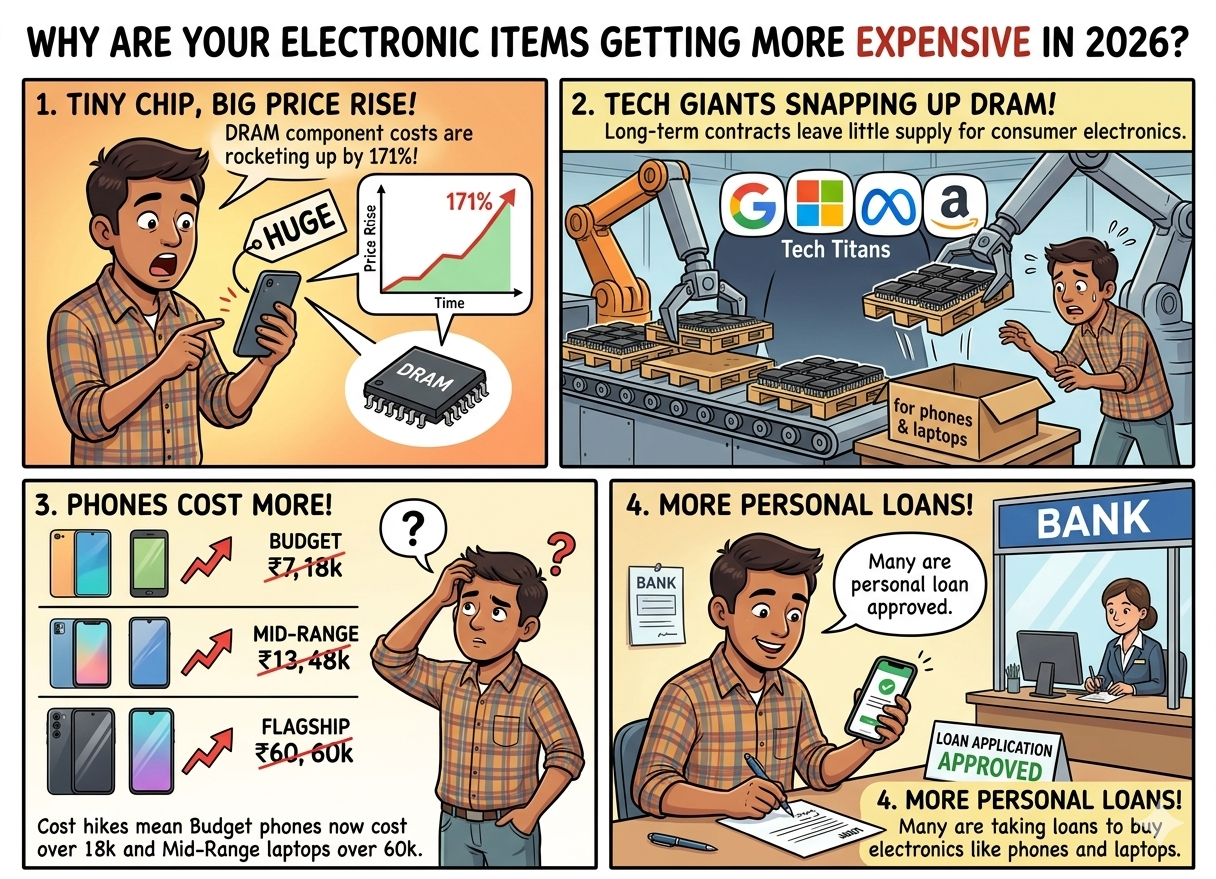
A tiny component called DRAM (Dynamic Random Access Memory) is making everyday electronics costlier across India. Google, Microsoft, Meta, and Amazon have signed long-term contracts for the lion’s share of the world’s supply of DRAM. It leaves only a minimal supply available to manufacturers of phones, laptops, refrigerators, and washing machines.
DRAM pricing has increased by 171% year-over-year, with DDR5 pricing quadrupling from September 2025. The consumers of India will be paying for this. Cost hikes caused by the rise in DRAM prices have led to a respective 25%, 15%, and 10% increase in BOM pricing for budget, mid-range, and flagship smartphones. These costs will ultimately be passed down to consumers.
At LoansJagat, we have noticed a clear shift in why people are applying for personal loans in 2026. Electronics purchases (mainly phones, laptops) are becoming a reported reason for taking loans more frequently than ever before.
As a 15k budget phone now costs over 18k, and a mid-range laptop costs above 60k, there is no need to wait for sales anymore. They simply apply for a loan. The chip shortage is not just an inflation story. It is quietly pushing more Indian households toward credit for things they previously bought outright.
The pricing effects are noticeable across categories. Prices of wholesale smartphones have already increased by 14%, while LPDDR4 availability is expected to drop by over 40% next year. This may make phones costing under $150 unviable in some markets. India is already feeling the effects directly, with the majority of customers purchasing phones between ₹8,000 and ₹ 12,000.
A weakened rupee makes the situation worse. The limited supply and excessive demand pressure profit margins of companies producing budget-friendly electronics, and the weakened rupee has made memory chips more expensive.
Counterpoint Research Principal Analyst Yang Wang said, “The impact is expected to continue through H2 2027, as it will take several quarters for memory supply expansion to materialise. Lower-end smartphones are likely to be affected the most, especially as LPDDR4 supply is shrinking faster than expected.”
Ashok Chandak, speaking at a semiconductor event in New Delhi in May 2026, said, “We are not seeing major new capacity additions immediately, and semiconductor fabrication expansion takes significant time.” New fab capacity from Micron and SK Hynix will not reach volume production until 2027 at the earliest, whi9ch means relief is at least 12 to 18 months away.
On the solution side, the Union Budget 2026-27 has taken a step. It allocated ₹1,000 crore for the India Semiconductor Mission 2.0, which focuses on producing semiconductor equipment and materials and designing full-stack Indian semiconductor IP. The mission aims to cover 70-75% of domestic chip requirements by 2029.
The memory chip shortage is not a short-term disruption. This is a structural issue, which means Indian electronic prices may remain high until 2027. Low-budget phone consumers, students purchasing computers, and households purchasing home appliances will be affected. The semiconductor mission of India is the solution to this issue for the future, but in the meantime, there is nothing that can be done until 2027.
Fridges, ACs, washing machines
*T&C Apply
Will the price of laptops increase in India in 2026?
Yes, because the laptop prices in Q1 2026 have increased by 15-20% due to the shortage of DRAM chips on an international level. The manufacturers prefer server memory to consumer gadgets, and new supplies won’t be available until 2027.
Should one wait for Flipkart Big Billion Days or Amazon Great Indian Festival for a phone/laptop purchase in 2026?
It is not advisable. By 2026, supply for LPDDR4 memory is estimated to fall by 40%, and phone wholesale prices have already jumped by 14%. The expected festive season discounts are less likely to offset the cost increases. Hence, waiting could increase costs rather than reduce them.









.png&w=3840&q=75)



