
By continuing, you agree to LoansJagat's Credit Report Terms of Use, Terms and Conditions, Privacy Policy, and authorize contact via Call, SMS, Email, or WhatsApp
Disclaimer: The information published on LoansJagat is intended for general informational and educational purposes only and should not be considered financial, legal, or investment advice. Interest rates, loan terms, statistics, and other data may change over time and may vary by lender or source. Please verify the latest information and consult a qualified financial advisor or the respective Bank/NBFC before making any financial decisions.
Subscribe Now
About the author

LoansJagat Team
‘Simplify Finance for Everyone.’ This is the common goal of our team, as we try to explain any topic with relatable examples. From personal to business finance, managing EMIs to becoming debt-free, we do extensive research on each and every parameter, so you don’t have to. Scroll up and have a look at what 15+ years of experience in the BFSI sector looks like.
Related News
Simplify All Your Loans Into One Affordable EMI

Customers Served

Debt Consolidated

1200+ Reviews

Locations in India
Club all Loans & Credit Card Bills into Single EMI

Quick Apply Loan
Consolidate your debts into one easy EMI.

Takes less than 2 minutes. No paperwork.

10 Lakhs+
Trusted Customers

2000 Cr+
Loans Disbursed

4.7/5
Google Reviews

50+
Banks & NBFCs Offers
Other services mentioned in this article
India’s loan recovery rulebook is being rewritten, with stricter borrower safeguards and limited phone-lock powers for lenders in device-finance defaults.
Key Takeaways
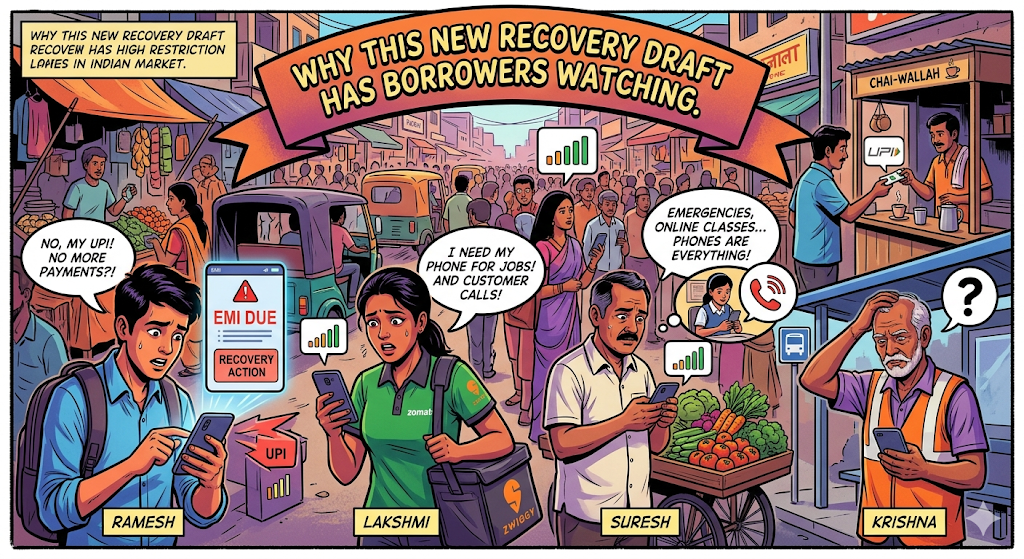
The revised draft on loan recovery has opened a fresh debate because phones are no longer just devices. For many borrowers, they are linked to UPI payments, job calls, delivery work, online classes and emergency contact. Reuters reported on May 20, 2026 that India has over 1.16 billion mobile connections, which shows why any phone-restriction rule will touch a large user base.
In the short term, EMI defaulters buying mobiles or tablets on credit may face tighter recovery action. In the long term, lenders may get a more regulated recovery route. The negative side is obvious: one delayed EMI cycle can hurt access to work, communication and digital payments, especially for low-income borrowers.
The biggest change is that lenders may restrict some functions of a financed phone or tablet, but only when the loan was taken for that same device. It cannot be used for a personal loan, home loan, car loan or any unrelated borrowing.
Even after restriction, core functions like incoming calls, internet, SOS and public alerts must remain active. TOI reported on May 21, 2026 that online shaming is also barred, which directly targets public humiliation by recovery agents.
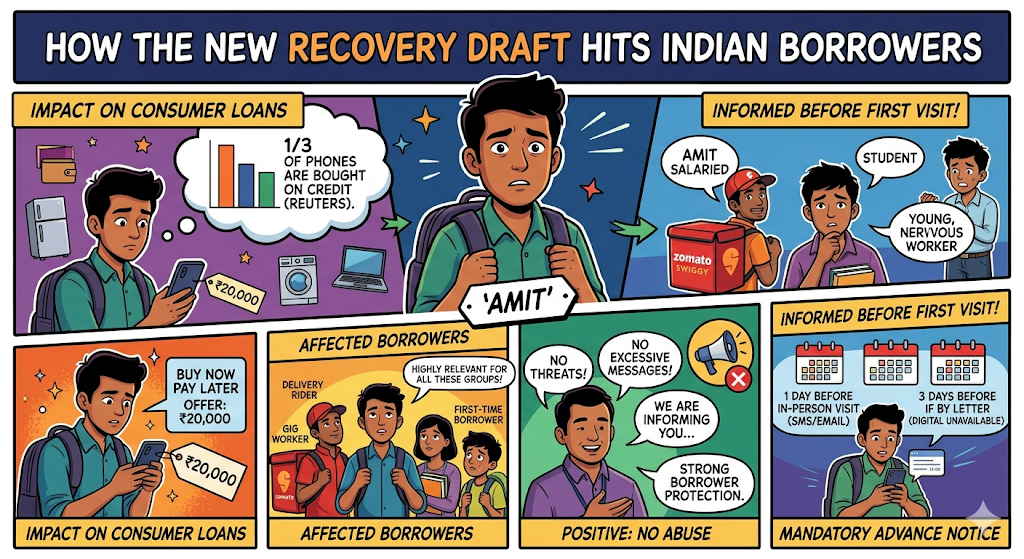
For the masses, the sharpest impact will be felt in small-ticket consumer loans. Reuters cited a 2024 Home Credit Finance study saying over one-third of consumer electronics, including phones, are bought through small-ticket loans. That makes the draft highly relevant for salaried workers, gig workers, students and first-time borrowers.
The positive part is stronger borrower protection. Recovery agents cannot use abusive language, threats, excessive messaging or public pressure. Business Standard reported on May 20, 2026 that borrowers or guarantors must be informed before the first in-person visit, at least 1 day earlier by SMS or email, or 3 days earlier by letter if digital contact is unavailable.
The previous draft came on February 12, 2026 and focused mainly on recovery agents. Reuters reported that it proposed stricter rules on use of borrower information, mandatory call recording, monitoring of agents and curbs on abusive recovery methods. Feedback on that draft closed on March 6, 2026.
*T&C Apply
Borrowers comparing credit options may also look at platforms like LoansJagat, which says it helps users compare offers from 20+ banks and NBFCs.
The regulator has linked the revision to industry feedback. Reuters reported that earlier smartphone-locking plans had raised consumer rights and privacy concerns. Economic Times reported on May 20, 2026 that the draft also brings agent certification and data privacy mandates.
The workable fix is simple: lenders must disclose device-lock clauses before loan approval, record recovery communication, train agents properly and resolve complaints before field recovery begins.
The revised draft gives lenders a tougher recovery tool, but with guardrails. For borrowers, the fine print in mobile and tablet EMI loans now needs closer reading.
Can recovery agents come home and pressure a borrower in front of others?
Recovery agents may visit a borrower’s house, but they cannot create a scene, threaten the family, abuse anyone or shame the borrower in front of neighbours. That is not allowed. The borrower should note the date, time, lender name and agent’s phone number. If possible, keep call recordings, messages or CCTV clips as proof.
First, send a written complaint to the bank or NBFC grievance officer. If there is no reply, raise it on the RBI CMS portal. If the agents use threats or force, the family can also approach the local police. At the same time, speak to the lender about EMI restructuring or settlement.
What Can A Borrower Do If A Recovery Agent Crosses The Line?
A recovery agent can ask for repayment, but cannot abuse, threaten, shame or disturb a borrower at odd hours. Calls and visits are generally allowed only between 8 AM and 7 PM. The borrower should ask for the agent’s name, agency details and bank authorisation.
If the agent calls relatives, uses bad language, posts online, or visits without proper intimation, the borrower can complain to the bank or NBFC first. If no action is taken, the complaint can be raised with the RBI Ombudsman. Keep call records, messages and visit details as proof.









.png&w=3840&q=75)



