
By continuing, you agree to LoansJagat's Credit Report Terms of Use, Terms and Conditions, Privacy Policy, and authorize contact via Call, SMS, Email, or WhatsApp
Disclaimer: The information published on LoansJagat is intended for general informational and educational purposes only and should not be considered financial, legal, or investment advice. Interest rates, loan terms, statistics, and other data may change over time and may vary by lender or source. Please verify the latest information and consult a qualified financial advisor or the respective Bank/NBFC before making any financial decisions.
Subscribe Now
About the author

LoansJagat Team
‘Simplify Finance for Everyone.’ This is the common goal of our team, as we try to explain any topic with relatable examples. From personal to business finance, managing EMIs to becoming debt-free, we do extensive research on each and every parameter, so you don’t have to. Scroll up and have a look at what 15+ years of experience in the BFSI sector looks like.
Related Blog Post
Simplify All Your Loans Into One Affordable EMI

Customers Served

Debt Consolidated

1200+ Reviews

Locations in India
Club all Loans & Credit Card Bills into Single EMI

Quick Apply Loan
Consolidate your debts into one easy EMI.

Takes less than 2 minutes. No paperwork.

10 Lakhs+
Trusted Customers

2000 Cr+
Loans Disbursed

4.7/5
Google Reviews

50+
Banks & NBFCs Offers
Other services mentioned in this article
Key Takeaways
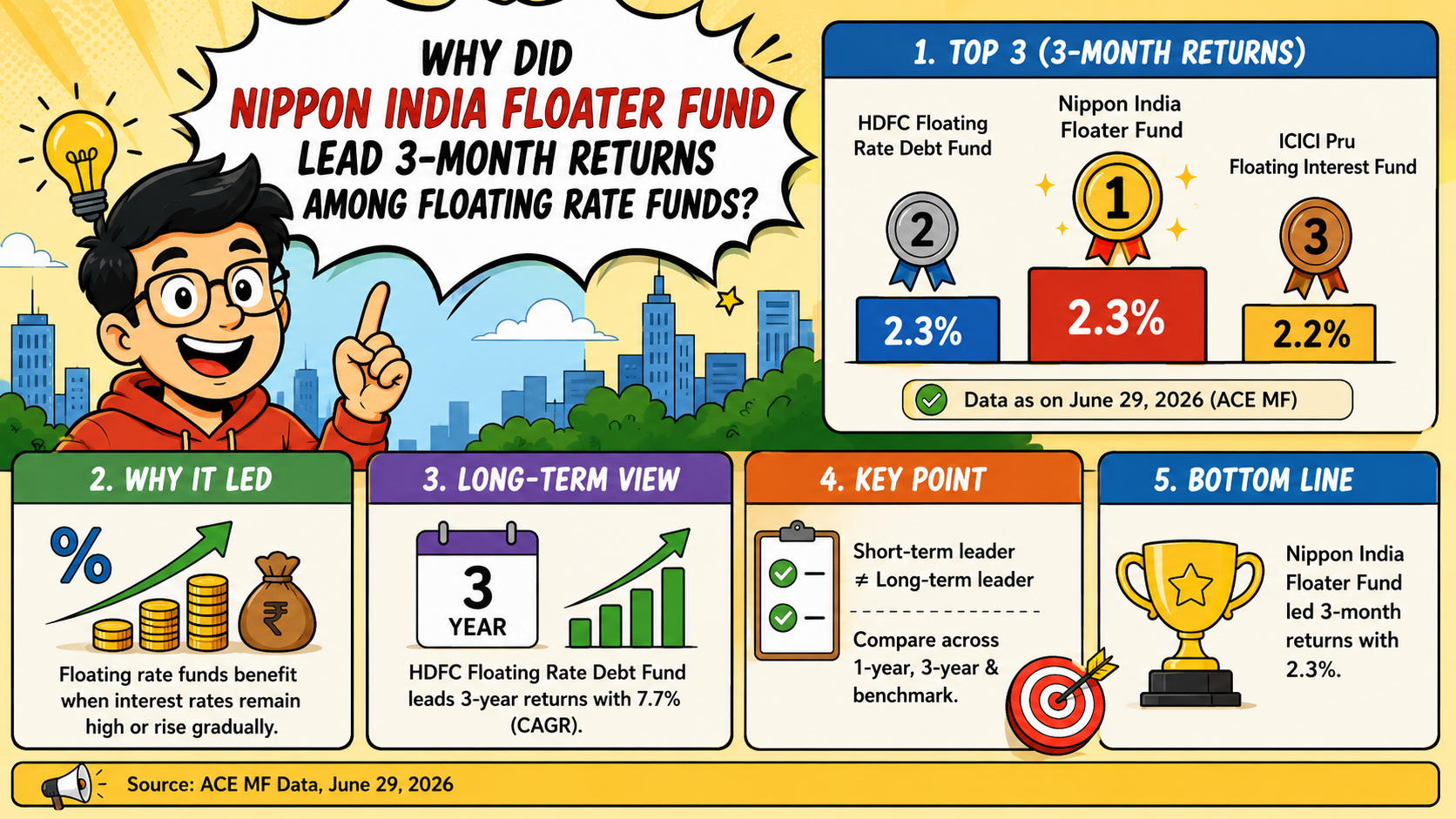
Nippon India Floater Fund has been ranked number one in the floating rate mutual fund scheme in terms of return for 3 months with a 2.3% return, as per data of ACE MF released on June 29, 2026.
HDFC Floating Rate Debt Fund also gave a 2.3% return, whereas ICICI Prudential Floating Interest Fund gave a return of 2.2%. Only schemes that managed assets worth more than ₹1,500 crore have been compared.
Performance of the schemes is important as floating rate funds can perform well if the interest rates continue to remain high or gradually increase. Short-term rating, however, should not be considered alone. Nippon India Floater Fund had given a 7.5% return for 3-year CAGR, whereas HDFC Floating Rate Debt Fund had been rated as the best with a return of 7.7%.
The latest rankings give conservative debt investors another benchmark for comparing floating rate funds. Nippon India Floater Fund also outperformed its benchmark by 3.5 percentage points over one year, while exceeding it by 0.8 percentage points over three years.
A related takeaway from LoansJagat shows that fintech-led lenders accounted for 77% of India’s personal loan market by volume in FY26. This indicates that more borrowers are actively managing debt and may increasingly seek stable investment options alongside loan planning.
Morningstar India advises that floating rate funds are most suitable when interest rates are expected to remain high or move higher.
*T&C Apply
Rushabh Desai, a Mumbai-based mutual fund distributor quoted by Morningstar India, says investors should compare floating rate funds with short-duration debt funds because the category’s average maturity is around 2.5 years. He also notes that these funds benefit when interest rates move favourably.
For investors, the practical approach is to compare one-year and three-year returns, benchmark performance, portfolio quality, and investment horizon before selecting a fund. The latest ACE MF data shows that the three-month leader was not the three-year leader, which makes long-term consistency more important than a single quarter’s ranking.
Nippon India Floater Fund has emerged to be the top performing floating rate mutual fund in the last three months giving returns of 2.3%, according to ACE MF. Recent statistics reveal that it is not always the case that a long-term leader gives a short term performance in line with its performance. This makes it necessary to do a multi period analysis before investment.
Which is the top performing floating rate mutual fund in the last three months?
As per the recent statistics provided by ACE MF on June 29, 2026, Nippon India Floater Fund is the top performer in the last three months. It gives returns of 2.3% compared to other floating rate mutual funds having assets above ₹1,500 crore.
Should an investor depend on the returns in the past three months alone?
No. According to recent statistics, it is seen that short-term and long-term leaders differ. An investor needs to consider factors like returns in one year and three years, benchmark and so on.









.png&w=3840&q=75)



