
By continuing, you agree to LoansJagat's Credit Report Terms of Use, Terms and Conditions, Privacy Policy, and authorize contact via Call, SMS, Email, or WhatsApp
Disclaimer: The information published on LoansJagat is intended for general informational and educational purposes only and should not be considered financial, legal, or investment advice. Interest rates, loan terms, statistics, and other data may change over time and may vary by lender or source. Please verify the latest information and consult a qualified financial advisor or the respective Bank/NBFC before making any financial decisions.
Subscribe Now
About the author

LoansJagat Team
‘Simplify Finance for Everyone.’ This is the common goal of our team, as we try to explain any topic with relatable examples. From personal to business finance, managing EMIs to becoming debt-free, we do extensive research on each and every parameter, so you don’t have to. Scroll up and have a look at what 15+ years of experience in the BFSI sector looks like.
Related News
Simplify All Your Loans Into One Affordable EMI

Customers Served

Debt Consolidated

1200+ Reviews

Locations in India
Club all Loans & Credit Card Bills into Single EMI

Quick Apply Loan
Consolidate your debts into one easy EMI.

Takes less than 2 minutes. No paperwork.

10 Lakhs+
Trusted Customers

2000 Cr+
Loans Disbursed

4.7/5
Google Reviews

50+
Banks & NBFCs Offers
Other services mentioned in this article
Key Takeaways
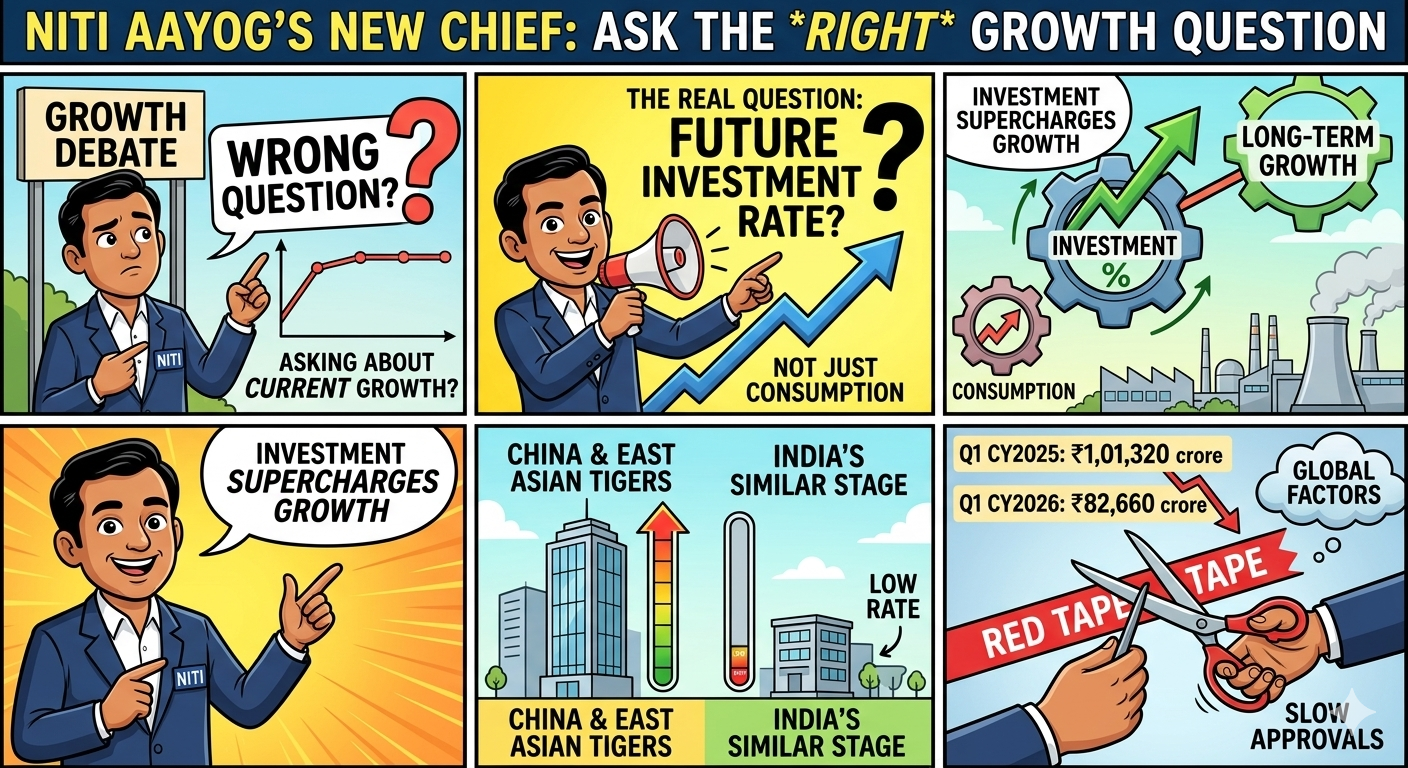
India grew 7.6% in FY26. Lahiri is not impressed. He says the real problem is that India’s investment rate is too low compared to where China and the East Asian Tigers were at a similar stage. Growth built on consumption alone does not last.
The short-term risk is already visible. PE and VC deals dropped from ₹1,01,320 crore in Q1 CY2025 to ₹82,660 crore in Q1 CY2026. Global factors play a part. But domestic red tape and slow approvals are just as responsible. That is what Lahiri is pushing back on.
More investment means more factories coming up. It means more jobs in manufacturing and services. When approvals take years and rules keep changing, businesses either wait or go elsewhere. That cost falls on workers, not on boardrooms.
India’s investment rate will need to climb from 33.5% of GDP to 40% by 2035 for it to achieve the high-income goal by 2047, says the World Bank.
In his first interview after taking charge, Lahiri said a drop in consumption will not hurt growth if investment picks up. That is a direct challenge to policymakers who keep pushing demand-side fixes.
At the CII Annual Business Summit 2026, Niti Aayog full-time member Rajiv Gauba said India must shift from “prohibited unless permitted” to “permitted unless prohibited” to push reforms forward. Two senior voices at the same institution are saying the same thing. The message from the top is clear.
The World Bank backs this up. It says simplifying FDI rules and removing credit barriers for small businesses are non-negotiable steps for India to hit its growth targets. These are not new recommendations. The gap is in how fast they get done.
Lahiri is not making a complicated argument. He is saying India has everything it needs except speed. Fewer approvals, stable rules, and less paperwork will bring capital in. The growth story is already there. The job now is to stop slowing it down.
*T&C Apply
What economic policy shift in India should we expect with Niti Aayog’s new Vice Chairman, Ashok Lahiri?
Lahiri wants India to stop chasing growth through consumption. He wants to attract more companies to invest here. This means more approvals, smoother regulations, and fewer regulatory obstacles. He took office in May 2026 and has already challenged the idea that more spending can maintain growth.
Why does Niti Aayog Vice Chairman Ashok Lahiri want Indians to buy less gold?
Lahiri says Indians’ spending on gold drains foreign exchange reserves without adding economic value. His words, “If you do not buy gold, you will spend that money on something else, or hopefully save it in the bank where it can be reinvested.” He believes savings in banks or markets do far more for the economy.









.png&w=3840&q=75)



