
By continuing, you agree to LoansJagat's Credit Report Terms of Use, Terms and Conditions, Privacy Policy, and authorize contact via Call, SMS, Email, or WhatsApp
Disclaimer: The information published on LoansJagat is intended for general informational and educational purposes only and should not be considered financial, legal, or investment advice. Interest rates, loan terms, statistics, and other data may change over time and may vary by lender or source. Please verify the latest information and consult a qualified financial advisor or the respective Bank/NBFC before making any financial decisions.
Subscribe Now
About the author

LoansJagat Team
‘Simplify Finance for Everyone.’ This is the common goal of our team, as we try to explain any topic with relatable examples. From personal to business finance, managing EMIs to becoming debt-free, we do extensive research on each and every parameter, so you don’t have to. Scroll up and have a look at what 15+ years of experience in the BFSI sector looks like.
Related News
Simplify All Your Loans Into One Affordable EMI

Customers Served

Debt Consolidated

1200+ Reviews

Locations in India
Club all Loans & Credit Card Bills into Single EMI

Quick Apply Loan
Consolidate your debts into one easy EMI.

Takes less than 2 minutes. No paperwork.

10 Lakhs+
Trusted Customers

2000 Cr+
Loans Disbursed

4.7/5
Google Reviews

50+
Banks & NBFCs Offers
Other services mentioned in this article
Key Takeaways
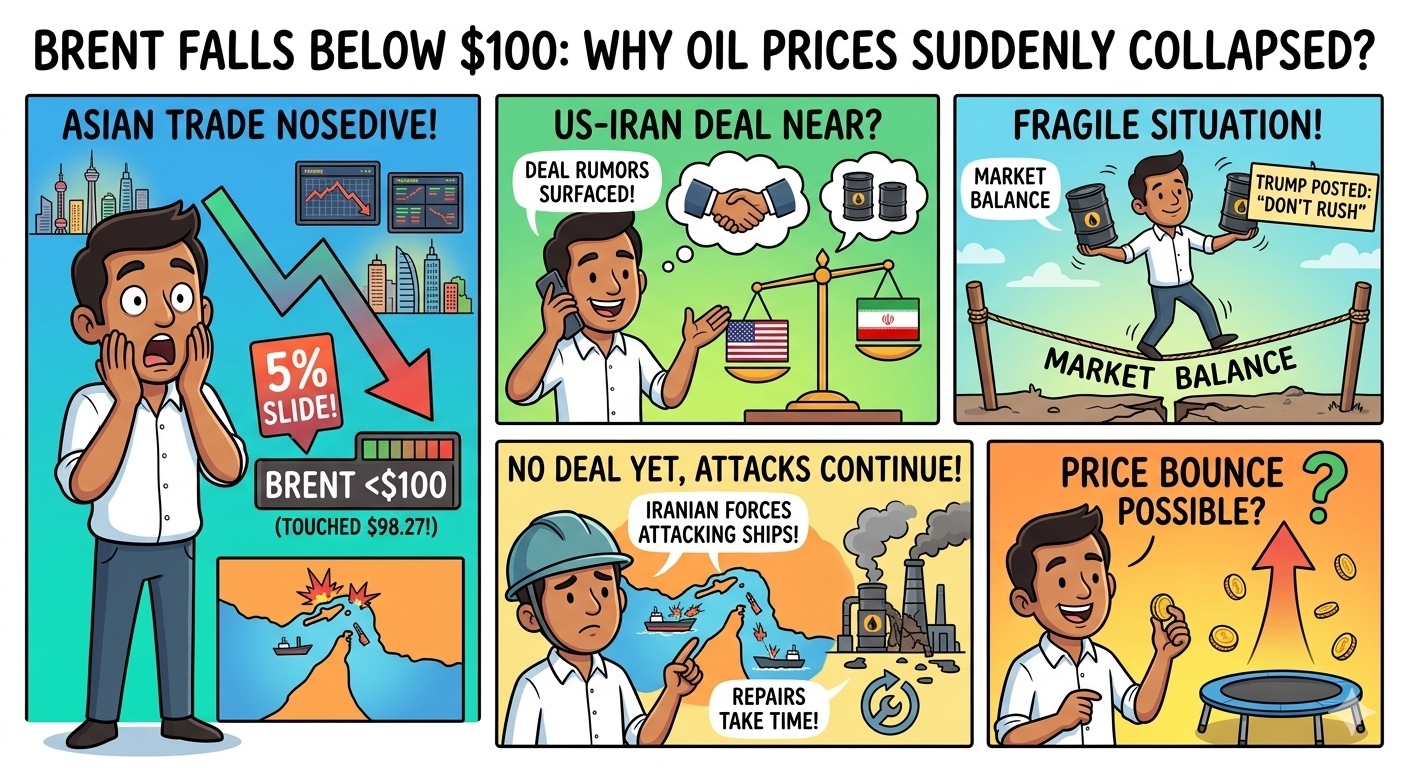
It was a dramatic Monday morning for oil traders. Prices fell more than 5% in Asian trade after reports over the weekend said a US-Iran deal was nearly done. Brent crude broke back below $100, touching $98.27, while WTI slid to $91.63.
But before you celebrate, the situation is still fragile. Trump posted on social media that he had told his team “not to rush.”
A senior US official confirmed no deal would be signed Sunday. And even if one is, Iranian forces have been attacking ships in the Strait since March 4, and damaged oil infrastructure won’t come back online overnight. A price bounce is very much on the table.
India imports a massive chunk of its energy through the Strait of Hormuz. Close to two-thirds of the country’s crude oil and around half its LNG arrive through this narrow waterway. When it shuts, India bleeds.
GTRI founder Ajay Srivastava put it bluntly, “Any closure could send oil prices soaring, sharply inflating India’s import bill, worsening inflation, and putting pressure on the country’s fiscal position.”
Higher crude means costlier petrol, diesel, LPG, and eventually, everything in your grocery bag. A deal, on the other hand, could bring real relief to Indian households faster than most people expect.
India’s Oil Import Exposure:
*T&C Apply
These numbers show why developments in the Strait of Hormuz matter so much for India’s fuel supply and oil prices.
Experts are cautiously hopeful. Patrick De Haan, a well-known energy analyst, says the impact could come fast, “When the strait opens in a meaningful way, it would likely have a fairly quick impact to start pushing prices down”, though he added that the pace depends on how quickly tanker traffic resumes.
Goldman Sachs isn’t fully buying the optimism yet. The bank raised its Brent forecast to $90 per barrel by late 2026, which warns that global inventories are drawing down at a record 11 to 12 million barrels per day. They think supply will stay tight for months.
Economist Ed Yardeni is more upbeat, given how markets rebounded quickly after the 1956 Suez Crisis when the canal was reopened.
The deal proposed includes a 60-day ceasefire, nuclear talks and a complete resumption of shipping. Iranian media said vessel traffic could return to pre-war levels within 30 days of any agreement. That would be a true game changer.
The fall in oil prices has come as some relief especially for countries like India which are heavily dependent on imported crude. Lower prices could help bring down fuel costs and inflation. But the situation is still tense. Oil prices could quickly climb back up in the coming weeks, if talks between the US and Iran fail, or if tensions rise again.
Q1. Why is the Strait of Hormuz important for India and global oil prices?
The Strait of Hormuz is one of the world’s most active oil shipping lanes. A large percentage of India’s crude oil passes through it. Oil price goes up quickly in global markets when the route is closed or conflict arises, which affects the supply of oil. That’s why even minor tensions there can affect fuel prices in India.
Q2. Will petrol and diesel prices also come down if oil prices fall globally?
Global crude prices do impact fuel prices in India but these changes are not always instant. India gets most of its oil from other countries. So lower crude prices can bring down costs over time. Taxes, transport costs and currency rates also affect petrol and diesel prices.









.png&w=3840&q=75)



