
By continuing, you agree to LoansJagat's Credit Report Terms of Use, Terms and Conditions, Privacy Policy, and authorize contact via Call, SMS, Email, or WhatsApp
Disclaimer: The information published on LoansJagat is intended for general informational and educational purposes only and should not be considered financial, legal, or investment advice. Interest rates, loan terms, statistics, and other data may change over time and may vary by lender or source. Please verify the latest information and consult a qualified financial advisor or the respective Bank/NBFC before making any financial decisions.
Subscribe Now
About the author

LoansJagat Team
‘Simplify Finance for Everyone.’ This is the common goal of our team, as we try to explain any topic with relatable examples. From personal to business finance, managing EMIs to becoming debt-free, we do extensive research on each and every parameter, so you don’t have to. Scroll up and have a look at what 15+ years of experience in the BFSI sector looks like.
Related News
Simplify All Your Loans Into One Affordable EMI

Customers Served

Debt Consolidated

1200+ Reviews

Locations in India
Club all Loans & Credit Card Bills into Single EMI

Quick Apply Loan
Consolidate your debts into one easy EMI.

Takes less than 2 minutes. No paperwork.

10 Lakhs+
Trusted Customers

2000 Cr+
Loans Disbursed

4.7/5
Google Reviews

50+
Banks & NBFCs Offers
Other services mentioned in this article
Key Takeaways
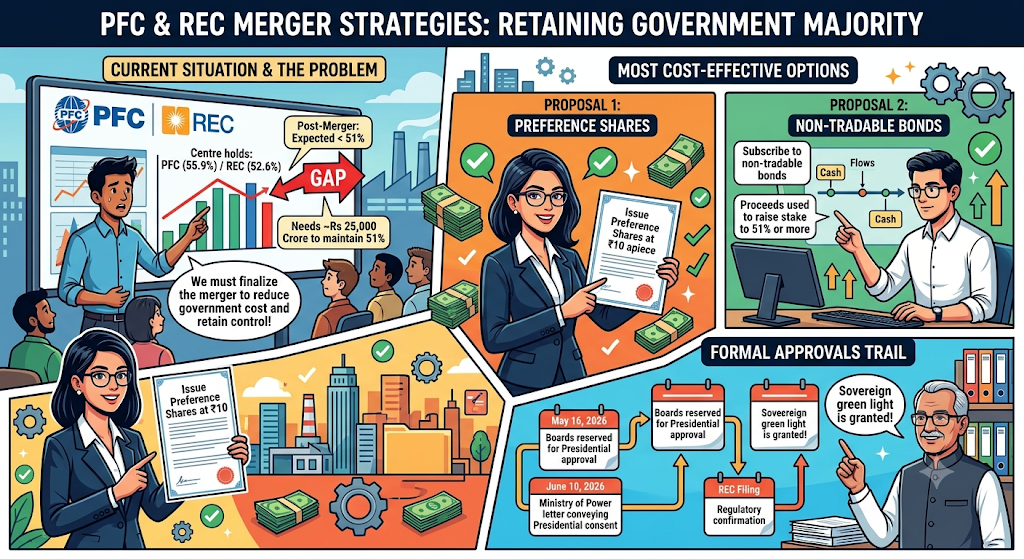
Power Finance Corp and its subsidiary REC are preparing to finalise their merger in a structure that could reduce the cost for the government to retain a majority stake in the combined entity. Many options have been examined, with 2 emerging as the most cost-effective. One proposal involves the merged entity issuing preference shares to the government at ₹10 apiece. The other involves the government subscribing to non-tradable bonds issued by the merged entity, with proceeds used to raise its stake to 51% or more.
The Centre currently holds a 55.9 per cent stake in PFC and a 52.6 per cent stake in REC. After the merger, the shareholding of the Centre in the combined entity is expected to be less than 51 per cent and would require close to Rs 25,000 crore for New Delhi to maintain majority holding. The Ministry of Power conveyed Presidential approval for the merger via a letter dated June 10, 2026, according to REC’s regulatory filing. Both boards reserved the proposal for Presidential approval on May 16, 2026, as required under their Articles of Association.
The merged entity will manage a loan asset book of over ₹17 lakh crore, making it India's largest government-owned NBFC. This scale matters for India's energy transition, since the combined company will have larger underwriting capacity for big-ticket renewable energy and transmission projects. PFC currently holds roughly 20% market share in power sector financing.
In terms of asset quality for the NBFC sector as a whole, it is quite heartening. Loans Jagat pointed out gross NPA of NBFCs, for example, declined from 6.4% to 3% in FY21–25 (as of March-end) and return on assets improved from 1.11% to 2.4% over the period. More importantly, a bigger and better capitalized PFC-REC could help push lending to renewable and rural infrastructure, areas the government specifically prioritised for the NBFC segment in its policy guidelines on future lending.
*T&C Apply
₹25,000 crore
A senior government official said, “The government would like to retain a majority stake in the merged entity as it would be the largest government-owned NBFC with strategic presence. Discussions are going on over the options to ensure that government stake in the merged entity does not fall below 51 per cent.” Under the Companies Act, a "government company" must have at least 51% central or state government ownership.
Analysts at Whalesbook noted that PFC currently trades at a Price-to-Earnings ratio of about 5.11x, and REC at 4.76x, both significantly lower than diversified lenders like Bajaj Finance, which trades near 35x. The solution markets are watching closely is whether the government's chosen capital structure, preference shares or bonds, can raise its stake without diluting shareholder value or triggering a valuation discount.
With board meetings set for June 28, 2026, PFC and REC are entering the final stretch of a merger years in the making. The structure the government chooses, preference shares or non-tradable bonds, will determine how cheaply New Delhi can keep control of what would become India's largest government-owned NBFC.
What is the PFC-REC merger, and what exactly was decided in the June 28, 2026 board meeting?
The President of India approved the merger on June 10, 2026, via a Ministry of Power letter. REC will cease to exist as a separate entity and merge into PFC, creating a combined loan book of ₹10.81 lakh crore. The June 28 board meeting was called to approve the formal merger scheme under Sections 230 to 232 of the Companies Act, 2013.
Should I hold REC shares or PFC shares ahead of the merger, and which one benefits more?
REC shareholders will receive PFC shares based on a swap ratio determined by independent valuers. Until this ratio is announced, it is not possible to judge which side gets a better deal. As of June 25, 2026, REC traded at ₹362.20 and PFC at ₹437.35 on the NSE.









.png&w=3840&q=75)



