By continuing, you agree to LoansJagat's Credit Report Terms of Use, Terms and Conditions, Privacy Policy, and authorize contact via Call, SMS, Email, or WhatsApp
Disclaimer: The information published on LoansJagat is intended for general informational and educational purposes only and should not be considered financial, legal, or investment advice. Interest rates, loan terms, statistics, and other data may change over time and may vary by lender or source. Please verify the latest information and consult a qualified financial advisor or the respective Bank/NBFC before making any financial decisions.
Subscribe Now
About the author

LoansJagat Team
‘Simplify Finance for Everyone.’ This is the common goal of our team, as we try to explain any topic with relatable examples. From personal to business finance, managing EMIs to becoming debt-free, we do extensive research on each and every parameter, so you don’t have to. Scroll up and have a look at what 15+ years of experience in the BFSI sector looks like.
Related News
Simplify All Your Loans Into One Affordable EMI

Customers Served

Debt Consolidated

1200+ Reviews

Locations in India
Club all Loans & Credit Card Bills into Single EMI

Quick Apply Loan
Consolidate your debts into one easy EMI.

Takes less than 2 minutes. No paperwork.

10 Lakhs+
Trusted Customers

2000 Cr+
Loans Disbursed

4.7/5
Google Reviews

50+
Banks & NBFCs Offers
Other services mentioned in this article
Key Takeaways
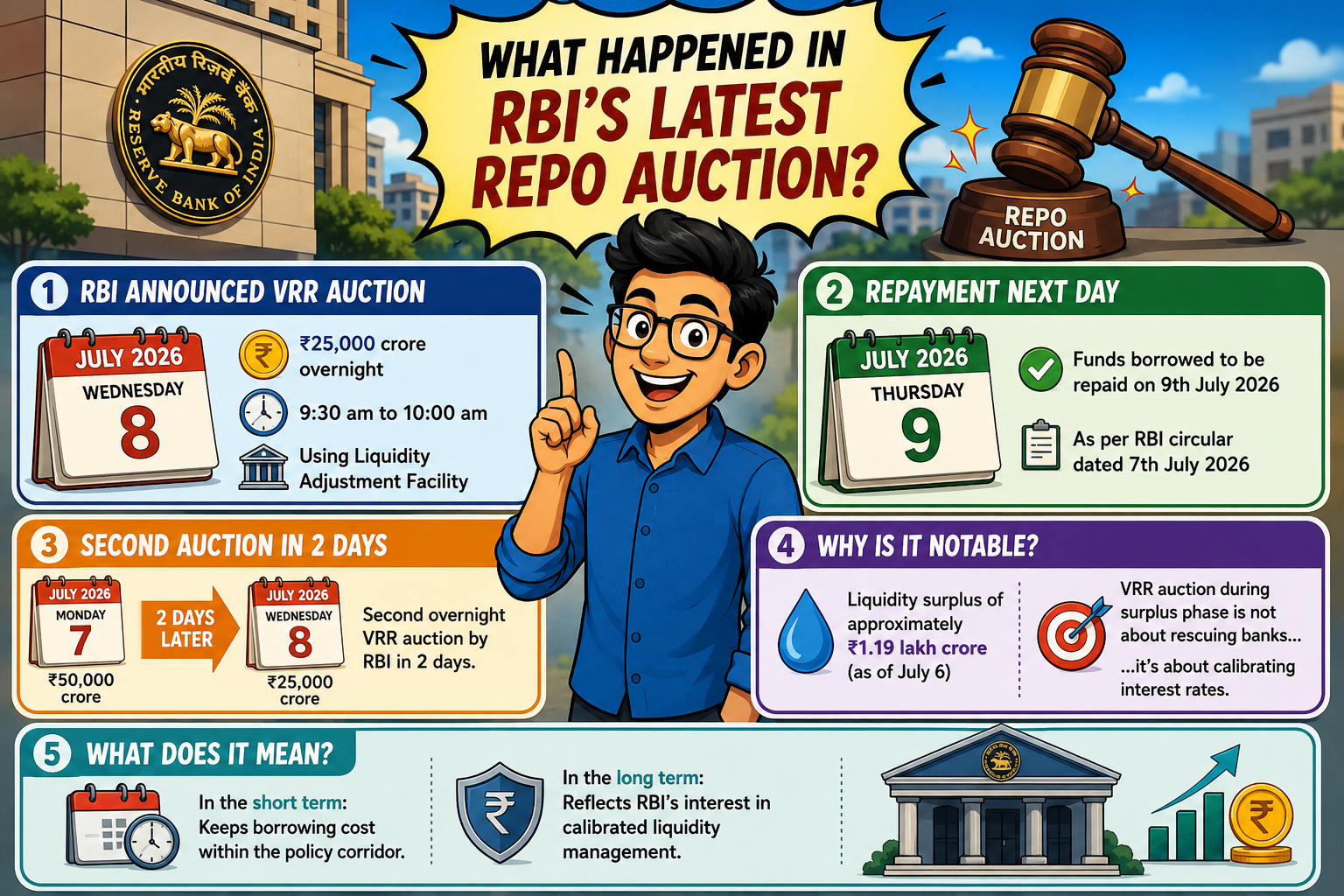
Repayment of the funds borrowed will be done on the next day i.e., 9th of July 2026. This decision was made as per a circular issued by the Reserve Bank of India on the 7th of July 2026. This decision is made based on “current and evolving liquidity conditions”. This is the second such overnight VRR auction by the RBI in 2 days after the one conducted for ₹50,000 crore on 7th of July 2026.
What makes it notable is the current liquidity condition, which remains comfortable and not tight. As per the data available with RBI, there was a liquidity surplus of approximately ₹1.19 lakh crore as of July 6. Conducting VRR auction amid the phase of surplus in liquidity is not so much about rescue of banks from shortage of funds as about calibrating interest rates.
In the short-term horizon, it ensures that the borrowing cost remains within the policy corridor while on a longer horizon, it reflects RBI's interest in calibrated liquidity management.
For most Indians, a single overnight VRR auction will not move their EMI by even one rupee. This is an interbank tool, not a policy rate change, and the repo rate itself has stayed at 5.25% since the February 2026 MPC review. What it does affect is the plumbing behind loan pricing. When call money rates and TREPS rates drift too far from the repo rate, banks’ funding costs become unpredictable, and that unpredictability eventually shows up in lending rates.
The positive side here is stability. This way, since the central bank is constantly intervening in such situations by conducting VRR auctions to bring down the interest rates, common people having loans like housing loan, personal loan, or MSME loans linked to repo will have a stable rate scenario. As per RBI, just from June 2026 till date, the central bank has infused an excess of ₹6 lakh crore into the system via overnight and 7-day VRR auction.
LoansJagat’s tracking of a similar liquidity operation conducted by RBI on July 9, 2025 reveals that the RBI infused ₹97,315 crore out of ₹1 lakh crore notified amount at 5.49%.
Weak demand at Tuesday’s July 7 auction tells its own story. Against a notified ₹50,000 crore, the RBI received bids worth only ₹1,135 crore, and accepted the full amount at a cut-off and weighted average rate of 5.26%.
9:30 am to 10:00 am
*T&C Apply
Dealers have flagged this pattern before. At an earlier seven-day VRR auction on March 17, 2026, a money market dealer at a primary dealership told Business Standard that large banks stayed away because they were “already sitting on ample liquidity” and getting better returns in the tri-party repo market.
That dynamic looks similar now. With surplus liquidity near ₹1.19 lakh crore, banks simply do not need to borrow much at auction. The RBI’s likely solution, based on its actions since June, is to keep offering VRR windows regardless of uptake, so that funds are available the moment any bank faces a genuine overnight mismatch.
This keeps the option open without forcing banks to borrow they don’t want. Analysts tracking the Liquidity Adjustment Facility expect the central bank to continue this calibrated approach through July, rather than shifting to larger, less frequent interventions.
The ₹25,000 crore overnight VRR auction on July 8 is not a policy shift. It is routine liquidity housekeeping from an RBI managing a comfortable surplus. The banks requiring funds overnight would be able to obtain funds at a market-related rate, but the system overall would be kept close to the repo rate of 5.25%. For the borrower, the point here would be that it is the continued intervention by RBI using such methods that ensures that repo-based interest rates remain stable despite the thinness in the bidding.
Has there been an announcement of a ₹25,000 crore switch auction on Monday by RBI?
Yes. RBI’s action this time is a ₹25,000 crore overnight VRR auction to be conducted on Wednesday, July 8, 2026. A switch auction is a separate RBI tool used to swap government bonds of different maturities. This week’s operation is purely a short-term liquidity infusion under the Liquidity Adjustment Facility.
How is this RBI auction different from the everyday repo market?
The everyday repo market, including TREPS, runs continuously between banks and financial institutions at market-driven rates. The RBI’s VRR auction is a scheduled, central bank-run operation held on specific dates, like July 7 and July 8, 2026, where the rate is set through bidding but capped by the RBI’s own liquidity assessment for that day.









.png&w=3840&q=75)



