By continuing, you agree to LoansJagat's Credit Report Terms of Use, Terms and Conditions, Privacy Policy, and authorize contact via Call, SMS, Email, or WhatsApp
Disclaimer: The information published on LoansJagat is intended for general informational and educational purposes only and should not be considered financial, legal, or investment advice. Interest rates, loan terms, statistics, and other data may change over time and may vary by lender or source. Please verify the latest information and consult a qualified financial advisor or the respective Bank/NBFC before making any financial decisions.
Subscribe Now
About the author

LoansJagat Team
‘Simplify Finance for Everyone.’ This is the common goal of our team, as we try to explain any topic with relatable examples. From personal to business finance, managing EMIs to becoming debt-free, we do extensive research on each and every parameter, so you don’t have to. Scroll up and have a look at what 15+ years of experience in the BFSI sector looks like.
Related News
Simplify All Your Loans Into One Affordable EMI

Customers Served

Debt Consolidated

1200+ Reviews

Locations in India
Club all Loans & Credit Card Bills into Single EMI

Quick Apply Loan
Consolidate your debts into one easy EMI.

Takes less than 2 minutes. No paperwork.

10 Lakhs+
Trusted Customers

2000 Cr+
Loans Disbursed

4.7/5
Google Reviews

50+
Banks & NBFCs Offers
Other services mentioned in this article
RBI accused Bank of Baroda and GIC Housing Finance of skipping rules associated with loan interest, KYC uploading and a periodic account risk review and imposed a fine on each bank.
Key Takeaways
The Reserve Bank of India imposed monetary penalties on Bank of Baroda and GIC Housing Finance after their supervisory reviews found regulatory lapses. The order against Bank of Baroda was issued on 30 June 2026, while the order for GIC Housing Finance was on 24 June 2026. Both were made public on 3 July 2026.
Based on the information available to RBI, Bank of Baroda charged interest above the agreed rate on certain loan accounts and delayed the upload of some KYC records to the Central KYC Records Registry. Regarding GIC Housing Finance, RBI found that the company had no framework to assess the risk level of borrowers’ accounts or to periodically review the risk categorization of accounts at least once every six months.
The penalty does not cancel customer transactions or loan agreements. That line is useful for borrowers. It means the fine has been imposed on the institutions for compliance gaps, not on customers. Still, the case has a direct customer link. If loan interest is not charged as agreed, borrowers may pay more than expected. If KYC records are not updated on time, customers can face delays during account servicing, top-up loans, balance transfers or loan closure.
The issue is not only the amount of the fine. The larger issue is how routine banking processes are followed after a loan is sanctioned. A borrower signs a sanction letter with a contracted interest rate. That rate, including later resets in floating-rate loans, should reflect correctly in the loan account. Any mismatch can affect EMI calculations, interest certificates and closure dues.
KYC is the second part of the story. Banks and finance companies collect identity and address documents, update customer profiles and upload records to the Central KYC Records Registry when required. A delay may look like a back-end problem, but customers feel it later when another lender asks for updated records, when a loan moves to another bank, or when a dormant account is reactivated.
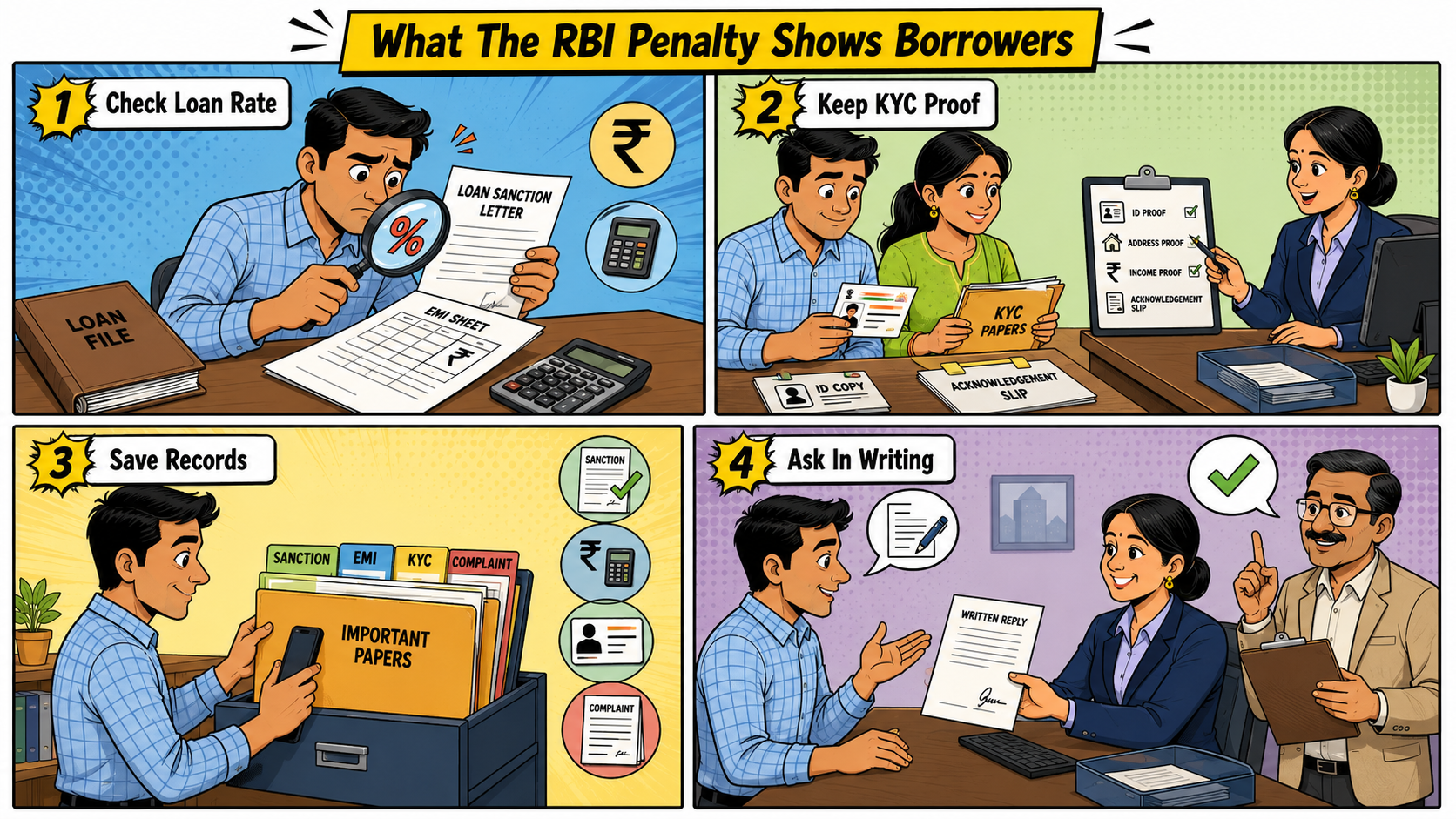
The 2 penalties together add up to ₹66.70 lakh. The Bank of Baroda case is linked to lending conduct and KYC upload timelines. The GIC Housing Finance case is linked to the KYC risk review. Both point to the same borrower lesson: keep loan papers and KYC proof ready, even after the loan is approved.
The table shows why the case should not be treated as a routine regulatory notice. A borrower may never read an inspection finding, but a poor internal check can still show up in a loan statement, KYC delay or account correction request.
For India’s borrowers, the immediate effect is awareness. Anyone with an active loan should check the sanction letter, repayment schedule, latest interest certificate and rate reset message. This becomes more important for home loans, MSME loans, gold loans, business loans and any floating-rate account where interest changes during the loan period. A small mismatch in rate can grow over several EMIs.
There is a positive side too. Regulatory penalties push lenders to clean up their systems. Branches may become quicker with KYC uploads. Loan teams may check contracted rates more carefully. Internal audit teams may ask harder questions before a problem reaches customers. That helps people who do not have the time or language to argue over technical banking entries.
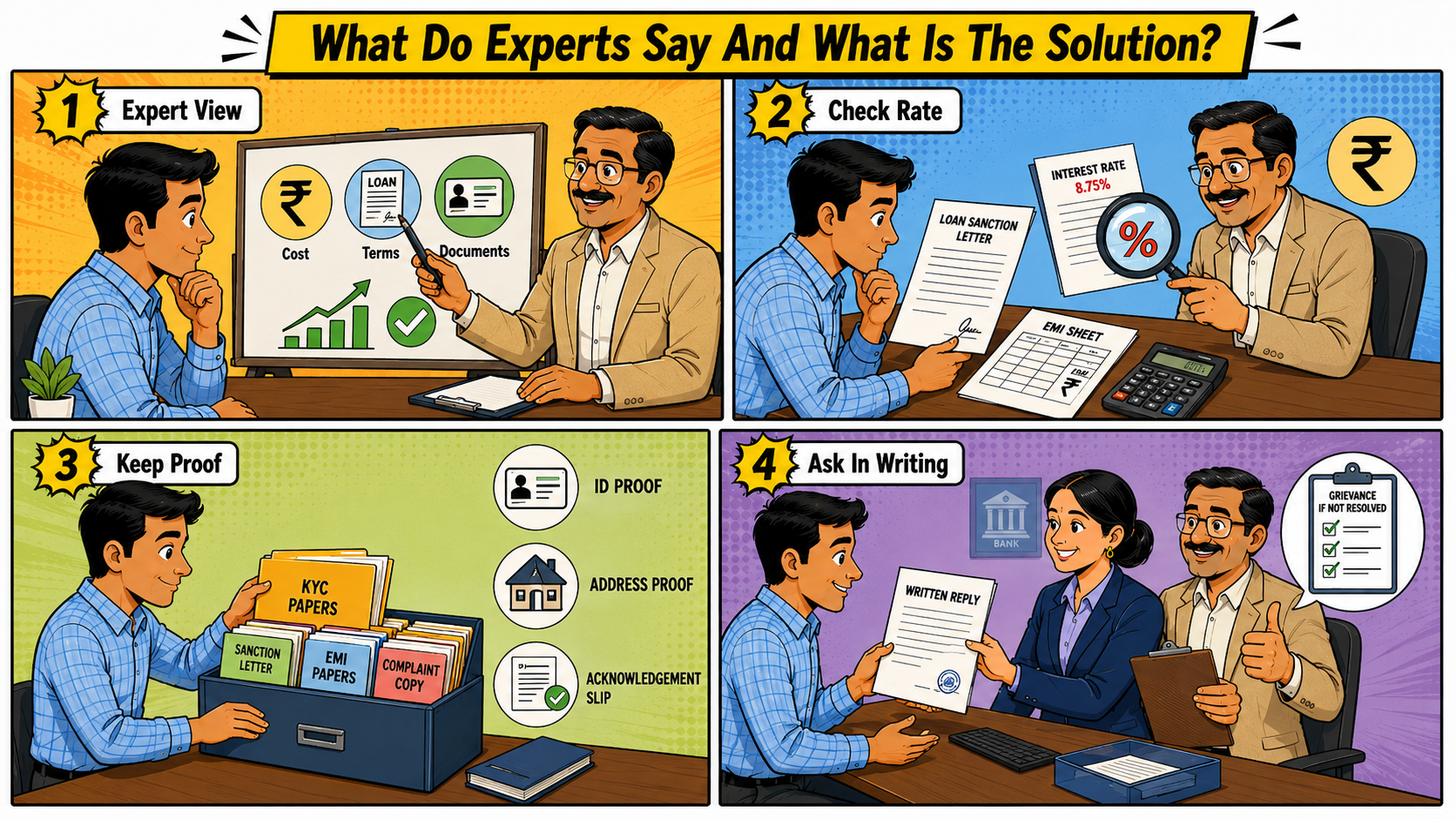
Compliance professionals usually read such penalties as a process warning. A fine on a large bank may look small when compared with the size of its loan book, but the finding can trigger internal reviews across branches. In this case, 3 areas need closer attention: rate accuracy, KYC upload timing and account risk review. These are not fancy banking terms. They decide how smoothly a customer’s account runs.
*T&C Apply
The solution should start inside the lender’s own systems. A bank can use automated alerts when the rate charged differs from the contracted rate. A housing finance company can keep a 6-month review calendar for account risk categorisation. Branches can track pending CKYCR uploads every week, not only before an audit. From the borrower side, according to LoansJagat, re-KYC coverage is simple: updated records reduce banking friction, especially when customers need faster service during camps, account updates, or loan-related requests.
The previous update came from inspections linked to the financial position of both institutions as of March 31, 2025. In Bank of Baroda’s case, the RBI conducted an inspection and later issued a notice to the bank. After reviewing the bank’s reply, RBI found grounds to impose the ₹63.60 lakh penalty.
For GIC Housing Finance, the inspection was conducted by the National Housing Bank with reference to the company’s financial position as of March 31, 2025. The finding was narrower, but still relevant for housing finance customers. Account risk categorisation helps lenders review customer profiles over time. If the review is delayed, old or weak records can remain in the system for longer than they should.
RBI said the penalties were based on deficiencies in regulatory compliance. It also said the action does not decide the validity of transactions or agreements entered into by the institutions with customers. That statement protects borrowers from panic. It also shows that customers should not expect automatic correction or refund only because a penalty has been imposed.
Bank of Baroda and GIC Housing Finance disclosed the penalty action under exchange rules. For borrowers, the useful step is personal record checking. If the charged interest rate differs from the agreed rate, the borrower should first ask the branch for a written explanation. If the reply is weak or delayed, the complaint should move to the lender’s grievance officer with account statements, a sanction letter, and rate reset proof attached.
The RBI penalty on Bank of Baroda and GIC Housing Finance is not just a fine update for the banking sector. It has a practical message for customers who trust lenders to follow loan terms correctly after disbursal.
Borrowers should remain calm, but vigilant examination is warranted. Having a record of your sanction letter, interest certificate, KYC acknowledgement, and a complaint in writing should and likely will prove helpful in the future. As for lenders, the message is clearer and stricter: routine compliance work must adhere to the same level of diligence and strictness when it comes to the cost of loans and customer records.
What was the RBI fine given to the Bank of Baroda?
The fine for Baroda Bank was ₹63.60 lakh for insufficient compliance for lending and KYC norms.
What was the RBI fine given to GIC Housing Finance?
GIC Housing Finance was fined ₹3.10 lakh for a KYC risk review deficiency.
Does this fine have any impact on customer loan contracts?
No. RBI mentioned the fine will not impact the legitimacy of the customer transactions or contracts.
What should borrowers cross-check after this update?
Borrowers should cross-check sanction letters and rate reset notices, interest certificates, KYC acknowledgements, and replies received from the bank.
Will borrowers get any automatic refund post this fine?
There is no announcement for any automatic refund, and for any claimed interest dispute, proof will have to be provided at the customer level.









.png&w=3840&q=75)



