By continuing, you agree to LoansJagat's Credit Report Terms of Use, Terms and Conditions, Privacy Policy, and authorize contact via Call, SMS, Email, or WhatsApp
Disclaimer: The information published on LoansJagat is intended for general informational and educational purposes only and should not be considered financial, legal, or investment advice. Interest rates, loan terms, statistics, and other data may change over time and may vary by lender or source. Please verify the latest information and consult a qualified financial advisor or the respective Bank/NBFC before making any financial decisions.
Subscribe Now
About the author

LoansJagat Team
‘Simplify Finance for Everyone.’ This is the common goal of our team, as we try to explain any topic with relatable examples. From personal to business finance, managing EMIs to becoming debt-free, we do extensive research on each and every parameter, so you don’t have to. Scroll up and have a look at what 15+ years of experience in the BFSI sector looks like.
Related News
Simplify All Your Loans Into One Affordable EMI

Customers Served

Debt Consolidated

1200+ Reviews

Locations in India
Club all Loans & Credit Card Bills into Single EMI

Quick Apply Loan
Consolidate your debts into one easy EMI.

Takes less than 2 minutes. No paperwork.

10 Lakhs+
Trusted Customers

2000 Cr+
Loans Disbursed

4.7/5
Google Reviews

50+
Banks & NBFCs Offers
Other services mentioned in this article
Key Takeaways
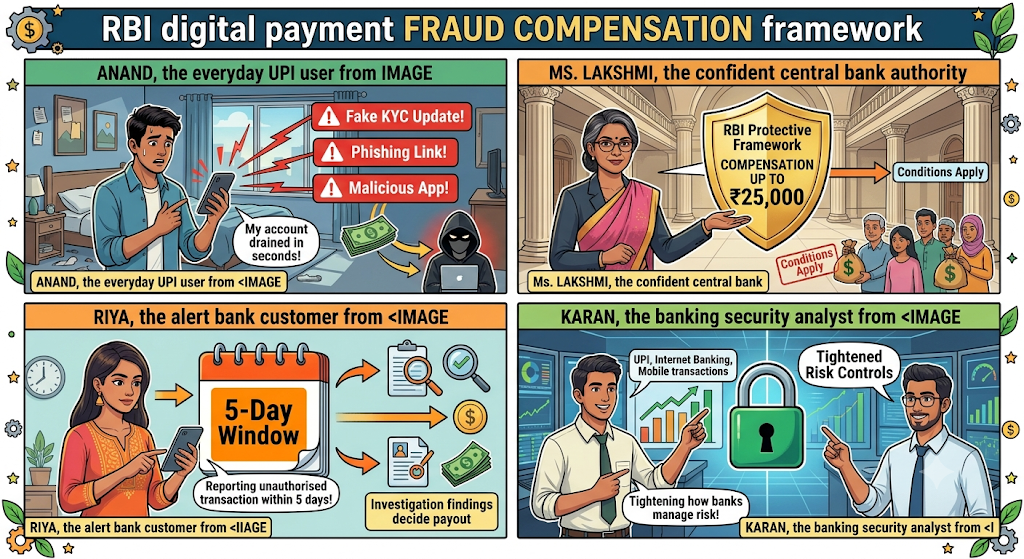
For years, cyber fraudsters relied on one simple assumption, most victims would never get their money back. A fake KYC update, a phishing link, or a malicious app could take down an account in seconds, and the recovery trail would often go cold. The RBI has now unveiled a framework that could provide compensation of up to ₹25,000 to victims of digital payment frauds, while also tightening how banks detect and manage risk.
Under the framework, customers who report unauthorised digital transactions within 5 days of noticing them can claim compensation up to ₹25,000, subject to conditions and investigation findings. The move comes as digital payment frauds rise alongside the rapid growth of UPI, internet banking, and mobile transactions.
This rule matters because recovery from online fraud has historically been slow and uncertain for ordinary users. The framework gives customers a clear, time-bound pathway, report within 5 days, and a structured compensation process kicks in. Speed is now the deciding factor for victims, since the faster a fraud is reported, the greater the likelihood of recovery.
There is real precedent showing recovery is possible when investigations move fast. LoansJagat reports that ₹48 lakh was returned to victims of a fake instant loan app scam in Visakhapatnam, after police converted seized cryptocurrency into Indian currency. The official police report, issued on August 13, 2025, identified 295 victims
*T&C Apply
Ajay Sirikonda, Partner and Leader of Financial Services Risk Management at EY India, said: “The RBI's draft guidance is a welcome step that finally gives Indian banks a clear playbook for model and AI risk. In some ways, it goes further than the UK’s PRA or the US regulators, it brings AI, third-party models and consumer protection into one frame.”
He added that the guidance could actually speed up AI adoption rather than slow it down, “The guidance does add governance and explainability friction, but mostly where the stakes are highest. Elsewhere, it removes the bigger blocker, uncertainty. Banks have sat on AI not just because it was costly, but also because no one had said what was allowed. This guideline says it. For most use cases, that is an accelerant, not a constraint.” The practical solution for banks is to deploy stronger AI-driven fraud detection, since the harder it becomes to move stolen money unnoticed, the fewer claims will need compensation in the first place.
The RBI’s ₹25,000 compensation framework, effective January 1, 2027, gives digital fraud victims a clearer path to recovery for the first time. Paired with tighter AI governance at banks, the goal is simple: catch fraud faster, and make sure victims aren't left to fight alone after a scam.
The RBI Ombudsman rejected my ₹9.21 lakh fraud case. Can I still take it to the Consumer Court?
Yes. An RBI Ombudsman rejection does not take away your right to a court trial. The District Consumer Commission remains open as a next step, even after the Ombudsman closes your case. You can also appeal to the RBI's Appellate Authority, the Deputy Governor, within 30 days of the Ombudsman’s order.
What is the maximum amount a fraud victim can recover through the RBI Ombudsman in India?
Under the Reserve Bank Integrated Ombudsman Scheme 2021, the Ombudsman can award up to ₹20 lakh as compensation, plus ₹1 lakh for harassment caused. For losses above ₹20 lakh, the Consumer Court or Commercial Court is the recommended route for full recovery.









.png&w=3840&q=75)



