By continuing, you agree to LoansJagat's Credit Report Terms of Use, Terms and Conditions, Privacy Policy, and authorize contact via Call, SMS, Email, or WhatsApp
Disclaimer: The information published on LoansJagat is intended for general informational and educational purposes only and should not be considered financial, legal, or investment advice. Interest rates, loan terms, statistics, and other data may change over time and may vary by lender or source. Please verify the latest information and consult a qualified financial advisor or the respective Bank/NBFC before making any financial decisions.
Subscribe Now
About the author

LoansJagat Team
‘Simplify Finance for Everyone.’ This is the common goal of our team, as we try to explain any topic with relatable examples. From personal to business finance, managing EMIs to becoming debt-free, we do extensive research on each and every parameter, so you don’t have to. Scroll up and have a look at what 15+ years of experience in the BFSI sector looks like.
Related News
Simplify All Your Loans Into One Affordable EMI

Customers Served

Debt Consolidated

1200+ Reviews

Locations in India
Club all Loans & Credit Card Bills into Single EMI

Quick Apply Loan
Consolidate your debts into one easy EMI.

Takes less than 2 minutes. No paperwork.

10 Lakhs+
Trusted Customers

2000 Cr+
Loans Disbursed

4.7/5
Google Reviews

50+
Banks & NBFCs Offers
Other services mentioned in this article
Key Takeaways
India is passing through one of the most complex moments of the economy in recent years. The ongoing West Asia conflict has rattled the country’s external sector which is pushing up crude oil prices, straining the rupee and swelling an already heavy import bill.
Finance Minister Nirmala Sitharaman struck back at what she termed a “cynical narrative” on India’s economy at a SIDBI event in Mumbai. She was clear that India’s problems were more external than internal.
The short-term pain is visible in India's forex data and market outflows. But the longer-term concern is structural. India imports over half its natural gas and has no commercially viable reserves of potash, rock phosphate, or sulphur. This leaves the country deeply exposed whenever global commodity markets turn turbulent.
A sustained conflict could push India’s 2026-27 fertiliser import bill past the record $33.4 billion set during the Russia-Ukraine war, according to estimates reported by the Indian Express.
Here are the key stress indicators across India’s external sector since the West Asia conflict began in late February 2026.
The most striking figure is the RBI’s $29.6 billion in forex market intervention during March alone. That scale of defence underscores how serious the rupee pressure has become. The fertiliser import bill signals that food inflation risks are far from resolved.
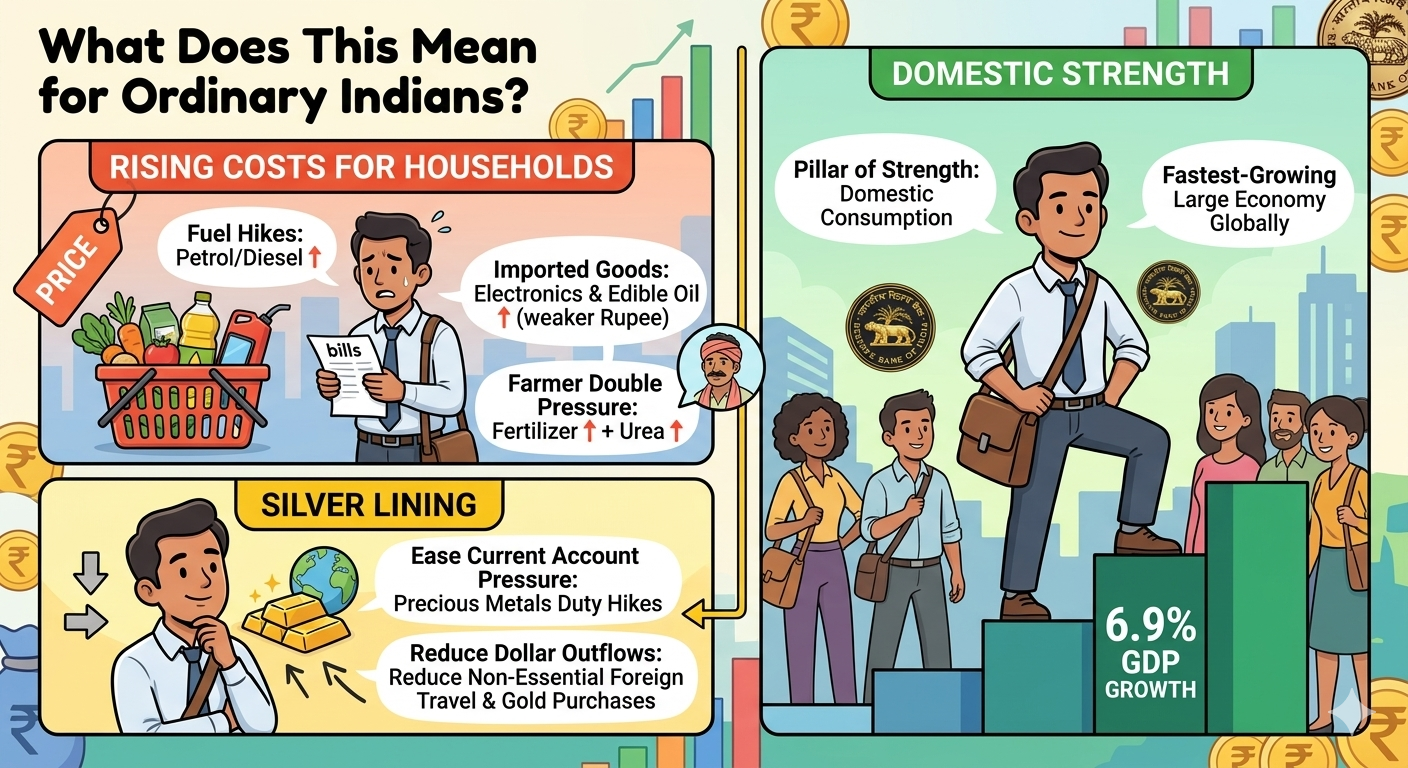
These numbers translate into rising costs for most Indian households. Four petrol and diesel price hikes within two weeks have already hit commuters and transport businesses. A weaker rupee makes everything imported more expensive, from electronics to edible oils.
Farmers face a double pressure of global fertiliser prices near Russia-Ukraine war highs, compounded by rupee depreciation that makes every import-denominated bag of urea costlier.
There is a silver lining. The government’s duty hikes on precious metals should ease pressure on India’s current account over time. PM Modi’s call to reduce non-essential foreign travel and gold purchases, if heeded broadly, could meaningfully reduce dollar outflows.
Domestic consumption remains a pillar of strength.The RBI’s base forecast of 6.9% GDP growth still places India among the fastest-growing large economies globally.
*T&C Apply
Economists are not as reassured as the Finance Ministry. Many warn of a balance of payments deficit for the third consecutive year in 2026-27, a sustained vulnerability that goes beyond cyclical commodity shocks.
Some analysts now see inflation risks serious enough that the RBI’s Monetary Policy Committee could reverse course at its June 3-5 meeting. The repo rate, already cut by 125 basis points to 5.25% in 2025, could be hiked, which will increase borrowing costs for businesses and homebuyers alike.
There seems to be agreement that India requires some structural measures on a medium-term basis – diversification of sources of energy, development of fertiliser production capabilities within the country, and deepening of bond markets to reduce volatility from foreign portfolio inflows. This may take time, but the urgency could not be any greater.
The fundamentals of the Indian economy remain sound, but the external scenario could not be tougher. Whether the coming 2026-27 turns out to be a year of resilience or of even higher levels of economic strain depends largely on how fast the West Asia situation resolves itself.
1. Why is the Indian Rupee depreciating in a hurry in 2026?
The rupee has weakened mainly due to the West Asia conflict, rising import costs and heavy outflows of foreign investors from the Indian markets. India imports large quantities of crude oil, gas and fertilisers and so global tensions increase demand for dollars and put pressure on the rupee. RBI has also sold billions from forex reserves to arrest the fall.
2. Why is the rupee falling even when inflation and oil prices are relatively contained?
The rupee is depreciating not only on oil prices, there is global uncertainty and a stronger dollar. Foreign investors are pulling money out of emerging markets such as India and shifting to safer assets in the US. At the same time, India’s high import dependence is increasing dollar demand, which weakens the rupee further.









.png&w=3840&q=75)



