By continuing, you agree to LoansJagat's Credit Report Terms of Use, Terms and Conditions, Privacy Policy, and authorize contact via Call, SMS, Email, or WhatsApp
Disclaimer: The information published on LoansJagat is intended for general informational and educational purposes only and should not be considered financial, legal, or investment advice. Interest rates, loan terms, statistics, and other data may change over time and may vary by lender or source. Please verify the latest information and consult a qualified financial advisor or the respective Bank/NBFC before making any financial decisions.
Subscribe Now
About the author

LoansJagat Team
‘Simplify Finance for Everyone.’ This is the common goal of our team, as we try to explain any topic with relatable examples. From personal to business finance, managing EMIs to becoming debt-free, we do extensive research on each and every parameter, so you don’t have to. Scroll up and have a look at what 15+ years of experience in the BFSI sector looks like.
Related Blog Post
Simplify All Your Loans Into One Affordable EMI

Customers Served

Debt Consolidated

1200+ Reviews

Locations in India
Club all Loans & Credit Card Bills into Single EMI

Quick Apply Loan
Consolidate your debts into one easy EMI.

Takes less than 2 minutes. No paperwork.

10 Lakhs+
Trusted Customers

2000 Cr+
Loans Disbursed

4.7/5
Google Reviews

50+
Banks & NBFCs Offers
Other services mentioned in this article
Key Insights
Mysuru's Deputy Commissioner G. Lakshmikanth Reddy has directed officials to raise awareness of schemes offered by the Department of Minority Welfare.
The PM SVANidhi programme stresses that beneficiary selection must be transparent and strictly adhere to guidelines.
The directive came during a progress review meeting at the Zilla Panchayat Hall and carried a sharp underlying message.
The programme is available, funded, and working, but awareness gaps are preventing full uptake.
In some states, low registration rates for the scheme were attributed to a lack of awareness about its provisions.
A study involving 150 street vendors in Meerut specifically found that awareness of the scheme positively influenced vendors' perceptions and uptake.
Long-term, the gap between entitled and enrolled beneficiaries represents a structural failure in last-mile delivery.
Short-term, it means thousands of vendors continue to rely on informal moneylenders at exploitative rates when government credit is available to them at just 7% annually.
The table below captures the key benefits and uptake metrics of India's flagship street vendor credit scheme.
The scheme has been implemented through banks, NBFCs, microfinance institutions, and digital platforms, with public sector banks issuing the majority of loans and cooperative and private banks playing a minimal role.
The Mysuru data suggests implementation is progressing, but the remaining gap of nearly 8,000 vendors signals work still to be done. The Globe and Mail
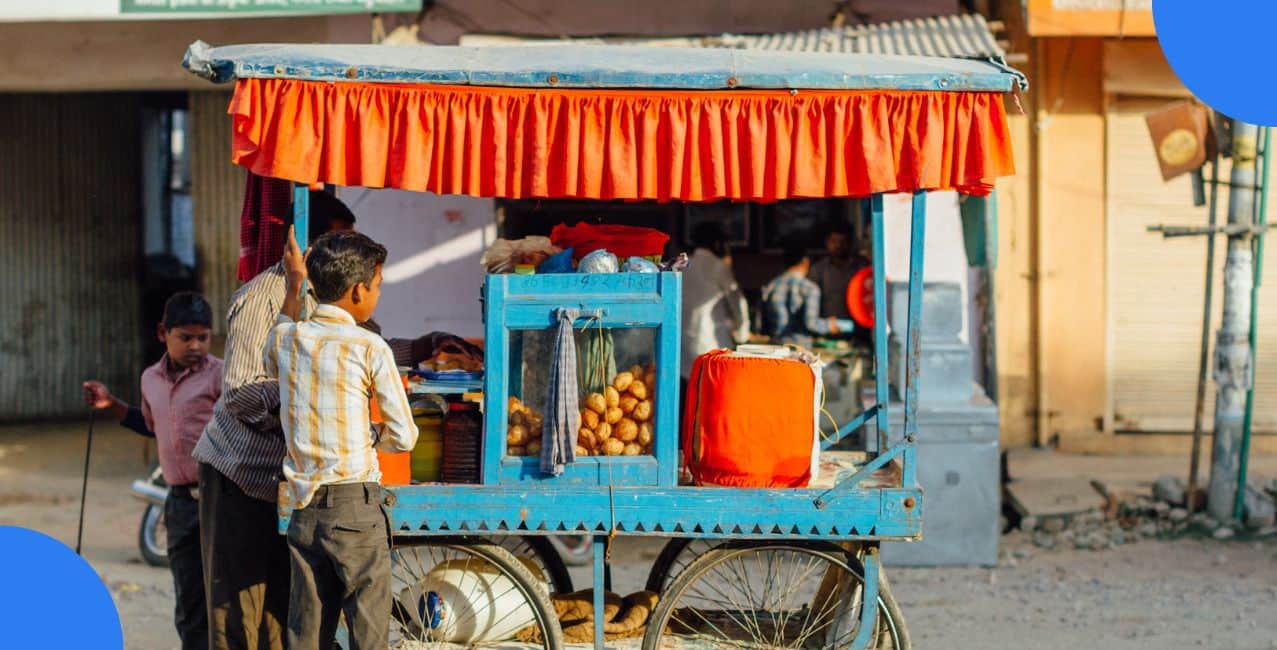
Street vendors represent a very important part of the urban informal economy, providing essential goods and services at affordable rates, including vegetables, fruits, ready-to-eat food, tea, clothing, footwear, and services such as barbering and laundry.
Most operate without any credit history and historically turn to informal lenders who charge usurious interest rates. The PM SVANidhi scheme directly addresses this dependence.
The positive case is clear and measurable.
Nearly 47 lakh digitally active beneficiaries have conducted over 557 crore digital transactions worth ₹6.09 lakh crore.
Earning a total cashback of ₹241 crore showing that when vendors do access the scheme, digital adoption and economic participation follow.
Each enrolled vendor is building a credit history that unlocks mainstream banking access over time.
The evidence from research and ground-level implementation tells a consistent story.
Banks employed strategies including collaborating with local authorities to distribute pamphlets and organising awareness drives, with direct interactions primarily occurring.
₹7,332 crore
*T&C Apply
The restructured scheme, approved by the Union Cabinet, includes provision of UPI-linked RuPay credit cards.
For beneficiaries who have repaid the second loan, along with digital cashback incentives for retail and wholesale transactions making the upgraded scheme significantly more attractive than its original version.
Active, on-ground outreach through ULBs, self-help groups, and mobile banking correspondents remains the most credible route to bridging the remaining awareness gap.
The Mysuru DC's directive is a reminder that policy intent and ground reality are not always the same thing. PM SVANidhi has the funding, the structure, and the track record. What it still needs in Mysuru and across India is consistent, face-to-face awareness that meets vendors where they stand.
Why is there no outrage over the establishment of data centres in India?
The lack of widespread public outrage over data centre expansion in India stems primarily from the government's view of them as vital infrastructure for digital development, job creation, and economic growth.
What are your views on data centres in India?
Data centres in India are experiencing a massive, government-backed boom driven by AI demand and data sovereignty, with capacity expected to triple by 2030.
Related Finance News | |||









.png&w=3840&q=75)



