By continuing, you agree to LoansJagat's Credit Report Terms of Use, Terms and Conditions, Privacy Policy, and authorize contact via Call, SMS, Email, or WhatsApp
Disclaimer: The information published on LoansJagat is intended for general informational and educational purposes only and should not be considered financial, legal, or investment advice. Interest rates, loan terms, statistics, and other data may change over time and may vary by lender or source. Please verify the latest information and consult a qualified financial advisor or the respective Bank/NBFC before making any financial decisions.
Subscribe Now
About the author

LoansJagat Team
‘Simplify Finance for Everyone.’ This is the common goal of our team, as we try to explain any topic with relatable examples. From personal to business finance, managing EMIs to becoming debt-free, we do extensive research on each and every parameter, so you don’t have to. Scroll up and have a look at what 15+ years of experience in the BFSI sector looks like.
Related News
Simplify All Your Loans Into One Affordable EMI

Customers Served

Debt Consolidated

1200+ Reviews

Locations in India
Club all Loans & Credit Card Bills into Single EMI

Quick Apply Loan
Consolidate your debts into one easy EMI.

Takes less than 2 minutes. No paperwork.

10 Lakhs+
Trusted Customers

2000 Cr+
Loans Disbursed

4.7/5
Google Reviews

50+
Banks & NBFCs Offers
Other services mentioned in this article
RBI’s ₹1 lakh crore upper-layer rule has kept Tata Sons under listing pressure, with India’s largest unlisted group holding company awaiting clarity.
Key Highlights
Tata Sons is back in the regulatory spotlight after the ₹1 lakh crore upper-layer NBFC rule renewed pressure on its possible stock market listing. The company, the main holding entity of the Tata Group, has been watched closely since it was linked to the RBI’s tighter NBFC classification framework. The issue involves Tata Sons, RBI, Tata Trusts, the Shapoorji Pallonji Group, lenders, investors, and India’s wider NBFC sector.
The short-term effect is market uncertainty. Investors want to know whether Tata Sons will list, get deregistered, or face another compliance route. The longer-term risk is sharper. If the final call remains unclear for too long, the case can fuel talk that India’s largest business houses get softer handling than smaller regulated entities. That is not a small reputational problem for any financial regulator.
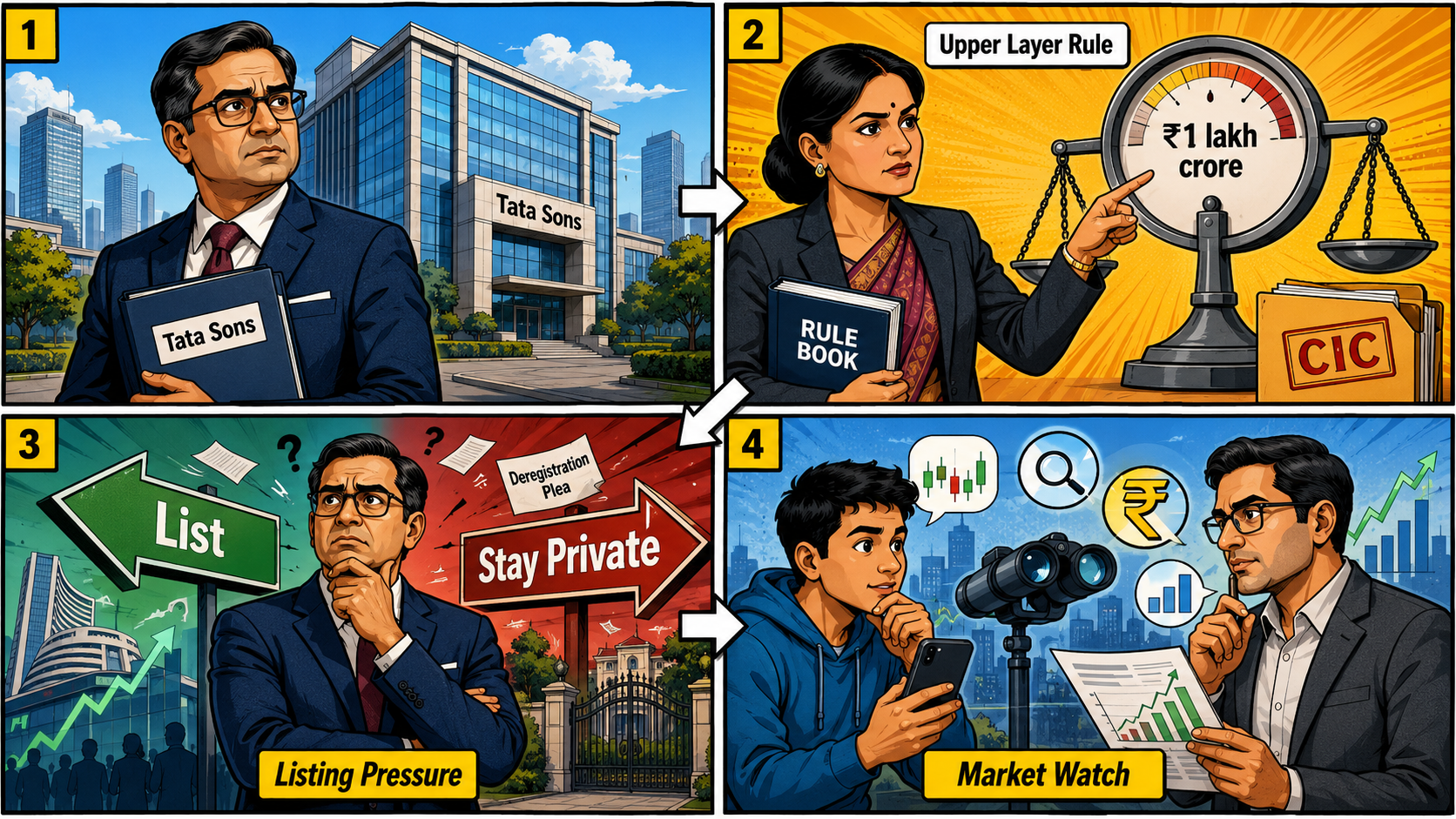
The issue is linked to RBI’s scale-based NBFC framework, where large finance-linked entities face closer supervision. Tata Sons has been treated as an upper-layer core investment company, and that tag has brought listing-related discussion back again. The latest focus is the ₹1 lakh crore asset trigger, which keeps large NBFCs within tougher oversight.
The official regulatory track begins with the Reserve Bank of India, which issued its scale-based NBFC framework on October 22, 2021. The framework grouped NBFCs by size, activity, and systemic importance. Tata Sons’ name became important later because the company is not a regular lender, but it holds major stakes across the Tata Group and has had NBFC-CIC status.
At first glance, this looks like a boardroom story. It involves a large holding company, a possible listing, and high-value shareholder stakes. Still, the rule behind the case affects ordinary Indians because NBFCs have become a major credit channel for small businesses, affordable housing buyers, vehicle borrowers, and underserved customers.
The Press Information Bureau, in a Ministry of Finance release dated January 10, 2026, said NBFCs’ share was expected to rise from 24% of credit disbursed by scheduled commercial banks to at least 50%. That is why supervision of large NBFC-linked entities cannot be treated as a private paperwork issue. If oversight looks uneven, borrowers and smaller lenders also read that signal.
RBI’s latest NBFC framework has put asset size at the heart of upper-layer classification. Market reports said the regulator retained the ₹1 lakh crore threshold rather than moving it higher. That decision has kept Tata Sons in the news because the company’s size and classification continue to draw attention.
This is where the listing debate becomes tricky. Tata Sons has reportedly tried to surrender its NBFC-CIC registration. If accepted, the company may argue that it should not follow the Upper Layer listing path. If rejected, listing pressure could return with far more force.
Before reading the table, one point needs to be kept straight. The Tata Sons case is not only about an IPO. It is also about how India applies rules to large private holding companies when their structure connects to the financial system.
The table shows why the debate has not faded. Tata Sons wants regulatory clarity. Minority shareholders want value visibility. Investors want predictable rules. RBI, on its part, has to protect the credibility of its framework without appearing rushed or selective.
The earlier update came after Tata Sons was linked to the Upper Layer NBFC list under the scale-based framework. That classification brought listing expectations because large NBFCs in the Upper Layer have been associated with stricter governance and public listing requirements. The story then shifted when Tata Sons moved to reduce debt and sought to surrender its NBFC-CIC registration.
That request changed the direction of the case. Instead of only asking when Tata Sons would list, the market started asking whether it could exit the classification route itself. For a smaller firm, such a filing may have attracted limited notice. For Tata Sons, it became a national business story because the company controls one of India’s most valuable corporate groups.

Tata Sons has not treated this as a routine listing event. The company’s structure is unusual because Tata Trusts hold a large controlling stake, while the Shapoorji Pallonji Group owns a significant minority stake. These 2 sides do not have the same commercial interest.
*T&C Apply
For SP Group, a listing could give a visible market value to its holding and possibly create a route to monetise its stake. For Tata Trusts, public listing can bring more disclosure, outside investor pressure, and quarterly scrutiny. That can disturb a structure that has stayed private for decades and has helped the group take long-term business calls across cars, steel, aviation, technology, retail, hotels, and semiconductors.
Banks and investors are watching for a different reason. They want to know whether the same rulebook applies to a household-name group and to other regulated entities. That is where the RBI credibility angle becomes serious.
Experts following the case broadly see 3 possible outcomes. RBI may ask Tata Sons to follow the Upper Layer path. It may allow deregistration after checking whether the company meets the required conditions. Or it may give a transition route with strict timelines and written conditions. Each route has supporters. Each route also has critics.
The better solution is a reasoned public order. That order does not need drama. It needs dates, legal grounds, and a direct explanation of why Tata Sons qualifies or does not qualify for relief. This would help borrowers, too, in an indirect but important way. When regulation looks predictable, NBFCs, banks, and investors price risk better. That can support steadier credit behaviour for MSMEs, housing buyers, and small-ticket borrowers.
According to LoansJagat, the ₹1 lakh crore trigger brings more large entities under tighter scrutiny, and then the Tata Sons file becomes a live test case for how such rules will work. A borrower may not track Tata Sons daily, but loan markets do react to regulatory signals.
A long delay can damage the story on both sides. Tata Sons cannot plan its next corporate step with full certainty. SP Group cannot value its options cleanly. Investors cannot judge whether a future Tata Sons listing is likely, delayed, or off the table. RBI also faces avoidable noise when no final public position is available.
Speed alone is not enough, though. A rushed order can invite court challenges or fresh disputes. The stronger route is a documented decision that explains the classification, the deregistration request, and the treatment of large holding companies under the revised framework.
The Tata Sons listing row has returned because the ₹1 lakh crore Upper Layer rule has made regulatory treatment impossible to ignore. The company is too large, its ownership too closely watched, and its role in Indian business too visible for the file to remain surrounded by whispers.
For Tata Sons, the final call may decide whether it stays private or moves closer to a listing path. For RBI, the test is sharper. A written decision with reasons would end speculation and show that India’s financial rules do not change tone when the name on the file is powerful.
What happened in the Tata Sons listing row?
Tata Sons remains under attention because the RBI’s ₹1 lakh crore upper layer rule keeps listing pressure alive.
Who is involved in the Tata Sons case?
The case involves Tata Sons, RBI, Tata Trusts, SP Group, investors, and India’s NBFC sector.
Why is Tata Sons facing listing pressure?
Its Upper Layer NBFC classification has been linked to stricter governance and possible public listing requirements.
Why is Tata Sons resisting an IPO despite strong investor interest?
Tata Sons wants to protect private control, avoid quarterly pressure, and preserve Tata Trusts’ long-term governance structure.
How credible is the speculation around the Tata Group taking control of the Central Bank of India?
The speculation has weak backing. No official government, bank, or Tata disclosure supports any takeover move yet.









.png&w=3840&q=75)



