By continuing, you agree to LoansJagat's Credit Report Terms of Use, Terms and Conditions, Privacy Policy, and authorize contact via Call, SMS, Email, or WhatsApp
Disclaimer: The information published on LoansJagat is intended for general informational and educational purposes only and should not be considered financial, legal, or investment advice. Interest rates, loan terms, statistics, and other data may change over time and may vary by lender or source. Please verify the latest information and consult a qualified financial advisor or the respective Bank/NBFC before making any financial decisions.
Subscribe Now
About the author

LoansJagat Team
‘Simplify Finance for Everyone.’ This is the common goal of our team, as we try to explain any topic with relatable examples. From personal to business finance, managing EMIs to becoming debt-free, we do extensive research on each and every parameter, so you don’t have to. Scroll up and have a look at what 15+ years of experience in the BFSI sector looks like.
Related News
Simplify All Your Loans Into One Affordable EMI

Customers Served

Debt Consolidated

1200+ Reviews

Locations in India
Club all Loans & Credit Card Bills into Single EMI

Quick Apply Loan
Consolidate your debts into one easy EMI.

Takes less than 2 minutes. No paperwork.

10 Lakhs+
Trusted Customers

2000 Cr+
Loans Disbursed

4.7/5
Google Reviews

50+
Banks & NBFCs Offers
Other services mentioned in this article
Key Takeaways
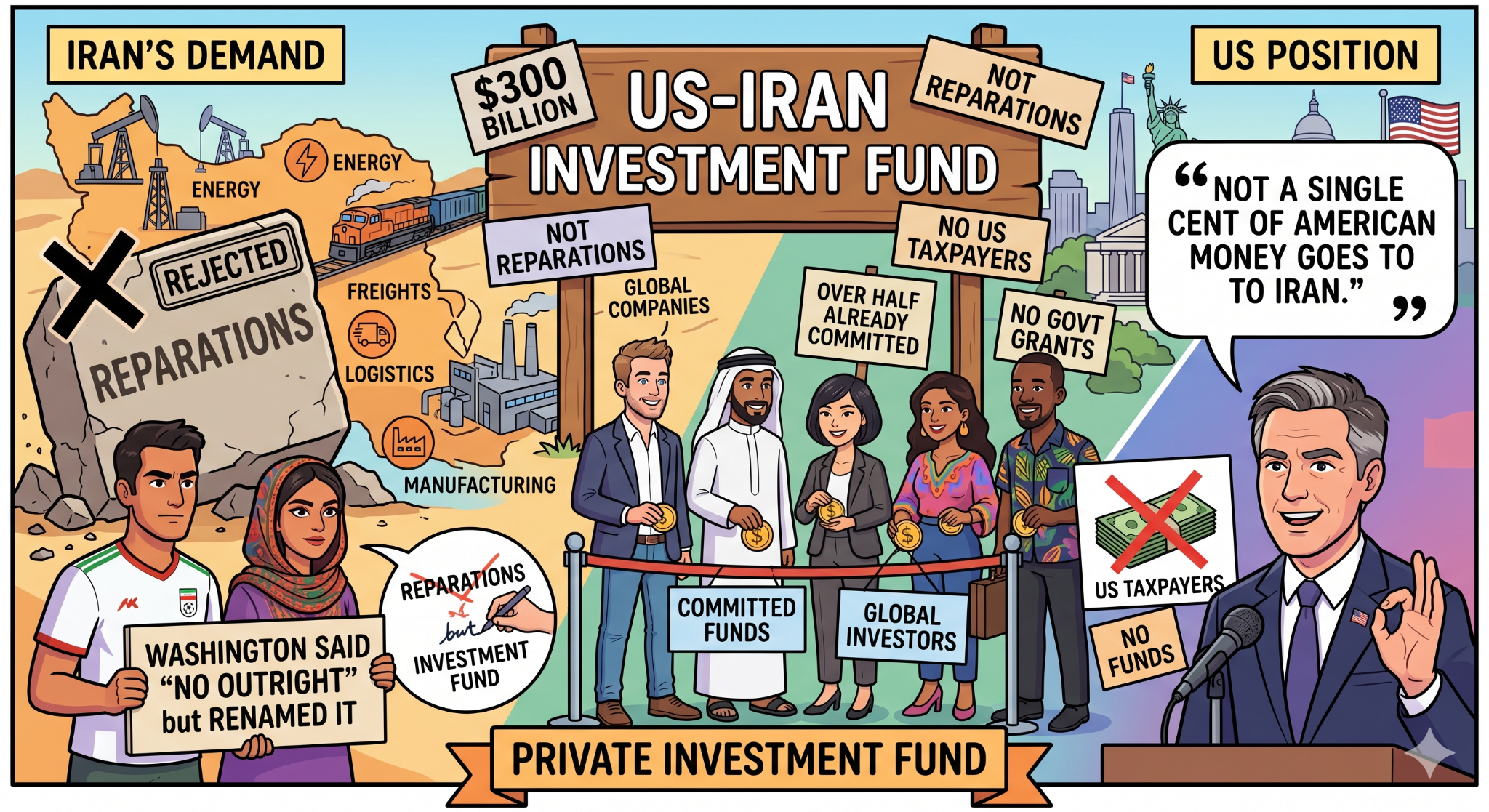
It's not a cheque. It's not reparations. And it's definitely not coming from US taxpayers.
On June 16, 2026, a source with direct knowledge told Reuters that a $300 billion private investment fund was written into the US-Iran framework agreement. More than half the money is already committed. Companies from the US, Gulf states, Asia, South America, and Africa are in. The sectors targeted are energy, logistics, manufacturing, and transport. No government grants involved.
Iran had originally pushed for reparations worth between $300 billion and $1 trillion for war damage. Washington didn't say no outright. It just renamed it. US diplomats dropped the word "reparations" entirely and called it an "international investment fund" instead. On June 15, 2026, VP JD Vance confirmed the fund is still in the deal. His exact words: “Not a single cent of American money goes to Iran.”
India imports over 85% of its crude oil needs. Nearly two-thirds of that crude and half of India's LNG travel through the Strait of Hormuz. When the conflict pushed that route close to shutting down, Brent crossed $100 a barrel. Fuel costs went up. Inflation followed. The rupee took a hit.
The moment Washington and Tehran announced a framework deal, markets reacted fast. Brent fell by almost 5%, trading at $83-84 per barrel. The rupee rose by 0.7% in one trading session and opened at ₹95.32. It went up to ₹94.95 during intraday trading and closed at ₹95.11.
GTRI founder Ajay Srivastava didn't mince words. “Any closure could send oil prices soaring, sharply inflating India’s import bill, worsening inflation, and putting pressure on the country's fiscal position,” he said. He also noted that a reopened Strait would stabilise energy markets and give the rupee room to recover.
Commerce Secretary Rajesh Agarwal said on June 15, 2026, "Many of the trade-related challenges could ease significantly if the peace deal holds and remains sustainable." Trump advisor Alex Bruesewitz called the $300 billion a "conditional incentive," not a handout. A senior US official confirmed to CNN that Iran gets nothing unless the Strait stays open and all deal conditions are met.
LoansJagat notes that the RBI's cumulative 125 basis point cut in 2025 already reduced total interest outgo by up to ₹7.71 lakh on a ₹50 lakh home loan. A sustained fall in crude below $85 could ease inflation further and create room for the RBI to cut rates again in 2026.
The $300 billion isn't America paying Iran. It's a private capital, tied to strict conditions. For India, the early signs are good, crude below $85 and a rupee that gained 0.7% in a single session. But it all hinges on 1 thing: the Strait of Hormuz staying open.
Is the $300 billion fund in the US-Iran deal American taxpayer money going to Iran?
No. The $300 billion is a private investment fund, not a government payment. Companies from the US, Gulf states, Asia, South America, and Africa are contributing. VP JD Vance confirmed on June 15, 2026, that no American money goes to Iran.
*T&C Apply
Will Iran get the full $300 billion as war compensation under Trump's peace deal?
No. Iran originally demanded $300 billion to $1 trillion in war reparations. The final deal reframes this as a conditional investment fund. Iran accesses it only if the Strait of Hormuz stays open and all deal terms are met, per a senior US official.
Related News Updates | |||









.png&w=3840&q=75)



