By continuing, you agree to LoansJagat's Credit Report Terms of Use, Terms and Conditions, Privacy Policy, and authorize contact via Call, SMS, Email, or WhatsApp
Disclaimer: The information published on LoansJagat is intended for general informational and educational purposes only and should not be considered financial, legal, or investment advice. Interest rates, loan terms, statistics, and other data may change over time and may vary by lender or source. Please verify the latest information and consult a qualified financial advisor or the respective Bank/NBFC before making any financial decisions.
Subscribe Now
About the author

LoansJagat Team
‘Simplify Finance for Everyone.’ This is the common goal of our team, as we try to explain any topic with relatable examples. From personal to business finance, managing EMIs to becoming debt-free, we do extensive research on each and every parameter, so you don’t have to. Scroll up and have a look at what 15+ years of experience in the BFSI sector looks like.
Related News
Simplify All Your Loans Into One Affordable EMI

Customers Served

Debt Consolidated

1200+ Reviews

Locations in India
Club all Loans & Credit Card Bills into Single EMI

Quick Apply Loan
Consolidate your debts into one easy EMI.

Takes less than 2 minutes. No paperwork.

10 Lakhs+
Trusted Customers

2000 Cr+
Loans Disbursed

4.7/5
Google Reviews

50+
Banks & NBFCs Offers
Other services mentioned in this article
Credit cards are rising fast in India, and so are overdue bills. In 2026, the smarter question is not “more cards”, it is “more control”.
India’s credit-card boom is colliding with early signs of repayment stress. On one side, usage is climbing: credit cards were “in force” as of May 2025, up 7% YoY, according to an industry note carried by IBEF.
On the other, delinquencies have ticked up. CRIF High Mark said the 91–180 DPD bucket rose to 7.6% as of June 2024 versus 6.5% in June 2023. Against this backdrop, adding cards without a plan is becoming a real risk for borrowers trying to protect their CIBIL profile.
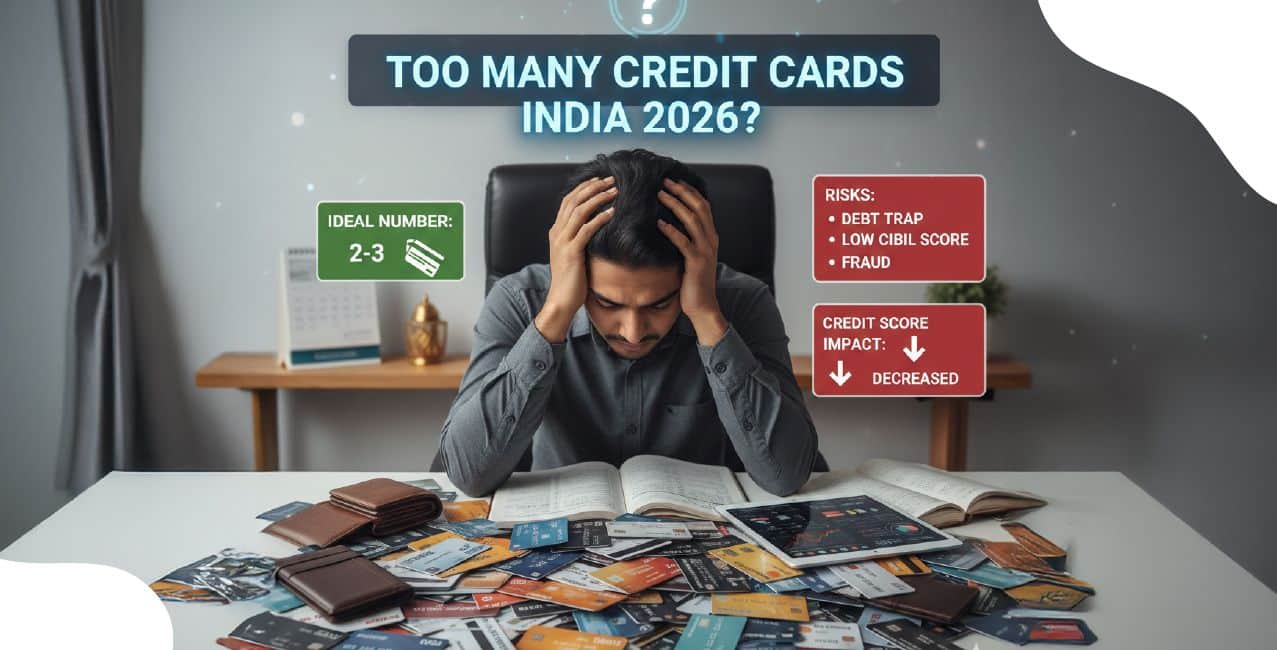
There is no legal ceiling on how many credit cards a person can own. The actual risk comes from behaviour: missing due dates, high utilisation, and frequent new applications. Experian’s guidance is blunt that “too many” is not a fixed number, it depends on whether a person can manage the accounts without slipping on payments or balances.
In India, lenders also watch credit behaviour closely when evaluating loans. LoansJagat explains credit utilisation with a simple example: if a card limit is ₹1,00,000 and spending is ₹30,000, utilisation is 30%.
For most working adults, the practical sweet spot in 2026 is 2–4 cards. Trade Brains, in its Feb 2026 explainer, frames this as ideal because it covers a primary card, a backup, and 1–2 reward-specific cards without creating tracking fatigue.
Globally, even real-world averages sit in this zone. Experian reported the average number of active cards was 3.7 in 2025 (US data, published Aug 15, 2025).
The logic is similar for Indian consumers: a few well-managed cards can keep utilisation smoother and offer redundancy if one card is blocked or compromised.
Before deciding the count, here is a clean way to map “how many cards” to “why”.
That range also aligns with how scoring risk builds. MyFICO notes that many applications close together can hurt more than a single application, because it signals higher risk.
LoansJagat adds a sharper consumer-facing estimate: 1 hard inquiry may lower a CIBIL score by 5–10 points, while 3 applications within 2 months could pull it down by 15–30 points.
Over the last 18–24 months, credit cards have shifted from niche to mass usage in India, and the spend numbers show it.
Business Standard reported credit-card spending moderated to ₹1.89 trillion in November 2025, after crossing ₹2 trillion in September and October 2025.
Times of India also reported November 2025 spends were 11.1% higher than a year earlier, while transaction volumes jumped 29% YoY (it cites about 390 million transactions in Nov 2024).
On volumes, ET BFSI reported about 0.49 billion credit-card transactions in September 2025, and said 48.7% of that volume was at PoS terminals. (ETBFSI.com)
Then came the stress indicators. CRIF High Mark’s Dec 13, 2024 update flagged the rise in 91–180 DPD delinquencies to 7.6% by June 2024.
Angel One later reported a further rise, citing CRIF data: 91–180 day overdue PAR at 8.2% in March 2025 versus 6.9% earlier, and 181–360 day overdues at 1.1% versus 0.9% in 2024.
Here is a quick snapshot of the key India indicators that shaped this debate.
*T&C Apply
This is why the “ideal number of cards” conversation has tightened. It is less about collecting cards and more about keeping utilisation and repayment clean, especially for borrowers planning loans.
Experian maintains that there is no universal “too many cards” number, and the right count depends on manageability and repayment discipline.
MyFICO warns that clustered applications can pull down scores because lenders view rapid credit-seeking as higher risk.
In India, CRIF High Mark and its media-cited updates show rising delinquency pockets, which pushes lenders to tighten underwriting and watch card behaviour more closely.
In 2026, 2–4 credit cards is a safe working range for most people, if bills are always paid on time and utilisation stays controlled. India’s latest spend and delinquency numbers show why discipline is now the real differentiator.









.png&w=3840&q=75)



