
By continuing, you agree to LoansJagat's Credit Report Terms of Use, Terms and Conditions, Privacy Policy, and authorize contact via Call, SMS, Email, or WhatsApp
Disclaimer: The information published on LoansJagat is intended for general informational and educational purposes only and should not be considered financial, legal, or investment advice. Interest rates, loan terms, statistics, and other data may change over time and may vary by lender or source. Please verify the latest information and consult a qualified financial advisor or the respective Bank/NBFC before making any financial decisions.
Subscribe Now
About the author

LoansJagat Team
‘Simplify Finance for Everyone.’ This is the common goal of our team, as we try to explain any topic with relatable examples. From personal to business finance, managing EMIs to becoming debt-free, we do extensive research on each and every parameter, so you don’t have to. Scroll up and have a look at what 15+ years of experience in the BFSI sector looks like.
Related Blog Post
Simplify All Your Loans Into One Affordable EMI

Customers Served

Debt Consolidated

1200+ Reviews

Locations in India
Club all Loans & Credit Card Bills into Single EMI

Quick Apply Loan
Consolidate your debts into one easy EMI.

Takes less than 2 minutes. No paperwork.

10 Lakhs+
Trusted Customers

2000 Cr+
Loans Disbursed

4.7/5
Google Reviews

50+
Banks & NBFCs Offers
Other services mentioned in this article
Key Takeaways
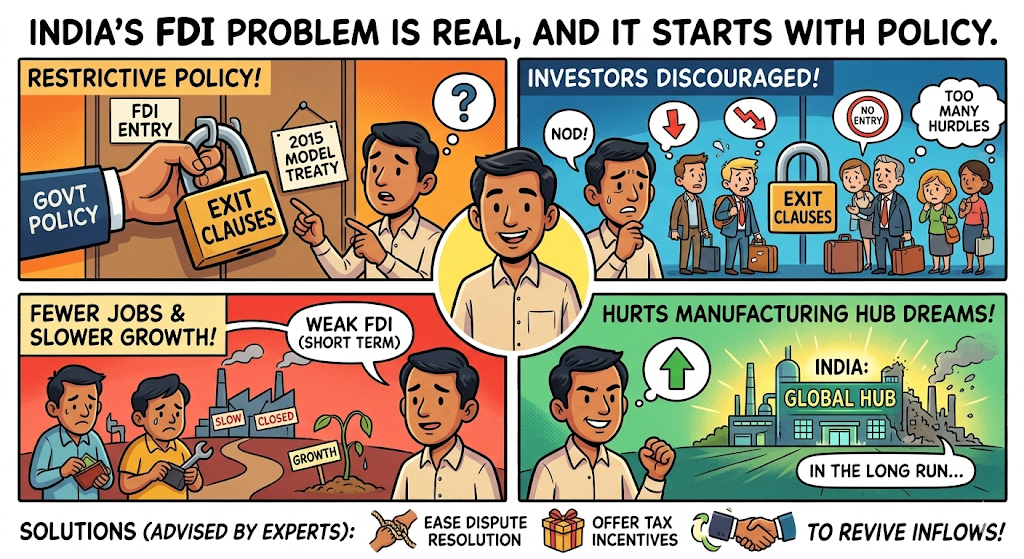
India should ease dispute-resolution procedures and offer tax incentives to revive foreign inflows, a former adviser to PM Narendra Modi said. The policy approach has become “restrictive”, said Surjit Bhalla, who was once in the PM’s Economic Advisory Council, in an interview.
The problem was the restrictive exit clauses that were introduced in India’s 2015 Model Bilateral Investment Treaty, said Bhalla. These clauses discouraged foreign investors from committing to the long term. Weak FDI in the short term means fewer jobs and slower growth. In the long run, it could hurt India’s prospects of becoming a global manufacturing hub.
Bhalla warned that not just foreigners, but even Indians, aren’t investing in India. “Private investment is not taking place. FDI has really declined into negative territory,” he said. When investment dries up, fewer factories are built, fewer people are hired, and wages stay stagnant.
Here is India’s FDI situation:
The government had cleared changes in FDI guidelines for countries sharing a land border with India in March 2026. The move aims to unlock inflows for startups and deep tech and set a 60-day decision timeline for critical sectors. But economists say this is not enough.
Bhalla suggested reverting to pre-2015 FDI norms, ending retrospective taxation, and offering export-linked incentives. He believes this could turn investor sentiment around faster than most expect.
Not all economists agree with the alarm.
Arvind Panagariya, who heads the 16th Finance Commission, described Bhalla’s views as “alarmist”. He cited average GDP growth of 7.3% over the last three years, and said gross fixed investment has remained steady at 31-32% of GDP. “There is no comparison between that situation and today's situation,” he said.
*T&C Apply
Both sides agree, however, that India must act. Simpler FDI rules, faster approvals, and fewer regulatory surprises will help.
As Bhalla put it, “Crises have been known to bring about reforms,” and with the government facing little political opposition, there is no better time to act boldly.
India’s FDI challenge is not about numbers alone. It’s about trust. Investors prefer clear regulations, fast clearances, and impartial dispute settlement mechanisms. The government’s efforts so far are minor, and bolder reforms are expected.
Why Are Foreign Investors showing hesitancy to invest in India amid its high growth?
Issues such as restrictive FDI policies, difficult exit processes, uncertain tax regime, and lack of robust dispute settlement mechanisms are issues that investors are facing in India. These are issues that are “causing apprehension to investors and lowering of private sector investment in India,” says Surjit Bhalla.
What should India do to attract foreign direct investment and increase manufactured exports?
Professional experts suggest that India must update its foreign direct investment (FDI) policies, create faster approval processes, and have a way to resolve disputes effectively. They should not impose retrospective taxes, and create export-linked incentives.









.png&w=3840&q=75)



