
By continuing, you agree to LoansJagat's Credit Report Terms of Use, Terms and Conditions, Privacy Policy, and authorize contact via Call, SMS, Email, or WhatsApp
Disclaimer: The information published on LoansJagat is intended for general informational and educational purposes only and should not be considered financial, legal, or investment advice. Interest rates, loan terms, statistics, and other data may change over time and may vary by lender or source. Please verify the latest information and consult a qualified financial advisor or the respective Bank/NBFC before making any financial decisions.
Subscribe Now
About the author

LoansJagat Team
‘Simplify Finance for Everyone.’ This is the common goal of our team, as we try to explain any topic with relatable examples. From personal to business finance, managing EMIs to becoming debt-free, we do extensive research on each and every parameter, so you don’t have to. Scroll up and have a look at what 15+ years of experience in the BFSI sector looks like.
Related News
Simplify All Your Loans Into One Affordable EMI

Customers Served

Debt Consolidated

1200+ Reviews

Locations in India
Club all Loans & Credit Card Bills into Single EMI

Quick Apply Loan
Consolidate your debts into one easy EMI.

Takes less than 2 minutes. No paperwork.

10 Lakhs+
Trusted Customers

2000 Cr+
Loans Disbursed

4.7/5
Google Reviews

50+
Banks & NBFCs Offers
Other services mentioned in this article
Key Takeaways
Your FD is Not Giving You 7.5%. Here is what it is Actually Giving You.
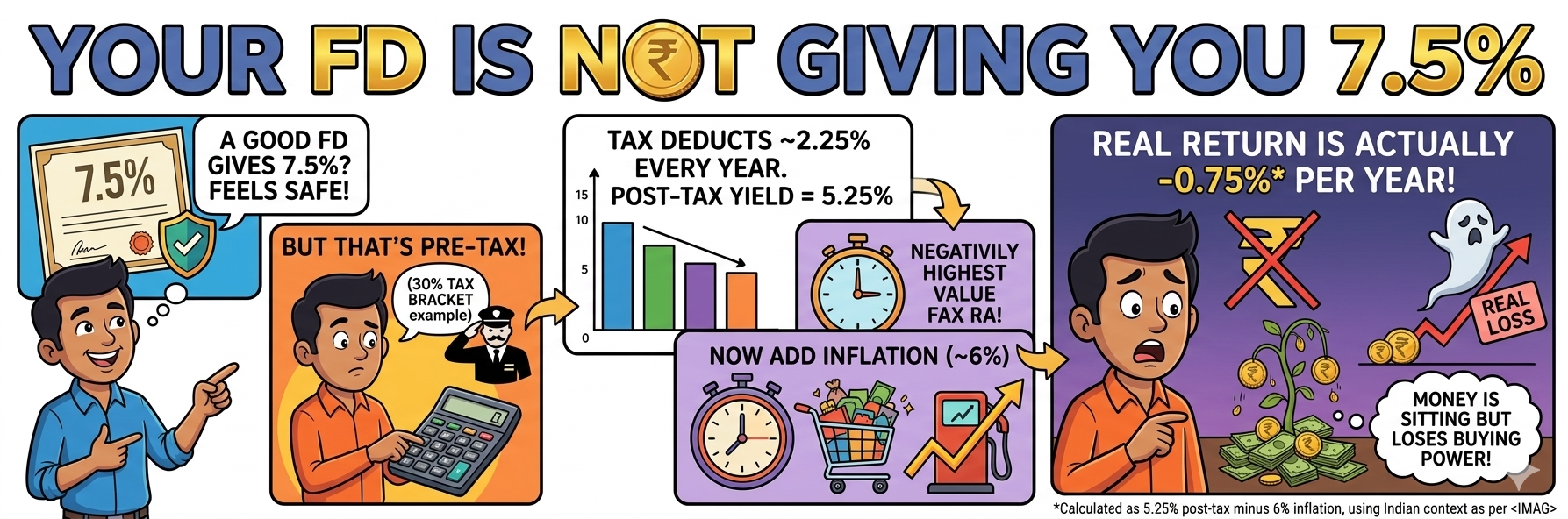
Most people renew their FD and move on. The certificate shows 7.5%, and it feels safe. But that number does not account for tax or inflation. For someone in the 30% tax bracket, the bank deducts tax on FD interest every year, even if you do not withdraw. The post-tax yield on a 6.5% FD works out to 4.55%.
Subtract inflation running near 6%, and you get a real return of -1.45% per year, according to Value Research’s analysis. The money sits in the bank. Prices rise faster than it grows. It loses buying power slowly.
India has tens of crores of retail FD investors, many of them in higher tax brackets. The negative real return problem is not limited to one bank or one rate. It applies to any FD at current rates for anyone paying 20% or 30% income tax.
Here is a direct comparison at the 30% tax slab, with 6% inflation:
The short-duration fund column does not show a guaranteed number. But its portfolio yield-to-maturity (YTM) sits above 7.5% right now. That is the expected annual yield from holding the fund’s current bond mix to maturity. The key difference is timing. FD tax hits every year. Debt fund tax hits only when you redeem.
Value Research’s analysis tracked 12 years of category returns. It found that short-duration direct plans outperformed FDs in 76% of comparable periods. The deferral advantage stayed intact, even after the April 2023 tax change that removed indexation benefits
The RBI had cut the repo rate from 6.5% in early 2025 to 5.25% by December 2025, a total of 125 basis points across four cuts. The 10-year G-Sec yield was sitting around 6.87% to 6.93% in late March 2026, more than 160 basis points above the repo rate.
When rates fall, bond prices rise. Short-duration fund investors captured that price gain mid-hold. FD investors just watched their renewal rate drop.
The practical steps are straightforward. Check the YTM of any short-duration fund, not its trailing one-year return. Subtract the expense ratio. If the net YTM exceeds your FD renewal rate, the fund is worth comparing seriously. Use the direct plan, not the regular plan. Regular plan fees run 40 to 80 basis points in this category and can wipe out the advantage entirely.
*T&C Apply
A 7.5% FD certificate is not a 7.5% return for most Indian investors. After tax and inflation, it is negative. Short-duration funds are not risk-free, and NAV can dip in a rate spike or credit event. But for investors with a one to three-year horizon who are in higher tax brackets, the math in 2026 no longer favours auto-renewing the FD.
1. Can a 7.5% FD still lose money after tax and inflation?
Yes. An FD at 7.5% could only be around 5.25% post tax if the tax bracket of the investor is high. In case inflation is at 6%, over time, your money loses value, and it becomes a negative return.
2. Are fixed deposits still good compared to short-duration debt funds in 2026?
FDs remain useful for safety and guaranteed returns. However, for investors in the 20% or 30% tax bracket, short-duration debt funds may offer better post-tax outcomes because taxes are paid only when the investment is redeemed, and the funds can also benefit when interest rates fall.









.png&w=3840&q=75)



