By continuing, you agree to LoansJagat's Credit Report Terms of Use, Terms and Conditions, Privacy Policy, and authorize contact via Call, SMS, Email, or WhatsApp
Disclaimer: The information published on LoansJagat is intended for general informational and educational purposes only and should not be considered financial, legal, or investment advice. Interest rates, loan terms, statistics, and other data may change over time and may vary by lender or source. Please verify the latest information and consult a qualified financial advisor or the respective Bank/NBFC before making any financial decisions.
Apply for Loans Fast and Hassle-Free
Subscribe Now
About the author

LoansJagat Team
‘Simplify Finance for Everyone.’ This is the common goal of our team, as we try to explain any topic with relatable examples. From personal to business finance, managing EMIs to becoming debt-free, we do extensive research on each and every parameter, so you don’t have to. Scroll up and have a look at what 15+ years of experience in the BFSI sector looks like.
Related Blog Post
Simplify All Your Loans Into One Affordable EMI

Customers Served

Debt Consolidated

1200+ Reviews

Locations in India
Club all Loans & Credit Card Bills into Single EMI

Quick Apply Loan
Consolidate your debts into one easy EMI.

Takes less than 2 minutes. No paperwork.

10 Lakhs+
Trusted Customers

2000 Cr+
Loans Disbursed

4.7/5
Google Reviews

50+
Banks & NBFCs Offers
Other services mentioned in this article
Key Takeaways:
We are all aware of how the government earns money from our taxes. But does it mean that the government gets more money when taxes are increased? It sounds logical.
In reality, things do not work like that. We never know what big plans the government is hiding from us. And probably, it's for our best that we remain unaware of such plans.
Still, most people think that taxes are fraud, so let me explain to you what really happens.
Sometimes, when the government raises taxes, it directly affects people’s earnings, spending, and investing limits. This process can directly affect the overall tax collection in the country. So how does the government manage such big decisions?
This is where the Laffer Curve helps the government. A Laffer curve economics is a way to balance the tax ratios. I know most of you are not from an economics background, so let’s understand this simply.
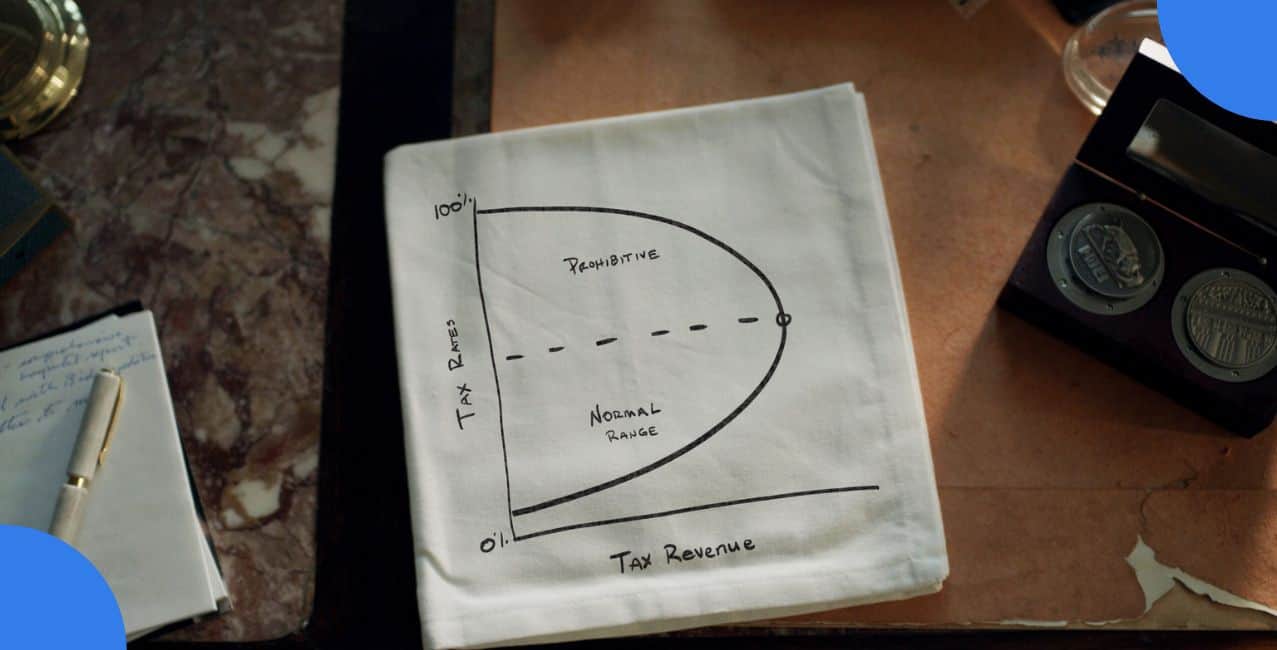
Talking in simple language, a Laffer Curve is an economic theory that tells us the relationship between the tax rates and government revenue. It suggests that there is an optimal rate that maximises the revenue. Think about it as a dot that connects the tax rates and government revenue.
Simple Explanation. If the tax rate is:
The concept of what is Laffer Curve in economics explains the focus point where the taxes are just the right amount. Meaning that the tax rates are not too high and not too low. However, most economists are still asking is the Laffer curve accurate. I guess we will never know.
The Arthur Laffer Curve has an almost story-like and interesting origin. Let me take you back to 1974, when an economist named Arthur Laffer sketched an idea on a restaurant napkin while discussing taxes. To date, that sketch is used as one of the most well-known concepts of economics.
The term Laffer Curve came into light in 1978 through a mainstream economic discussion by Jude Wanniski. Back then, the concept was not that much used, but today it is often explained in textbooks and used in public debates.
The economic world was introduced with the idea of the Laffer Curve a very long time ago. Famous economists like Milton Friedman, John Maynard Keynes, and Adam Smith already mentioned it. This idea is mostly used to evaluate the difference between the tax rates and government revenue. However, Arthur represented this in a much simpler way, so the world still remembers him.
Bonus Tip: Recently, a news item has been trending in the economic market that the Laffer Curve is no longer a punch line. This claims that the Laffer curve shows that tax cuts can increase revenue.
In real life, a Laffer curve is not just a drawing on a napkin; it is a big concept that can directly affect economic decisions. This simple drawing plays a big role in shaping the tax policies, especially in countries like the United States.
From a political perspective:
*T&C Apply
Both of the sides argue about the optimal point of taxation. The difference here is their belief; both of them think in different ways to achieve the same thing.
This fact is about a movie scene. In the movie “Ferris Bueller’s Day Off,” the economics teacher mentions the Laffer Curve in class.
He quoted, "The Laffer Curve. Does anyone know what this says? It says that at this point on the revenue curve, you will get the same amount of revenue as at this point."
This is where the famous Laffer Curve Ferris Bueller came from.
In the end, the main objective of a Laffer curve is to find balance in the economy. Taxes can never be measured as higher or lower; it is all about balance. There are points where lower works best, and sometimes the higher keeps the balance. Figuring out the exact balance is what makes this concept interesting. What makes it more connecting is that it helps make real-life decisions and everyday business choices. Tax debates are never straightforward, but there is always more to learn from each side.
Is there empirical evidence for the Laffer Curve?
There is some evidence, but they depend as per the country and situation. This is why it is not always consistent and conclusive.
What does “the Laffer curve is flat” mean for US tax policy?
It refers to the changes in tax rates that may not directly affect the government revenue in that range.
Is the Laffer curve accurate?
The Laffer curve can be a useful concept for discussion, but it may not work accurately in real-world situations.
What does the Laffer curve illustrate?
In simple words, it shows the relationship between tax rates and government revenue.
What is the Laffer Curve?
A Laffer curve is a concept that explains how tax rates affect government revenue.