By continuing, you agree to LoansJagat's Credit Report Terms of Use, Terms and Conditions, Privacy Policy, and authorize contact via Call, SMS, Email, or WhatsApp
Disclaimer: The information published on LoansJagat is intended for general informational and educational purposes only and should not be considered financial, legal, or investment advice. Interest rates, loan terms, statistics, and other data may change over time and may vary by lender or source. Please verify the latest information and consult a qualified financial advisor or the respective Bank/NBFC before making any financial decisions.
Subscribe Now
About the author

Vidhi Chauhan
Vidhi Chauhan is a copywriter and content writer with extensive experience creating high-quality, SEO-driven content across multiple industries, with a strong focus on fintech. She has written extensively on GST, banking, personal loans, business loans, credit cards, income tax, insurance, and other financial topics, helping Indian readers understand complex concepts through clear, accurate, and engaging content.
Related Blog Post
Simplify All Your Loans Into One Affordable EMI

Customers Served

Debt Consolidated

1200+ Reviews

Locations in India
Club all Loans & Credit Card Bills into Single EMI

Quick Apply Loan
Consolidate your debts into one easy EMI.

Takes less than 2 minutes. No paperwork.

10 Lakhs+
Trusted Customers

2000 Cr+
Loans Disbursed

4.7/5
Google Reviews

50+
Banks & NBFCs Offers
Other services mentioned in this article
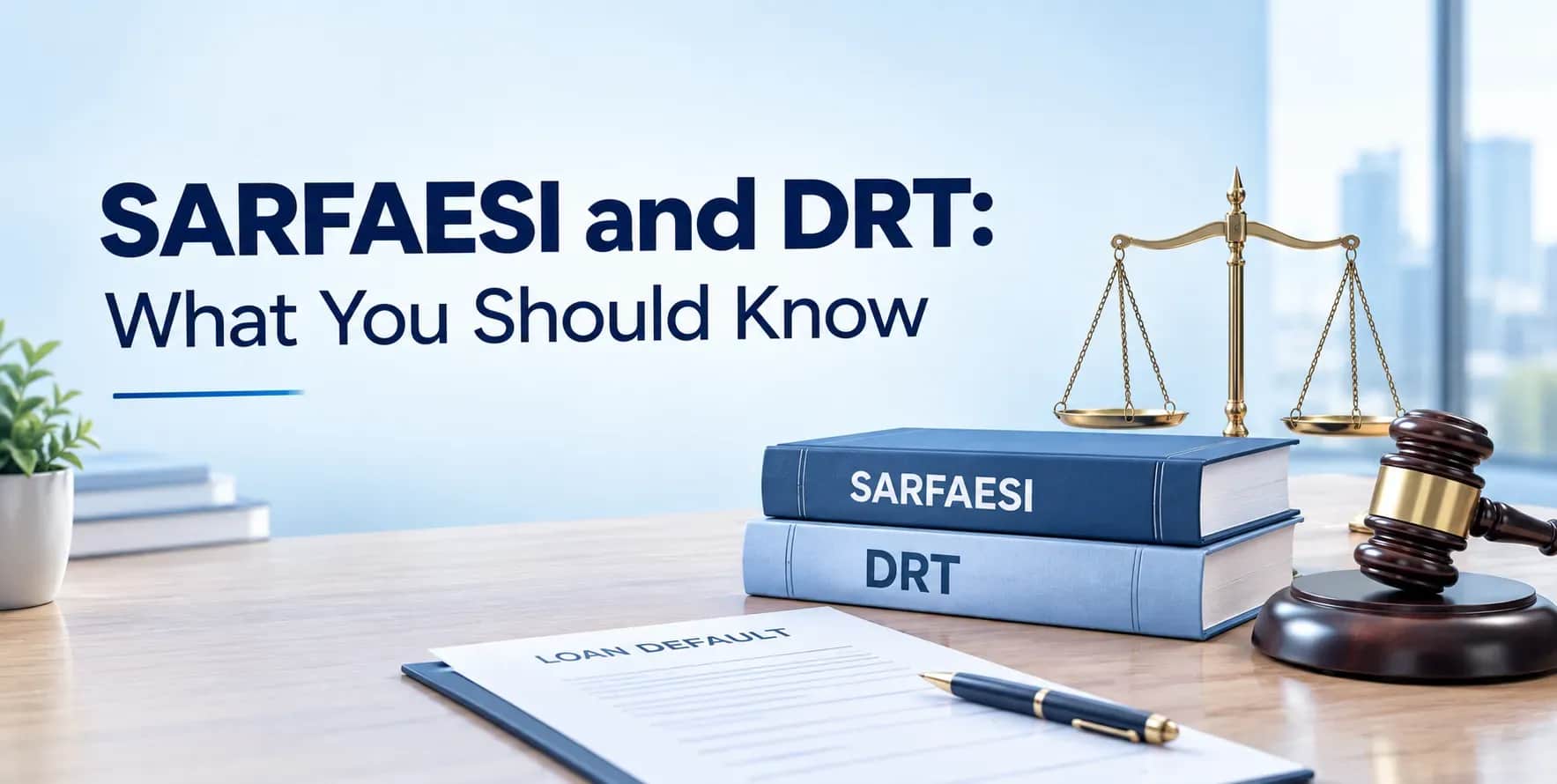
While SARFAESI and DRT present very different functions within India's debt recovery system, they are both important pieces. The SARFAESI Act, 2002 gives secured creditors the right to exercise security interests and collect secured debts as long as the prescribed conditions are satisfied. The DRT acts as a forum of law through which parties can oppose the actions taken under Section 13(4) of SARFAESI. Knowing what each of these processes entails will help the debtor to understand how and when DRT proceedings can be utilised, the time required, and the remedies available. The following paragraphs discuss these issues in detail.
Key Takeaways
The SARFAESI Act of 2002 was introduced to oversee the securitisation as well as the restructuring of financial properties, in addition to enforcing the security interests. The Act allows secured creditors to enforce security interests without the intervention of a court or tribunal, subject to the conditions prescribed under the Act.
The Enforcement of Security Interest is dealt with in Section 13 of the Act. In the event of a borrower’s default and the account being classified as a non-performing asset, a secured creditor is entitled to send a demand notice under the provisions of Section 13(2) requiring the borrower to repay his liability within 60 days. In case of failure to comply by the borrower, the secured creditor may adopt one or more measures permitted under Section 13(4) read with the Act and applicable rules.
The Debts Recovery Tribunal (DRT) is a specialised tribunal established under the Recovery of Debts and Bankruptcy Act, 1993, to adjudicate applications for the recovery of debts due to banks and financial institutions and facilitate the recovery of such debts. The DRTs deal with and facilitate the resolution of the cases relating to the recovery of dues to banks and financial institutions.
An individual who is unhappy with the actions of a secured creditor according to the SARFAESI Act can file a request with the Debt Recovery Tribunal as per Section 17 of the Act. Thus, SARFAESI serves as a recovery mechanism while the DRT provides a legal platform to challenge such mechanisms.
When the borrower feels aggrieved by the actions taken by the secured creditor under Section 13(4) of the SARFAESI Act, the borrower may file an application with the DRT, which examines whether the measures taken by the secured creditor are in accordance with the Act and the rules made thereunder.
For instance, under Section 13(4) of the SARFAESI Act, a secured creditor may take possession of secured assets, take over the management of the secured business in certain circumstances, appoint a manager to manage the secured assets, or require a person who has acquired secured assets from the borrower and from whom money is due or may become due to the borrower to pay the secured creditor an amount sufficient to discharge the secured debt.
The DRT mechanism is not merely another step in the loan recovery process but provides a legal recourse to an aggrieved party against measures undertaken by a secured creditor.
As per the provisions of the SARFAESI Act, restrictions on the jurisdiction of civil courts regarding cases that should fall under the adjudication of DRT or DRAT have also been provided under the Act.
The SARFAESI Act's Section 17 establishes the statutory remedy against such actions taken pursuant to Section 13(4) and permits a party aggrieved, which includes the borrower, to submit an application.
The plea generally must be submitted within 45 days from the time when the act mentioned in Section 13(4) occurs, as is provided by Section 17 as well.
It is necessary to differentiate a notice of demand under Section 13(2) from the measures enacted in Section 13(4). Section 13(2) states that the secured creditor must allow the borrower 60 days to clear the obligation once the relevant defaults and NPA conditions are satisfied, while the remedy for the actions pursuant to Section 13(4) is provided under Section 17.
This, therefore, signifies that the borrower must analyse the received notice, the conduct of the lender, and the related dates before turning to the DRT.
*T&C Apply
The DRT has the legal power to scrutinise actions taken by the creditor as stipulated by section 13(4) of the SARFAESI Act. It can assess if the actions conform to the Act and the appropriate regulations.
If, after examining the facts, circumstances and evidence, the DRT finds that a measure under Section 13(4) is not in accordance with the Act or applicable rules and requires restoration of possession, it may declare the measure invalid and restore possession to the borrower or other aggrieved person, as applicable.
Filing an application under Section 17 of the SARFAESI Act enables an aggrieved person to challenge measures taken under Section 13(4) before the DRT. The DRT may examine whether such measures comply with the Act and applicable rules and grant appropriate relief. The tribunal considers the legal provisions, facts, and documentation presented to it.
The DRT conducts its operations based on the legal regulations envisaged by the SARFAESI and Debt Recovery and Bankruptcy laws. It is thus necessary to differentiate between a legal challenge to a SARFAESI measure and a mere request for more time to repay the loan.
In a DRT proceeding under the SARFAESI Act, the Tribunal examines the measures taken by the secured creditor under Section 13(4) and may grant appropriate relief in accordance with Section 17.
For instance, a person taking out a loan against residential premises may face proceedings under SARFAESI while having other loans or credit card dues. The treatment of those obligations will be dependent on the agreements, legislation, and recovery procedures in question.
Borrowers are advised to keep track of all pending debts as well as realise the implications of defaulting under each of the agreements and laws involved.
By studying SARFAESI and DRT, borrowers can learn about the provisions available to them to protect their rights in secured debt recovery proceedings. However, one must also realise that while SARFAESI allows lenders to enforce security interests, DRT offers a way of contesting some of these steps. Being aware of timelines, applicable processes, and approaches for appeal can help them respond to the recovery steps that they are subjected to.
Borrowers may place evidence relating to the valuation and their objections before the appropriate forum.
Yes, borrowers have the right to approach their secured creditors to negotiate on repayment or settlement issues, which are subject to the terms and conditions of the secured creditors. It is important to record any such arrangements properly to avoid any future disputes.
No, there are certain conditions, exclusions, and limitations in the Act regarding the kinds of security interests that can be dealt with under SARFAESI. Therefore, the applicability of SARFAESI depends on the kind of loan that has been taken, the type of security provided, the creditor, and the applicable provisions of law.
It is advisable for borrowers to maintain certain loan-related documents, including loan-related communication with the lender, such as notices and other correspondence. Keeping a timeline of the events can help establish the facts if the lender's actions are disputed later on.
Yes, the guarantee, along with the nature of aspects of the debt as well as the laws applicable, would impact the guarantee. Hence, it is important for persons acting as guarantors to go through the relevant loan and guarantee documents and accordingly respond to any attempts to recover the dues.
Whether the sale of the secured asset would affect the borrower's rights and the amount of dues would depend on the nature of the sale. The borrower, therefore, needs to check the sale notification, sale procedure, and terms of sale.
Yes, recovery proceedings may include the seized assets in cases where the security interest covers them. The type of asset to be seized depends on the security documentation and applicable regulations.
Not really, since the consequences of repayment depend on the stage of the proceedings as well as the actions of creditors. Borrowers should get written confirmation from the lender regarding the state of the account and recovery.
The right to inspect documentation will depend on the case, laws, etc. If the documents are necessary for the legal case, then the borrower can ask for them through the proper channels.
Disagreement over the amount does not automatically stop recovery efforts. The borrower will need to file the dispute claiming the amount through the appropriate means with valid documentation.