Check AI Loan Optimisation Plans to Reduce Your EMI

Disclaimer: The information published on LoansJagat is intended for general informational and educational purposes only and should not be considered financial, legal, or investment advice. Interest rates, loan terms, statistics, and other data may change over time and may vary by lender or source. Please verify the latest information and consult a qualified financial advisor or the respective Bank/NBFC before making any financial decisions.
Subscribe Now
About the author

Anishka Bhadly is a content writer with a finance and business background. She has completed her bachelor's degree with a specialisation in finance and is currently pursuing an MBA in the finance field too. The knowledge she has gained from her studies and experience working with EdTech companies helped her combine theoretical knowledge with practical industry insight. Her expertise lies in creating well-researched, informative, and reader-friendly content in various banking, personal finance, loans, insurance, and investment-related topics.
Related Blog Post
Simplify All Your Loans Into One Affordable EMI

Customers Served

Debt Consolidated

1200+ Reviews

Locations in India
Club all Loans & Credit Card Bills into Single EMI

Quick Apply Loan
Consolidate your debts into one easy EMI.

Takes less than 2 minutes. No paperwork.

10 Lakhs+
Trusted Customers

2000 Cr+
Loans Disbursed

4.7/5
Google Reviews

50+
Banks & NBFCs Offers
Managing a start-up business will involve many tasks at once; controlling your company’s outgoings is an important task. Your business could incur many costs such as subscription fees for software, travel, and general day-to-day costs. A business credit card can help with this by separating your personal and business spending, keeping track of your spending, and helping you control your short-term cash flow. Certain cards may also offer rewards, increased credit limits, and other benefits. Find a card that suits your business’ spending, budget, and ability to repay.
Key Takeaways:

Business and personal credit cards have different characteristics, requirements, and purposes. Therefore, a specific card will seem more relevant to a person looking to make specific purchases.
By comparing the two cards’ fees, rewards, eligibility criteria, and repayment rules, a person can choose the most suitable one. All things considered, it is critical to determine what exactly is needed: tracking business expenses or making purchases on a personal level.
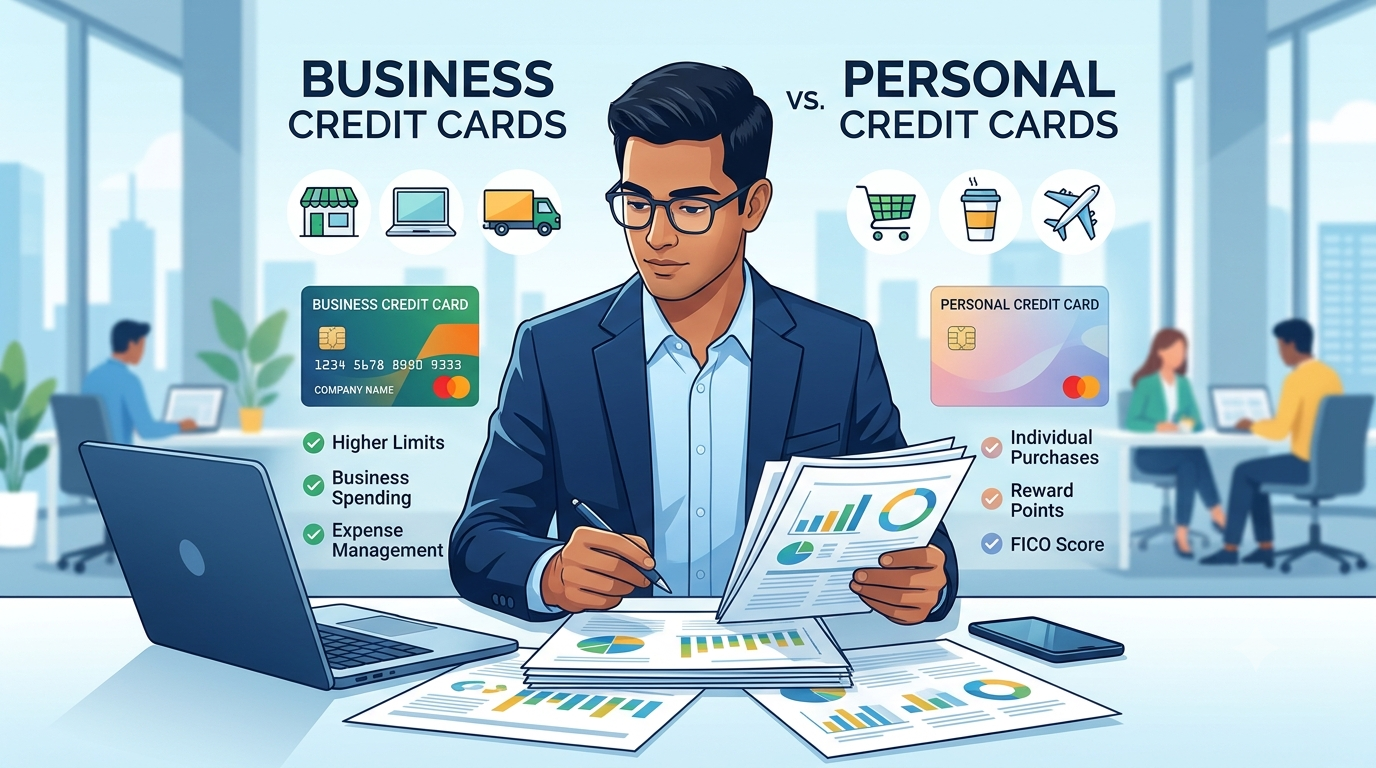
A business credit card can help start-ups in several ways. It allows them to manage expenses and track the payments made. Moreover, they offer some benefits and provide short-term credit, which can be useful for eligible purchases.
Business credit cards can be easier to get than some loans. You will need to satisfy the eligibility criteria of the provider and provide the correct documents.
With a business credit card, it becomes easier to separate personal and business expenses. It helps keep track of all the expenses, simplifies bookkeeping, and prepares tax documents. Moreover, it allows a start-up to monitor expenses.
Business credit cards may have various rewards and benefits depending on the issuing companies and specific cards. One can receive rewards, for example, for advertising, travel, and business purchases of office supplies. The benefits and their descriptions depend on the cards and the issuing companies.
With a business credit card, a start-up can pay for eligible purchases from a credit line. However, the credit line depends on the card and its issuing company. It is worth noting that some of the credit cards may have limits on the amount of money available and that the balance can accumulate interest.
Business credit cards help businesses manage and monitor employee expenses. Cards can be issued to employees so that the start-up owner can provide spending limits and monitor employee’s spending.
A business credit card may provide discounts or rewards on some expenses, for example, on travel, hotel bookings, tickets, etc. It is important to analyse which cards provide such benefits and also the details and restrictions of each.
A start-up business can use a grace period that some issuing companies provide. During this period, interest-free payments are possible. However, it is important to know that there are different conditions for different types of purchases. Thus, for example, a cash advance may not be interest-free.
A business credit card can help start-ups track expenses and manage short-term purchases. However, each card has specific terms and conditions, and one should study them and compare the offers.
Before applying for a business credit card, you should consider the different features they have to offer to help run your everyday business.
Business credit card rewards vary by issuer and card. Depending on the card, eligible purchases may include advertising, flights, hotel stays, shipping, and other business-related expenses. They can also give larger credit limits than those available on personal credit cards. These benefits should be compared to your startup business's usual spending habits.
Having a business credit card will make it easier to track your expenses by separating personal and business spending. Some credit cards will also offer expense reports and controls for employees to manage your spending.
Using a business credit card sensibly can help build your company's credit history if the provider reports your account to business credit reference agencies. Having a good credit history could help you apply for business loans, credit lines and more in the future. It is important to ensure you make payments on time.
Overall, start-ups should look at what their spending habits are, what their financial needs are and what they can afford to pay back. Check what benefits and fees are available and what the card reports in regard to business credit.
Selecting the most appropriate card will certainly assist start-ups in managing the business’s expenses, monitoring costs, and receiving attractive benefits. Some credit cards issued by different banks in India can be used for business, but one has to evaluate a few factors before applying.
Therefore, compare the features and benefits of different credit cards before applying. In addition, the credit card user must ensure that they meet the eligibility criteria of the issuing company to find the most suitable one for their monthly expenses and business needs.
Whilst a business credit card can help you with your day-to-day expenditure, it is also important to have a plan in place to pay back any money you borrow. Before you apply, take some time to compare the offers, perks, fees, and credit limits on offer. If your start-up requires any extra finances, then there are alternative options available. You can look at taking out a business loan or overdraft via LoansJagat. Compare the offers from different lenders and find a finance solution that will work for your business.
A business credit card helps start-ups manage business expenses, track spending, and access credit up to an approved limit.
Business credit cards are usually meant for business expenses, whereas personal ones are for private needs. However, there are varieties of both, and the criteria are set by the issuer.
Yes, you can use a credit card for your business to control your expenses. But you will need to meet certain criteria to get a business credit card. Some companies may ask you to show that you are registered as a business, have an income, or be an established business.
A start-up business can buy anything with the credit card that is allowed by the issuer, including advertising, travel, goods, and services.
A business credit card can provide liquidity to the start-up business, but the business should make well-thought decisions about spending and repayment and should not spend more money than it intends to earn.
Certain cards provide cashback, reward points or discounts on specific company purchases, depending on the terms and conditions of the card.
Some cards allow the issuance of additional cards to employees. Each card’s terms and conditions, including spending features and fees, may vary.
Depending on the card, it may be possible to build business credit history by reporting account information to a business credit bureau.
Depending on the terms and conditions of the card, purchases may be interest-free for qualifying purchases if the amount due is paid in full and on time.
Among other factors, start-up businesses should compare cards’ annual fees, interest rates, credit limits, rewards, availability of employee cards, eligibility requirements and terms of liability.
Start your journey today
Apply Now*T&C apply
Financial charges: 2.95% monthly (41.75% per annum) on retail purchases for individual-liability cards.