By continuing, you agree to LoansJagat's Credit Report Terms of Use, Terms and Conditions, Privacy Policy, and authorize contact via Call, SMS, Email, or WhatsApp
Disclaimer: The information published on LoansJagat is intended for general informational and educational purposes only and should not be considered financial, legal, or investment advice. Interest rates, loan terms, statistics, and other data may change over time and may vary by lender or source. Please verify the latest information and consult a qualified financial advisor or the respective Bank/NBFC before making any financial decisions.
Subscribe Now
About the author

Anishka Bhadly is a content writer with a finance and business background. She has completed her bachelor's degree with a specialisation in finance and is currently pursuing an MBA in the finance field too. The knowledge she has gained from her studies and experience working with EdTech companies helped her combine theoretical knowledge with practical industry insight. Her expertise lies in creating well-researched, informative, and reader-friendly content in various banking, personal finance, loans, insurance, and investment-related topics.
Related Blog Post
Simplify All Your Loans Into One Affordable EMI

Customers Served

Debt Consolidated

1200+ Reviews

Locations in India
Club all Loans & Credit Card Bills into Single EMI

Quick Apply Loan
Consolidate your debts into one easy EMI.

Takes less than 2 minutes. No paperwork.

10 Lakhs+
Trusted Customers

2000 Cr+
Loans Disbursed

4.7/5
Google Reviews

50+
Banks & NBFCs Offers
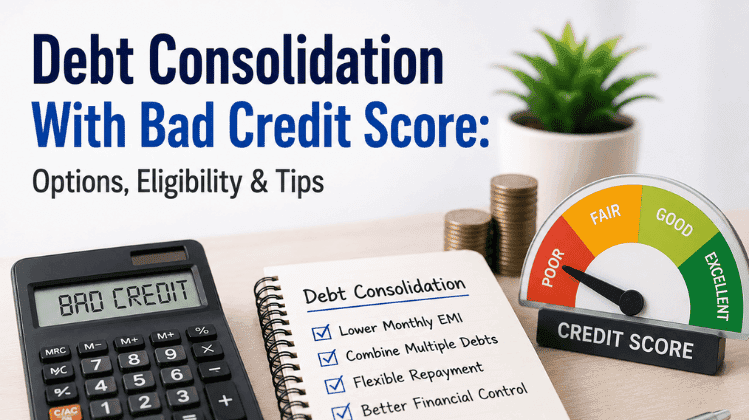
Dealing with more than one debt is often complicated, particularly if the individual has a low credit score. This may be challenging when trying to repay various bills or EMIs, including those with high rates of interest or missed payments. The best thing about consolidating debts is that it consolidates multiple debts into one payment with lower terms and conditions. However, it is essential to know that having a low credit score will restrict one’s options for consolidating debts, as well as the terms and conditions of such an arrangement. Most companies consider several aspects before finalising a loan application for debt consolidation, including income, responsibilities, and repayment history. It is therefore crucial to research and compare options before selecting the most appropriate option.
'Debt consolidation' refers to merging various debts, like personal loan repayments and credit card dues, among others, into a single instalment or scheme. It is, therefore, a means of combining multiple payments into a single one. In this regard, instead of managing several bills with different due dates, people can pay a single bill each month. One of the main goals of consolidation is to make a repayment process simpler and more convenient. In addition, in some cases, depending on the conditions, it can also be lower cost, but it cannot reduce the amount of debt itself.
The CIBIL score needed for a debt consolidation loan can differ based on the lender and the borrower’s creditworthiness. While some lenders may ask for a higher CIBIL score, others may have a lower score requirement. Apart from the CIBIL score, your income, EMIs, repayment history, and overall financial status are also taken into account. Moreover, two individuals with the same CIBIL score may get different offers from various lenders. If you have a lower CIBIL score, it may be challenging to get an unsecured consolidation loan, and you must explore other repayment options apart from a consolidation loan.
When consolidation loans get denied, you may want to explore some other options to manage your debts. The best option would depend on your ability to repay the loan, credit profile, and overall financial position. Here are a few options that you can consider before taking up another loan that you may not be able to repay.
Each of these options would have its own pros and cons, and you should evaluate which option would be the most viable for you based on your repayment capacity. It is important to make selections on a programme which fits your ability to repay instead of choosing a programme which may put you in a position where you are unable to make payments.
Debt consolidation and debt settlement are two separate strategies of paying off debts. While consolidation merges debts under one new form of payment, settlement aims to pay off less than what was initially owed.
Check the comparison below to understand the key differences between these two:
Neither of the two options, debt consolidation or settlement, is better in all situations. It depends on the borrower’s ability to repay his or her debts. If the client can make payments, consolidating debt is a better option because it allows the person to pay off debts systematically. In contrast, negotiating debts makes sense when an individual is unable to pay back all money owed to the lender. Settling debts negatively affects the borrower’s credit rating and should be used sparingly because it might harm one’s ability to secure future loans.
LoansJagat can assist you by providing information on various loan options, eligibility criteria, interest rates, and repayment terms. It can help you to compare and contrast different offers and understand the total cost of borrowing. However, it is advisable to evaluate your repayment capacity and select the most suitable option.
Read Also : ATM Withdrawal Limit & Transaction Charges in India: Rules and Limits
Consolidating debt with bad credit is doable; however, it is not a magic bullet. It is critical to consider your budgetary constraints and ability to repay any new loan. Additionally, the amount of debt and collateral you hold are important factors in determining whether consolidation is a viable option. Although consolidation can make life easier by lowering the amount of money owed or providing more favourable repayment terms, a costly consolidation loan can actually exacerbate financial problems, so the overall cost of borrowing should always be taken into account.
Yes, but you may not get a consolidation loan easily. Moreover, the income, existing EMIs, and repayment history also matter.
There is no specific CIBIL score required to consolidate debt. Every lender has different eligibility criteria based on which they approve or reject the application.
It may reduce EMI if the interest rate is lower and/or the tenure is longer. However, a longer tenure may increase the overall interest amount.
Yes, you can consolidate credit card dues with a personal loan if you are eligible for one and the interest rate is lower than your credit card issuer’s rate.
Taking a new loan for debt consolidation may impact your CIBIL score. However, if you maintain a good repayment record, it should not affect you.
You can choose to restructure your existing loan, extend the repayment tenure, take a secured loan or even negotiate repayment terms with the lender.
No, debt settlement refers to negotiating with your lender to pay back a lesser amount than you actually owe on a loan, whereas debt consolidation refers to combining multiple debts into a single consolidated debt.
Yes, you can apply for personal or unsecured loans in order to pay off your various debts; however, you may be subjected to different credit and income requirements.
If the terms and conditions of a consolidated loan do not impose a significant burden on your finances, then yes.
LoansJagat can advise you on the kind of loan you wish to choose and the eligibility, terms and conditions associated with it.