By continuing, you agree to LoansJagat's Credit Report Terms of Use, Terms and Conditions, Privacy Policy, and authorize contact via Call, SMS, Email, or WhatsApp
Disclaimer: The information published on LoansJagat is intended for general informational and educational purposes only and should not be considered financial, legal, or investment advice. Interest rates, loan terms, statistics, and other data may change over time and may vary by lender or source. Please verify the latest information and consult a qualified financial advisor or the respective Bank/NBFC before making any financial decisions.
Subscribe Now
About the author

Darshana Patel is a finance and tech writer with a strong background in journalism, financial economics, and political science, working with Loans Jagat. She has immense experience writing content through her previous work in fintech and edtech companies. Her contribution at Loans Jagat is to simplify finance-backed content and academically powered content for the readers.
Related Blog Post
Simplify All Your Loans Into One Affordable EMI

Customers Served

Debt Consolidated

1200+ Reviews

Locations in India
Club all Loans & Credit Card Bills into Single EMI

Quick Apply Loan
Consolidate your debts into one easy EMI.

Takes less than 2 minutes. No paperwork.

10 Lakhs+
Trusted Customers

2000 Cr+
Loans Disbursed

4.7/5
Google Reviews

50+
Banks & NBFCs Offers
Other services mentioned in this article
In India, several banks offer a loan against property to people. Each bank has its own criteria for eligibility to give this loan, which include credit score, income, credit history, age, and employment status. India specifically follows the CIBIL score to analyse the creditworthiness for loans against property or others. The range is decided between 300 and 900 credit scores, as these are the standard margins for the credit score which is followed. A loan against property is a loan taken by keeping the property as collateral in exchange for funds, and every bank in India has its own policies and criteria for it. Similarly, people with diverse options often get confused, and to mitigate this confusion, LoansJagat provides accurate and authentic information to them in the banking and finance fields.
Also Read: How Much Loan Can You Get Against Property?
In India, a loan against property is a loan taken after keeping the property as collateral in exchange for funds provided by the banks. Each bank or lender offers the loan up to a certain percentage of the property’s worth; this is known as the loan-to-value ratio.
For example, if your property is worth ₹1 crore, you can keep it as collateral to a bank in exchange for funds. Suppose your bank gives 85% on it, analysing your credit score, age, employment status, credit history, etc. It means you will get ₹8,500,000 as a loan from the bank, which you can utilise for your personal or commercial use.
Hence, these are the major features of the loan against property one needs to understand.
In India, the credit score estimates your creditworthiness. In short, it shows whether you are really capable of paying the loan back to the bank, how you can manage your finances, etc.
A credit score can help a bank to determine your interest rates, fix the loan amount and approval timing, understand default risk, etc., for a loan against property. Lowering the credit score means higher interest rates, longer approval timing, and high default risk. Whereas, if the credit score is excellent or high, it means lower interest rates, faster approval timings, and low default risk.
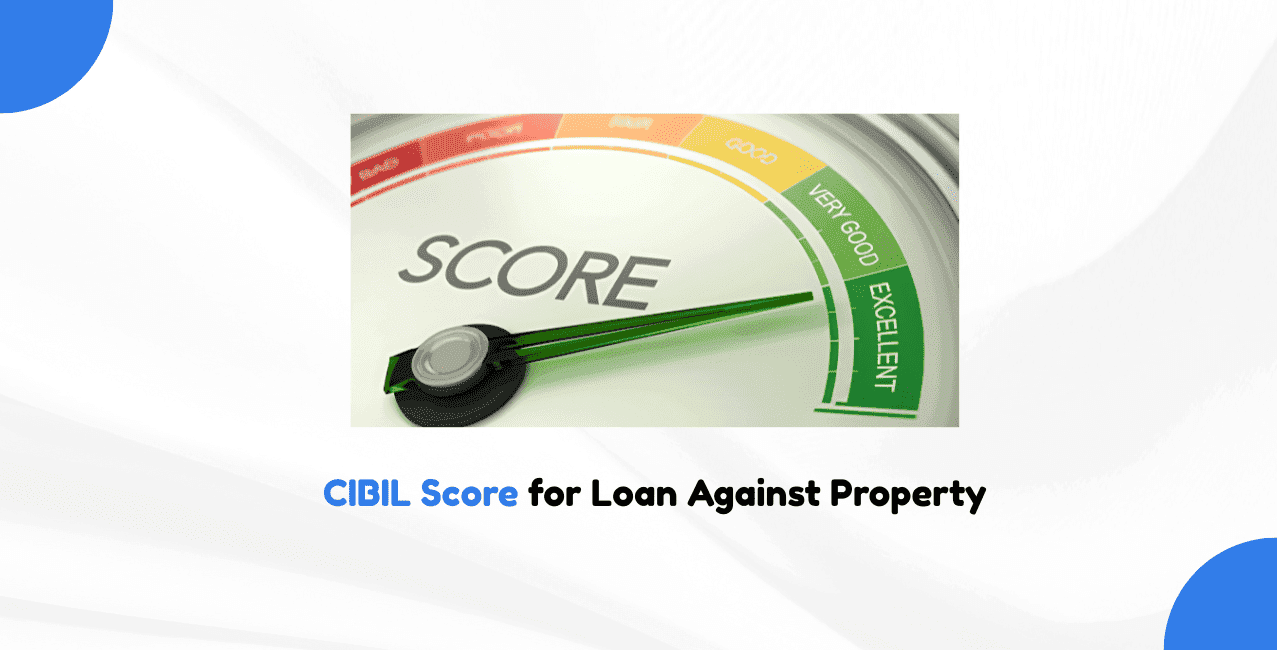
In India, the credit score is estimated through the CIBIL score, ranging between 300 and 900.
A credit score above 750+ can lead to easy loan approval against property. Whereas any score above 700 is considered good. Moreover, a 900 credit score is considered an ideal score, which is rare, but one can get many benefits with easy loan approvals, lower interest rates and higher loan amounts.
Hence, this is how the credit score affects the aspects of a loan against property from the banks.
There is no standard margin for all the banks in India to get a loan against property. Each bank has a different margin for the credit score that people need to have to get a loan against property.
Here are the banks providing loans against property with eligible credit scores:
*T&C Apply
Hence, these are the minimum CIBIL scores needed for the loan against property in different banks.
Bottom line:
In India, many banks provide loans against property to people with different eligibility criteria. The minimum credit score for the banks in India varies because some accept a credit score of 750 as the minimum CIBIL score for easy loan approval. Some also accept 700, but the loan approvals become a little tougher. A loan against property is the concept of keeping your property as collateral and taking funds as a loan in return from banks. In the same way, LoansJagat provides the proper up-to-date information to people related to such topics.
FAQs:
A loan against property is a loan taken by people by keeping their property as collateral with the bank.
Yes, a CIBIL score matters for a loan against property.
India follows the credit score range between 300 and 900.
ICICI Bank needs a credit score of 750 as the minimum range for the loan against property.
A loan against property is a secured loan, and the loan can be used for personal and commercial purposes.
One should always check the eligibility criteria and the processing fees that the banks are applying to people for the loan against property.
No, a home loan is a loan specifically taken for buying a house. Whereas a loan against property is a loan taken for personal or commercial use by keeping the property as collateral.
Yes, one can keep their own house for a loan against the property.
IDFC First Bank’s minimum credit score requirement is 750 for a loan against the property.
Yes, it does matter because it helps the bank to determine the loan-to-value ratio.