By continuing, you agree to LoansJagat's Credit Report Terms of Use, Terms and Conditions, Privacy Policy, and authorize contact via Call, SMS, Email, or WhatsApp
The information published on LoansJagat is intended for general informational and educational purposes only and should not be considered financial, legal, or investment advice. Interest rates, loan terms, statistics, and other data may change over time and may vary by lender or source. Please verify the latest information and consult a qualified financial advisor or the respective Bank/NBFC before making any financial decisions.
Subscribe Now
About the author

Ananya Shrivastava
Ananya Shrivastava is a Content Writer specialising in finance-focused news, blogs, and long-form articles on Indian markets, RBI policy, personal finance, and lending. She has authored over 450 blogs and 250 news pieces, combining technical knowledge with rigorous research to simplify complex financial concepts into clear, engaging content. With a marketing-driven lens and sharp editorial judgment, she consistently achieves top Google rankings while ensuring every claim is backed by verified data.
Related Blog Post
Simplify All Your Loans Into One Affordable EMI

Customers Served

Debt Consolidated

1200+ Reviews

Locations in India
Club all Loans & Credit Card Bills into Single EMI

Quick Apply Loan
Consolidate your debts into one easy EMI.

Takes less than 2 minutes. No paperwork.

10 Lakhs+
Trusted Customers

2000 Cr+
Loans Disbursed

4.7/5
Google Reviews

50+
Banks & NBFCs Offers
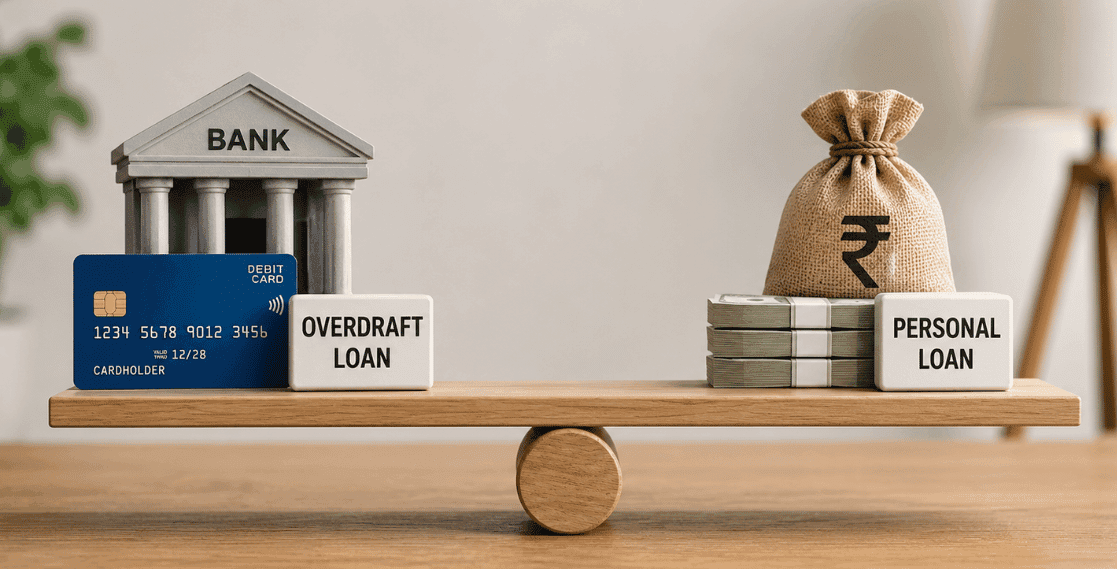
An overdraft loan lets you dip below zero in your account, up to a pre-set limit, and you only pay for what you actually use. A personal loan works differently. You get the whole amount upfront and pay EMIs on all of it from day one. HDFC Bank's Overdraft Against Fixed Deposit charges just 2% above your FD rate, while personal loans start at 9.99% p.a.
SBI's overdraft against deposit facility charges just 1% over your FD rate, a fraction of what a typical personal loan would cost you.
Need cash fast, whether it's a business gap, an emergency bill, or something you've been planning for a while, and you're stuck weighing overdraft loan vs. personal loan. This is for anyone in India trying to figure out which of these two actually fits their situation. We'll cover how each one really works, why the interest calculation matters so much, who qualifies, what paperwork you'll need, and a real cost comparison to help you land on the right choice.
It's a facility that lets you pull out more than is sitting in your account, up to a limit the bank's already approved, and you only pay interest on what you've actually used.
This isn't some separate loan sitting off on its own. It's tied directly to your existing savings, current, or fixed deposit account. As per HDFC Bank's overdraft against FD, you can move funds out through NEFT, RTGS, or a regular transfer. Your Fixed Deposit keeps earning interest the whole time it's backing your overdraft. You can link it to either a savings or current account, and cancelling it whenever you're done is as simple as logging into NetBanking.
A personal loan hands you a full lump sum in one shot, no strings to any collateral, and you pay it back through fixed EMIs over whatever tenure you've agreed to.
No Fixed Deposit needed here. Your income and credit score do the work instead. HDFC Bank's personal loan lists rates starting at 9.99% p.a. for salaried customers who qualify. Once that money lands in your account, interest starts ticking on the entire amount right away, whether you spend it all that same week or let half of it just sit there.
Overdraft interest only kicks in on whatever you've actually pulled out, and only for the days you've held onto it. Personal loan interest, on the other hand, runs on the full amount from the moment it's disbursed, right through the entire tenure.
| Aspect | Overdraft Against FD | Personal Loan |
| Interest base | Amount withdrawn only | Entire sanctioned amount |
| Interest duration | Days the amount was held | Full loan tenure |
| Typical rate | 1% to 2% above FD rate | Starting at 9.99% p.a. |
| Cost of unused funds | None | Interest still applies |
HDFC Bank's Overdraft Against FD is priced at 2% above the deposit's FD rate, with interest calculated only on the drawn portion. SBI prices its equivalent facility at 1% above the deposit rate under the same usage-based structure. A personal loan does not offer this flexibility, since interest accrues on the full sanctioned sum from disbursement.
Overdraft eligibility usually hinges on having an existing Fixed Deposit or the right kind of salary account, while a personal loan comes down mostly to your income, job stability, and credit score.
Overdraft Against Fixed Deposit
Eligibility rests entirely on holding a qualifying FD, not on income or credit history.
| Criterion | HDFC Bank | SBI |
| Minimum FD amount | ₹25,000 | ₹25,000 |
| Minimum FD tenure | 6 months, 1 day | Not specified for minimum; deposit must be active |
| Maximum overdraft limit | Up to 90% of FD value | Up to 90% of FD value, capped at ₹5 crore |
| Eligible depositor types | Individuals, HUFs, private and public limited companies | Single account holders (online); joint holders via branch only |
| Excluded FD types | Not specified | Tax-saving FDs and Recurring Deposits are not eligible |
| Minimum residual FD period | 6 months, 1 day | 6 months (for NRI deposits under this facility) |
This FD-backed structure explains why HDFC Bank and SBI need no income proof for overdraft approval.
Personal Loan
Eligibility is assessed on the borrower's financial profile rather than any asset pledged.
| Criterion | Requirement |
| Collateral | None (unsecured) |
| Primary basis | Income, credit score, employment stability |
| Employment type | Salaried or self-employed, per lender policy |
| Credit score | Higher scores typically unlock lower rates |
| Documentation basis | Income and identity proof substitute for collateral |
Because no FD or asset is securing a personal loan, the bank's risk assessment shifts entirely to the applicant's repayment capacity, which is why income proof and credit checks carry more weight than they do for an FD-backed overdraft.
An overdraft against FD barely needs any paperwork since your own deposit is already backing it, but a personal loan needs the full income and identity documentation since there's nothing securing it.
Here's roughly how that splits:
For an overdraft against FD:
A simple activation request, often done entirely through NetBanking
For a personal loan:
Since your own FD is the security backing an overdraft, banks skip most of the income digging a personal loan would otherwise put you through.
Here's how these two actually stack up side by side, on the things that matter when you're deciding.
| Factor | Overdraft Loan (Against FD) | Personal Loan |
| Collateral required | Yes, an existing Fixed Deposit | No, unsecured |
| Interest charged on | Only the amount withdrawn | The entire sanctioned amount |
| Typical interest rate | 1% to 2% above FD rate | Starting at 9.99% p.a. |
| Repayment structure | Flexible, repay anytime | Fixed monthly EMIs |
| Maximum amount | Up to 90% to 95% of FD value | Based on income and credit profile |
| Processing time | Can be instant for eligible customers through NetBanking | A few days to a week |
| Best suited for | Short-term, fluctuating fund needs | Larger, planned, one-time expenses |
Go with an overdraft if you've already got a Fixed Deposit and just need flexible access for something short-term. Go with a personal loan if you need a bigger chunk of money for something planned, and you don't have a deposit to lean on.
| Situation | Better Option |
| You already hold a Fixed Deposit | Overdraft |
| Funding need is short-term or uncertain in amount | Overdraft |
| You want to repay on your own schedule | Overdraft |
| Funding need is large and clearly defined | Personal Loan |
| Expense is planned, such as a wedding or renovation | Personal Loan |
*T&C Apply
| You have no FD to draw against | Personal Loan |
An overdraft suits situations where the amount or duration of need is not fixed in advance, since interest applies only to actual usage. A personal loan suits a defined, one-time expense where predictable EMIs are preferred. Without an FD, a personal loan is generally the only available option between the two.
Suresh's Case: Cost Comparison
Suresh needs ₹3,00,000 to bridge a temporary cash flow gap in his business. He holds a ₹4,00,000 Fixed Deposit with HDFC Bank earning 7% p.a.
| Factor | Overdraft Against FD | Personal Loan |
| Interest rate | 9% (2% above FD rate) | 9.99% p.a. |
| Interest charged on | ₹3,00,000, the amount withdrawn | ₹3,00,000, the full sanctioned amount |
| Interest period | 45 days, until client payment clears | Entire loan tenure |
| Repayment structure | Repaid once funds are received | Fixed EMIs regardless of cash flow |
The overdraft costs less here because interest is calculated only on the amount used and only for the days it remained outstanding. The personal loan would have charged interest on the full ₹3,00,000 for the entire tenure, independent of when Suresh's cash flow recovered.
Choosing between an overdraft loan and a personal loan really just comes down to what you've already got and what you actually need the money for. Got a Fixed Deposit sitting there and a need that's short-term or a bit unpredictable? An overdraft against it keeps your costs down and gives you room to breathe on repayment. Planning for something specific and bigger, with no deposit to fall back on? A personal loan's the more practical route. Just go in knowing you're committing to fixed EMIs on the full amount right from month one.
An overdraft only charges you for what you withdraw. A personal loan charges you interest on the entire amount the moment it's disbursed.
Yes. Overdraft rates against an FD sit at 1% to 2% above your deposit rate, while personal loans typically start near 9.99% p.a.
Yes, usually an existing Fixed Deposit. A personal loan needs none, it's unsecured.
Up to 90% with HDFC Bank, or as much as 95% with SBI, depending on which bank you're with.
₹25,000, confirmed on both HDFC Bank's and SBI's own pages.
Yes, that's the flexible part, unlike a personal loan's fixed EMI schedule.
PAN, Aadhaar, salary slips or ITR, and your recent bank statements.
Yes, since you get the full amount upfront with predictable EMIs, works well for things like weddings or renovations.
No, your FD stays completely intact and keeps earning interest the whole time.
An overdraft against an FD you already hold is often instant through NetBanking. A personal loan usually takes a few days to a week.