By continuing, you agree to LoansJagat's Credit Report Terms of Use, Terms and Conditions, Privacy Policy, and authorize contact via Call, SMS, Email, or WhatsApp
The information published on LoansJagat is intended for general informational and educational purposes only and should not be considered financial, legal, or investment advice. Interest rates, loan terms, statistics, and other data may change over time and may vary by lender or source. Please verify the latest information and consult a qualified financial advisor or the respective Bank/NBFC before making any financial decisions.
Subscribe Now
About the author

Diwaker Sharma is a finance content specialist with expertise in banking, personal finance, credit cards, loans, fintech, and financial news. An MBA in Finance with prior experience in the banking sector, he combines industry knowledge with SEO and content strategy to produce insightful, research-backed articles. Passionate about making finance accessible, he transforms complex financial concepts into clear, engaging content that empowers readers to make smarter financial decisions with confidence.
Related Blog Post
Simplify All Your Loans Into One Affordable EMI

Customers Served

Debt Consolidated

1200+ Reviews

Locations in India
Club all Loans & Credit Card Bills into Single EMI

Quick Apply Loan
Consolidate your debts into one easy EMI.

Takes less than 2 minutes. No paperwork.

10 Lakhs+
Trusted Customers

2000 Cr+
Loans Disbursed

4.7/5
Google Reviews

50+
Banks & NBFCs Offers
From 1 January 2026, RBI's Pre-payment Charges on Loans Directions, 2025, require regulated entities not to charge foreclosure or prepayment charges on floating-rate loans sanctioned to individuals for non-business purposes. This applies to loans given to people for personal use (not business) when the loan starts or gets renewed on or after that date. Fixed-rate loans can still have early payment fees as per the lender’s rules. Lenders also have to give you a Key Fact Statement before you sign. It shows the full cost of the loan, including the yearly rate. These changes help people understand the loan better and close it early without extra cost if the rate is floating.
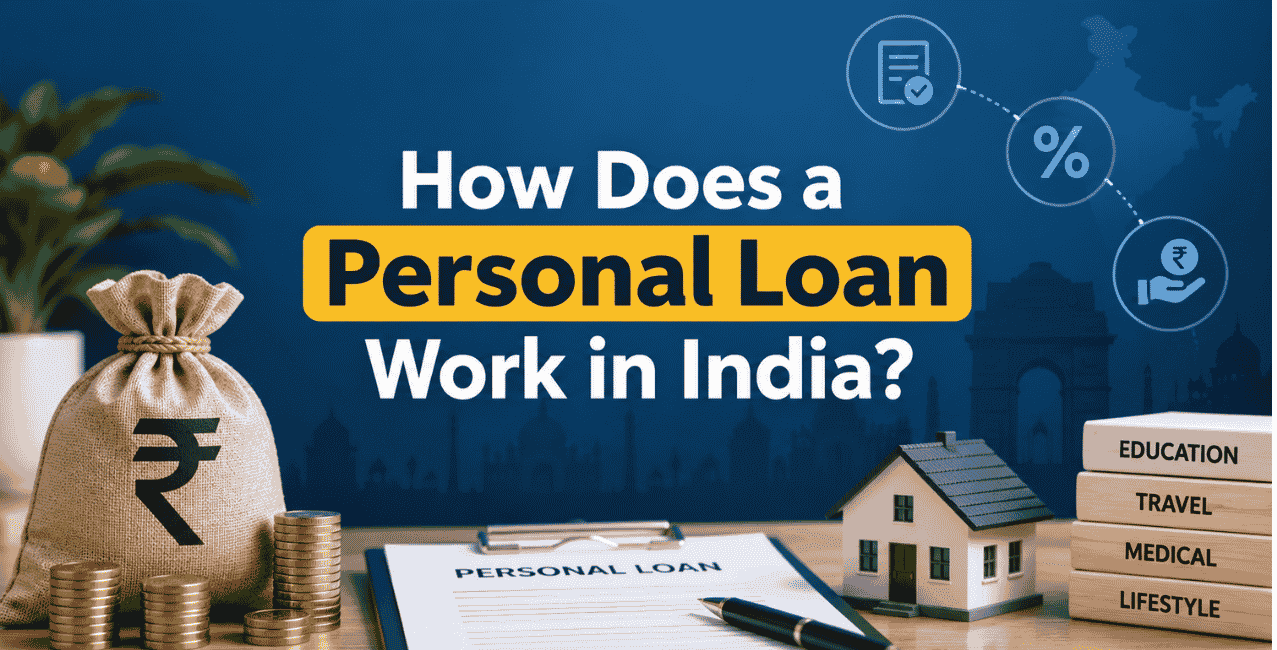
A personal loan means you borrow money without putting up any house, gold or other property as security. The lender sends a fixed amount to your bank account. You return the money in equal monthly payments over a fixed time, mostly between 12 and 60 months. Interest is only on the remaining amount. You can spend this money on almost any personal need you have.
You fill out a form at a bank or other private lender, and share your details and papers. The lender looks at your credit score, income, job, and other loans you already have. If they say yes, you get a letter that shows the loan amount, interest rate (fixed or floating), time period, monthly payment and all fees. They also give you the Key Fact Statement that lists the full cost.
You agree to the terms, mostly by signing online. The money then comes into your account, often in 1 or 2 day. For loans taken online under RBI’s digital lending rules, the lender must give you a short cooling-off period (at least 1 day, set by the lender) when you can return the money. You only pay the main amount plus interest for the days you kept it. No extra penalty. After that, your monthly payments start and go on till the loan is finished. Each monthly payment covers some of the main amount and some interest. As the principal amount goes down, the interest part also becomes smaller. You only pay the main amount plus interest for the days you kept it. No extra fee. After that, your monthly payments start and go on till the loan is finished. Each monthly payment covers some of the main amount and some interest. As the principal amount goes down, the interest part also becomes smaller.
The requirements to apply for a personal loan totally depend on the lender. These are the general requirements. The final requirements will depend on your needs, eligibility, and repayment capacity.
People living in India who have a job or run their own work can apply. You should usually be at least 21 years old when you apply and not older than 60 when the loan ends. This is not an RBI rule. Some lenders accept borrowers from age 18, others from 21, and a few from 23. You need regular income. Salaried people need a steady monthly take-home pay. The minimum amount depends on the lender and the city. Self-employed people need to show enough yearly income through tax papers. A credit score of 700 or more helps a lot. Lenders also like to see that you have been in the same job or business for 1 or 2 years. First-time applicants with no credit history may still get a smaller amount if their income is steady.
The amount depends on your income, expenses, your credit score and the lender’s rules. Many lenders give 10 to 24 times your monthly take-home pay. They also check that all your monthly loan payments stay under about 40–50% of your income. People with good scores and fewer other loans can get more money. Loans start from small amounts and can go up to several lakhs, but only what you can pay back easily. Higher income and a clean record usually mean a higher amount and better rate. The final figure is always based on what the lender thinks you can manage every month without stress.
Lenders look at your age, income, how steady your job or business is, your credit score and how much of your income already goes to other loans. A better credit score and lower other payments make approval easier and the interest rate better. It is smart to check your own credit score first. That check does not lower your score. They may also look at your employer type or how long your business has been running. Stable details help the application move faster.
You will usually need:
Online applications mostly take scanned or digital copies. Keep the papers ready so the process does not get delayed.
Applying to different banks one by one just to find a decent personal loan takes a lot of time and effort. A simpler option is to check offers through LoansJagat. They work with over 50 banks, so you can see multiple options together and choose the one that fits you best. You don’t pay any extra fee for this. If something feels confusing, their team is there to help. Everything happens online and stays quick.
Interest is the main cost. It is usually between about 10% and 24% or more each year on the money still left to pay. Your exact rate depends on your details.
Other common costs are the processing fee (often 0.5% to 3–4% of the loan amount plus tax, taken out when the money is given), late payment fees and charges if the monthly payment bounces.
From 1 January 2026, RBI rules stop any early payment or full close fees on floating-rate personal loans given to people for personal use when the loan starts or is renewed on or after that date. Fixed-rate loans can still have those fees as per the lender’s rules. Always look at the exact details in your approval letter and Key Fact Statement. Knowing the full list of costs helps you avoid surprises later.
You get late fees and extra interest on the unpaid amount. The delay goes to the credit bureaus and can lower your score a lot. If the unpaid debt remains outstanding for more than 90 days, it is reported to the credit bureau as a bad debt. Collection agencies may contact you, the longer the arrears persist, the more difficult it becomes to repay the debt. It’s always a better option to contact the loan service provider before the delinquency occurs; many times the bank will advise what to do if the customer really can’t make the payment on time.
Personal loans help in many ways when you use them carefully.
*T&C Apply
These points make the loan useful for real short-term needs when you have a clear plan to pay it back.
There are also many downsides to think about.
Look at these points carefully against your real need and ability to pay back.
Take one only for a real need that you can pay back easily from your current income, like medical costs, important family events, needed repairs or clearing costlier debt. Do not take it just for lifestyle spending if you have no clear plan. Work out the monthly payment first and see how it fits after all other costs. If the payment feels comfortable every month and you still have some money left for daily needs, then the loan can help without creating extra worry.
A personal loan gives quick money without security, but the full cost and the need to pay on time matter most. Check the Key Fact Statement, see if the rate is fixed or floating, and borrow only what you can handle.
No bank is "easy" without checking income and credit score. SBI, HDFC, ICICI approve faster if you already bank with them.
Any RBI-registered bank or NBFC. Suggested list: SBI, HDFC, ICICI, Axis, Kotak, Bajaj Finserv.
Likely PM Mudra Yojana or PM Vishwakarma, government schemes, for MSME/self employed, up to 10,00,000.
At 11% for 5 year would be paying approx. ₹21,700 per month. Exact value depends on the EMI calculator provided by the bank.
None of them offer flat 50%, PMEGP scheme provides up to 35% subsidy depending on the category and location.
Depends on the need, for MSME, the Mudra scheme or PM Vishwakarma for artisans – PMEGP, for housing – PMAY, for education – education loan, etc.
No, 700 is quite a good score; above 750 one gets the most preferred rates, but even with 700 most banks will approve the loan.
Yes, apps like MoneyView, KreditBee, CASHe offer small loans like this if your income proof checks out.
Not a fixed rule, but 3 active loans can hurt your credit score and approval chances.
Instant apps like MoneyView, KreditBee, Navi disburse within hours if documents and credit score are fine.