
By continuing, you agree to LoansJagat's Credit Report Terms of Use, Terms and Conditions, Privacy Policy, and authorize contact via Call, SMS, Email, or WhatsApp
Disclaimer: The information published on LoansJagat is intended for general informational and educational purposes only and should not be considered financial, legal, or investment advice. Interest rates, loan terms, statistics, and other data may change over time and may vary by lender or source. Please verify the latest information and consult a qualified financial advisor or the respective Bank/NBFC before making any financial decisions.
Subscribe Now
About the author

Arshathul Afia
Arshathul Afia is a journalism graduate and fintech content writer with 4+ years of experience in digital publishing and research-led writing. She has written 200+ articles covering personal finance, lending, banking, digital payments, credit, insurance, and major financial developments in India. At LoansJagat, she focuses on simplifying complex fintech news, RBI updates, loan-related changes, policy developments, and industry trends for everyday readers. Her journalism background helps her approach stories with research, context, and clarity, while her SEO experience ensures content remains discoverable and relevant. She aims to make financial news easier to understand, practical, and useful for readers across India.
Related Blog Post
Simplify All Your Loans Into One Affordable EMI

Customers Served

Debt Consolidated

1200+ Reviews

Locations in India
Club all Loans & Credit Card Bills into Single EMI

Quick Apply Loan
Consolidate your debts into one easy EMI.

Takes less than 2 minutes. No paperwork.

10 Lakhs+
Trusted Customers

2000 Cr+
Loans Disbursed

4.7/5
Google Reviews

50+
Banks & NBFCs Offers
Other services mentioned in this article
A viral ₹1.14 crore tax claim has reopened debate over public services, filing pressure and what compliant taxpayers receive after making large payments each year.
An anonymous Indian taxpayer has drawn attention after a tax summary shared on X appeared to show ₹1,14,52,835 as net tax payable on total income of ₹3,07,77,610. The post was uploaded in India on 1 August 2026 and reported the next day. According to the post, the man said the payment made him feel as though he was “earning for someone else”. He also claimed that he had turned down job offers in the US to remain close to his elderly parents.
The screenshot arrived just after the main income-tax filing deadline for many taxpayers. It adds to complaints about tax outgo, portal pressure and public services. Over time, skilled professionals may look at overseas jobs more seriously when high payments come with private healthcare, private schooling and weak civic services. Yet the taxpayer remains unidentified, and the visible page does not reveal the full return.
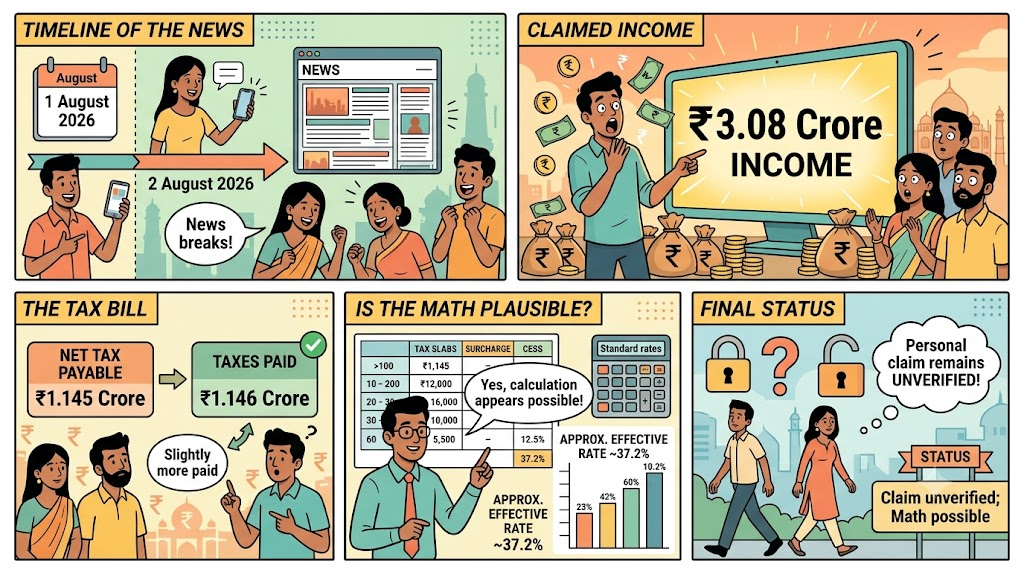
The screenshot looks like part of an income-tax filing summary rather than a salary statement. It reportedly shows taxes paid of ₹1,14,68,591, slightly higher than the net tax payable. That may happen when TDS or advance tax already deposited exceeds the final amount. The visible page, however, does not disclose salary, business income, rent, capital gains, deductions or losses.
Those missing details can change the liability. The figure should therefore be treated as a reported claim, not a confirmed personal tax record. Still, it can be tested against official rules.
A rough calculation using ordinary income under the new regime comes close to the screenshot. Base tax on ₹3.08 crore works out to about ₹88.13 lakh. A 25% surcharge adds around ₹22.03 lakh, while the 4% cess adds roughly ₹4.41 lakh. The result is near ₹1.1457 crore. Rounding, special-rate income, or marginal relief could explain the small difference.
The arithmetic looks consistent, but it does not authenticate the person or return.
Most Indian households will never face a ₹1.14 crore tax bill. The reaction still reaches far beyond the highest income group. A salaried employee sees tax deducted before salary reaches the bank. The same household then pays GST on insurance, mobile bills, appliances and restaurant meals. When roads remain damaged, or a family must depend on a private hospital, frustration rises.
A larger filing base gives the government more room to fund hospitals, schools, defence, courts and welfare programmes. The Ministry of Finance said on 29 January 2026 that return filings rose from 6.9 crore in FY 2021-22 to 9.2 crore in FY 2024-25. More filers can spread the burden, provided citizens also see better delivery.
Tax cannot work like a private subscription where each person receives services equal to the exact amount paid. Revenue collected in Mumbai may fund a rural health centre in Bihar or a highway in Assam. But redistribution cannot answer every complaint. Broken drains, delayed refunds and repeated notices remain administrative failures.
No named chartered accountant has publicly verified the viral return. A tax professional would first inspect the income schedule, TDS entries, advance-tax payments, capital gains and any relief claimed. A person earning ₹3.08 crore from salary may have a different final bill from someone whose income includes listed equity gains or business profits.
The 37.2% effective rate also needs care. It comes from the numbers displayed in one document and should not be presented as a standard rate for everyone earning above ₹3 crore. The top slab is 30%, while surcharge and cess push the final outgo higher.
The department can reduce repeated notices, release refunds faster and offer one place to track complaints. Filing forms should explain why a figure changed from the previous year. A salaried person facing a sudden demand should not have to open several portal tabs to find the reason.
At the 167th Income Tax Day event on 24 July 2026, Finance Minister Nirmala Sitharaman spoke about the 5Rs of taxpayer administration: Recognise, Respond, Redress, Reflect and Reform. Revenue Secretary Arvind Shrivastava referred to simpler rules and forms. CBDT Chairman Ravi Agrawal highlighted faster return processing and lower litigation.
LoansJagat offered a useful test of that policy. Its report on the Income Tax Department’s 5Rs approach said taxpayers would judge it through response time, correction of genuine errors and relief from avoidable disputes. A polished announcement carries little weight when a refund remains stuck for months, or a notice repeats an issue already settled.
The latest post follows a similar complaint from July 2026. Professional Mohamed Nowsath reportedly said he had paid more than ₹1 crore in income tax during a 14-year career but received no financial support after losing his job. His experience led to debate over unemployment assistance and whether long-term taxpayers should receive temporary protection after a layoff.
Another case appeared later in July. A chartered accountant said an IIT graduate earning more than ₹1 crore a year, with 3 houses, had to borrow ₹15,000 to finish a tax payment. That story was about cash availability. High income and property ownership do not always mean enough money is available in the bank on a filing date.
All 3 cases arrived during filing season. One involved job loss, another poor liquidity, while the latest focuses on public benefits. The timing gave the screenshot a ready audience.
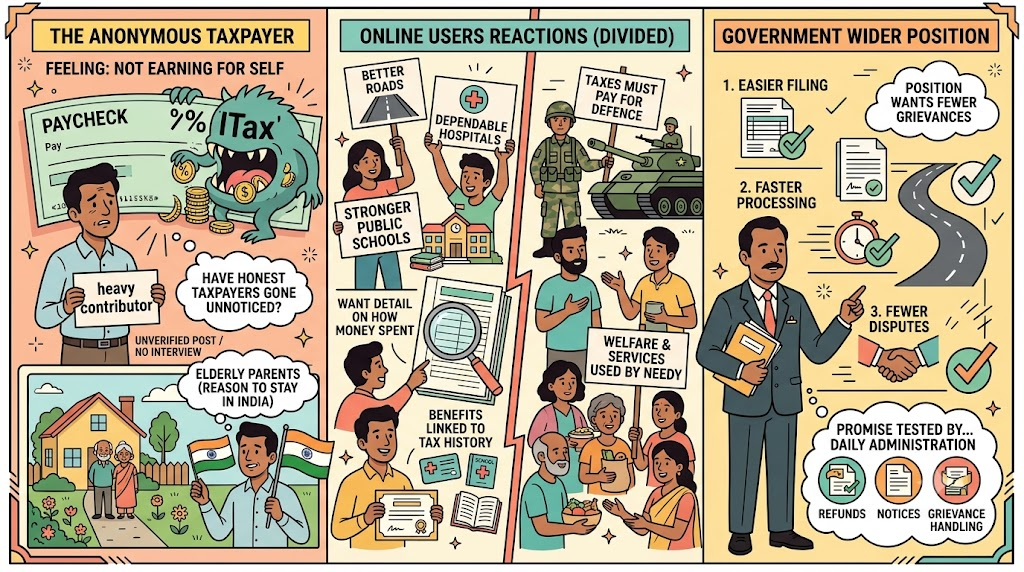
The anonymous taxpayer reportedly said the payment made him feel that he was no longer earning for himself. According to the post, he believed honest taxpayers receive little attention despite contributing heavily to government revenue. He also referred to his elderly parents while explaining why he had remained in India. No verified interview with the man has been published.
Online reactions were divided. Some users asked for better roads, dependable hospitals, stronger public schools and more detail on how tax money is spent. A few suggested medical or education benefits linked to tax history. Others argued that taxes must pay for defence, welfare and services used by people who cannot afford them privately.
The government has not responded to this screenshot of an individual. Its wider position focuses on easier filing, faster processing and fewer disputes. That promise will be tested through everyday administration, particularly refunds, notices and grievance handling.
The tax demand of ₹1.14 crore has been spreading like wildfire as it appears to be a plausible calculation and the grievance is common. Despite all this, the document is far from complete. The taxpayer is anonymous, income is not broken down, and the full return is not verified.
India needs tax revenue for public services and national spending. Taxpayers also expect decent administration after they file and pay. The useful response is quicker redressal, fewer avoidable disputes, working civic services, and a tax portal that explains figures without sending people in circles.
The screenshot claims that amount, but the taxpayer and complete return have not been independently verified.
The visible summary reportedly listed total income of ₹3,07,77,610.
Yes. The 64% (30% slab, 25% surcharge and 4% cess) can give a nearby figure.
It linked a high amount of payment with familiar grievances over roads, health, education and delayed grievance resolution.
Regular taxpayers may not need special privileges, but faster refunds, better services and quicker grievance handling would address growing frustration.
Improved refund timelines, more streamlined notices, fewer duplicate queries, and timely complaint resolution would benefit a large segment of the population.









.png&w=3840&q=75)


