.png&w=3840&q=65)
By continuing, you agree to LoansJagat's Credit Report Terms of Use, Terms and Conditions, Privacy Policy, and authorize contact via Call, SMS, Email, or WhatsApp
Disclaimer: The information published on LoansJagat is intended for general informational and educational purposes only and should not be considered financial, legal, or investment advice. Interest rates, loan terms, statistics, and other data may change over time and may vary by lender or source. Please verify the latest information and consult a qualified financial advisor or the respective Bank/NBFC before making any financial decisions.
Subscribe Now
About the author

Arshathul Afia is a journalism graduate and fintech content writer with 4+ years of experience in digital publishing and research-led writing. She has written 200+ articles covering personal finance, lending, banking, digital payments, credit, insurance, and major financial developments in India. At LoansJagat, she focuses on simplifying complex fintech news, RBI updates, loan-related changes, policy developments, and industry trends for everyday readers. Her journalism background helps her approach stories with research, context, and clarity, while her SEO experience ensures content remains discoverable and relevant. She aims to make financial news easier to understand, practical, and useful for readers across India.
Related News
Simplify All Your Loans Into One Affordable EMI

Customers Served

Debt Consolidated

1200+ Reviews

Locations in India
Club all Loans & Credit Card Bills into Single EMI

Quick Apply Loan
Consolidate your debts into one easy EMI.

Takes less than 2 minutes. No paperwork.

10 Lakhs+
Trusted Customers

2000 Cr+
Loans Disbursed

4.7/5
Google Reviews

50+
Banks & NBFCs Offers
Other services mentioned in this article
If a salaried individual files the ITR-1 or ITR-2, then the due date for filing is 31st July, and in case of late filing, it would attract fees, interest, delay in getting the refund, and would also have the restrictions of loss carry forward in 2026.
Salaried employees, pensioners, and others with due dates up to 31st July 2026 for their ITR have a deadline to file! The
The immediate concern is fairly direct. Someone with tax still payable may also face Section 234A interest at 1% for every month or part of a month. The longer impact depends on the return. For a household that is expecting a cash refund, a late refund may be a negative, or for an investor with capital losses, a late refund may be a missed opportunity. No official extension of the July 31, 2026 deadline is yet out for those filing ITR-1 and ITR-2.
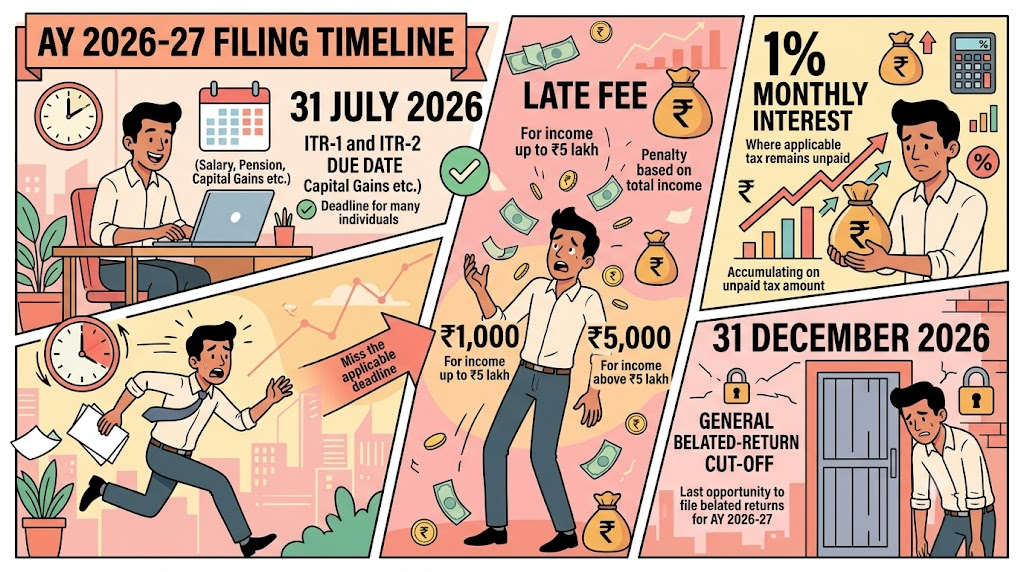
The impact will not look the same for every filer. Take a salaried employee whose employer has already deducted the full tax through TDS. If the final calculation shows no tax payable, Section 234A may not create the same cost faced by somebody with an unpaid balance. The Section 234F fee can still apply where filing was mandatory. A refund claim also enters processing later because the return itself was filed later.
Investors have another concern. Suppose an employee sold shares during FY 2025-26 and ended the year with an eligible capital loss. Timely filing can allow that loss to be carried forward for adjustment against eligible gains in later years. Miss the prescribed return date and that benefit may be lost. A ₹5,000 filing fee looks small beside a large capital loss that can no longer be used later.
The 2026 filing calendar also needs some care. July 31 is widely discussed, but it does not cover every non-audit taxpayer. Different dates apply according to the return form and type of income.
This is where a common assumption causes trouble. December 31 is available as a belated-return date, but it is not simply another version of July 31. The return is already late by then. Fees, interest, and restrictions can follow depending on the taxpayer's position.
Refund cases need attention too. A person may have ₹25,000 coming back because TDS exceeded the final tax bill. Filing in July puts that claim into the system earlier than filing in October. There can also be an impact on the period used to calculate eligible refund interest.
Also Read: Due To A 3 Crore ITR Filing For AY 2026-27 The Tax Department Issues A July 31 Flying Deadline
Tax professionals generally point to the same weak spots before a deadline rush: missing income, the wrong ITR form, mismatched AIS entries and capital gains calculated from incomplete records. A Form 16 alone does not tell the entire tax story for someone who changed jobs, earned FD interest, sold mutual funds or received rent.
The fix is fairly ordinary, but people skip it. Form 16 should be checked against AIS and Form 26AS. Bank statements can uncover interest from an old deposit. Broker statements help where shares or mutual funds were sold. Property owners need the ownership share, rent, municipal tax, and home-loan figures in front of them. Then comes the return form.
A salaried employee with professional income on the side is a useful example. Salary may form 90% of annual income, yet ITR-1 can still be unsuitable because of the additional professional receipts. Filing the easiest-looking form merely to finish before midnight may create a defective-return problem later.
LoansJagat raised a similar concern in its 22 July 2026 filing review. The LoansJagat analysis identified 6 filing traps, covering AIS errors, property income, capital gains, tax-regime selection, incorrect return forms and delayed verification. That is useful in the final filing week because most errors start with records, not with the tax portal itself.
Verification deserves its own check. Uploading an ITR is only part of the filing process. Taxpayers who leave verification pending can create an avoidable problem even after preparing the return correctly.
Also Read: ITR Filing Deadline 2026: Important Update for Salaried Taxpayers
The fee attracts attention because it has a fixed number attached to it. For some taxpayers, that will be the main cost. Others could lose much more elsewhere.
Consider an investor carrying a sizeable short-term or long-term capital loss eligible for future set-off. If the law requires the return to be filed by the original due date for that loss to be carried forward, filing in December may remove that option. The immediate fee could be ₹5,000. The unused loss may represent a much larger future tax cost.
There is a similar difference with interest. Section 234A does not simply charge 1% of annual income. It applies to the relevant unpaid tax amount and counts every month or part of a month. Somebody whose TDS already covers the final bill will therefore be in a different position from a taxpayer who discovers ₹80,000 of tax still due while preparing the return.
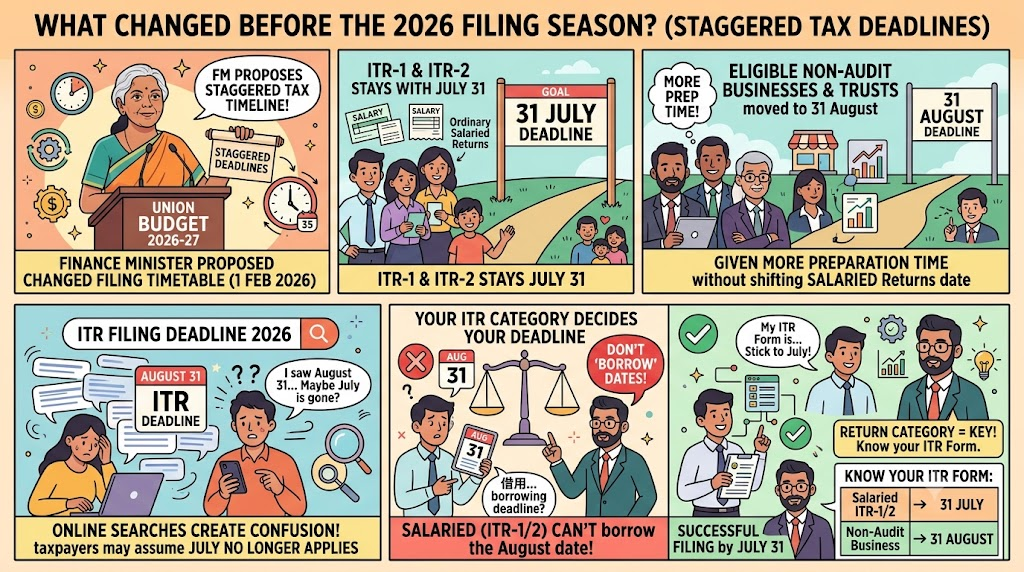
Union Budget 2026-27 changed the filing timetable before the current season began. On 1 February 2026, Finance Minister Nirmala Sitharaman proposed staggered deadlines for taxpayers who earlier fell around the same July timeline.
ITR-1 and ITR-2 filers stayed with 31 July. Eligible non-audit business cases and trusts moved to 31 August. The difference gave certain business and professional taxpayers more preparation time without shifting the date for ordinary salaried returns.
That change has created some confusion in online searches. A taxpayer may see “August 31 ITR deadline” and assume July no longer applies. The return category decides that. A salaried individual filing ITR-1 or ITR-2 should not borrow the August deadline from a non-audit business case.
The revised-return window also changed for AY 2026-27. Taxpayers who file and later find an error have a longer period available for revision, subject to the rules in force. A revised return and a belated return do different jobs, though. Revision corrects a return already filed. A belated return starts after the original filing date has been missed.
The tax department has been pushing filing reminders through July while keeping its online return utilities active for AY 2026-27. Its support arrangements also became longer during the closing days of the month, including 24x7 support from 25 July until 23:59 hours on 31 July 2026.
For taxpayers, the useful message is less dramatic. Do not leave bank interest, share transactions or property details to memory. AIS should be checked, but pre-filled information should not be treated as automatically correct. A bank may have reported an entry differently. A transaction may appear twice. An old account may contain interest that the taxpayer forgot.
Tax advisers also caution against treating 31 December 2026 as a free extension. It is a rescue route for a missed return. It does not restore every benefit attached to filing by the original due date. There is also no advantage in submitting an obviously incomplete return purely to meet the clock. A taxpayer who has a genuine reporting complication should get the figures checked properly.
The ITR last date 2026 is now close for taxpayers covered by ITR-1 and ITR-2. The 31 July 2026 date carries more weight than the headline ₹5,000 fee suggests. Late filing can bring Section 234A interest where tax remains due, push a refund claim further back and block the carry-forward of certain eligible losses.
A missed July deadline does not end the filing opportunity. A belated return can generally be submitted until 31 December 2026. Still, that date comes after the original compliance window has closed. Taxpayers whose records are available are better placed to file after one final check of AIS, Form 26AS, bank income, investments, and the chosen ITR form.