By continuing, you agree to LoansJagat's Credit Report Terms of Use, Terms and Conditions, Privacy Policy, and authorize contact via Call, SMS, Email, or WhatsApp
Disclaimer: The information published on LoansJagat is intended for general informational and educational purposes only and should not be considered financial, legal, or investment advice. Interest rates, loan terms, statistics, and other data may change over time and may vary by lender or source. Please verify the latest information and consult a qualified financial advisor or the respective Bank/NBFC before making any financial decisions.
Subscribe Now
About the author

Arshathul Afia is a journalism graduate and fintech content writer with 4+ years of experience in digital publishing and research-led writing. She has written 200+ articles covering personal finance, lending, banking, digital payments, credit, insurance, and major financial developments in India. At LoansJagat, she focuses on simplifying complex fintech news, RBI updates, loan-related changes, policy developments, and industry trends for everyday readers. Her journalism background helps her approach stories with research, context, and clarity, while her SEO experience ensures content remains discoverable and relevant. She aims to make financial news easier to understand, practical, and useful for readers across India.
Related News
Simplify All Your Loans Into One Affordable EMI

Customers Served

Debt Consolidated

1200+ Reviews

Locations in India
Club all Loans & Credit Card Bills into Single EMI

Quick Apply Loan
Consolidate your debts into one easy EMI.

Takes less than 2 minutes. No paperwork.

10 Lakhs+
Trusted Customers

2000 Cr+
Loans Disbursed

4.7/5
Google Reviews

50+
Banks & NBFCs Offers
Other services mentioned in this article
Following the peak-period outages and deadline-related disruptions, the government has announced FY26 penalties on the ITR portal service providers.
According to the Upstox report, speaking to the Lok Sabha about the MSP's outages for reasons that forced filing deadlines to be extended, Finance Minister Pankaj Chaudhary, on July 20, 2026, addressed the repeated outages of the Income Tax e-Filing Portal, the related peak period outages, and the extension of filing deadlines due to outages of the portal. The government stated that penalties were imposed on the income tax e-filing managed service provider for peak period outages.
This affects taxpayers right now because the 31 July filing window is still active for many individual filers. A slow portal can delay return submission, self-assessment tax payment, refund claims and e-verification. The longer impact is bigger. When crores of Indians depend on one digital tax system, every outage becomes a compliance risk, not just a website problem.
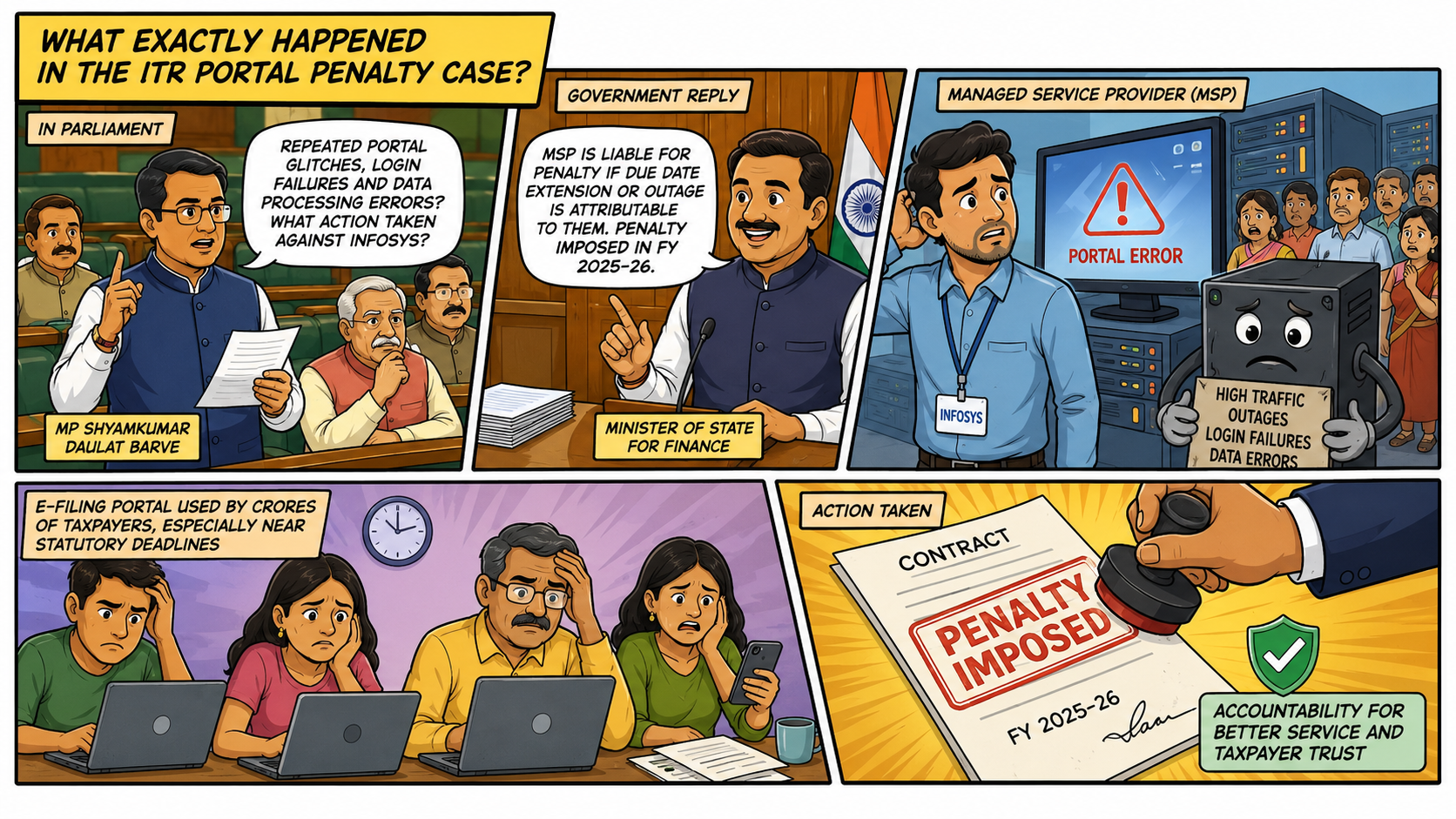
The Finance Ministry’s reply said the MSP was liable for penalty if the due date of ITR filing or any other pre-notified date was extended due to reasons attributable to the MSP. The government also said a penalty on this ground had been imposed in FY 2025-26. The answer was linked to concerns over the e-filing portal during the peak filing period.
The issue came up in Parliament after MP Shyamkumar Daulat Barve asked whether the government was aware of repeated portal glitches, login failures and data processing errors. He also sought details of action taken against Infosys, the managed service provider named in the question. The government said the portal is a high-volume platform used by crores of taxpayers, especially near statutory deadlines.
For salaried workers, pensioners, small business owners and people with capital gains, ITR filing is not only form submission. Taxpayers check Form 16, AIS, Form 26AS, bank validation, tax payment, deductions and e-verification before the return becomes complete. The Income Tax Department portal currently lists ITR utilities and filing options for AY 2026-27, which means the filing channel is open but the last-week load remains the real test.
There is some benefit in the wider shift to digital filing. Refund tracking is easier, returns can be filed from home, and taxpayers can correct basic details without visiting a tax office. But that benefit works only when the portal performs when people need it. A taxpayer who reaches the final screen and then faces payment reflection or login trouble does not see a policy success. That person sees a deadline getting closer.
The government has also extended helpdesk support for the final filing stretch. This should help taxpayers who face login, e-verification or return-status problems before the deadline.
The table shows why the issue is no longer a small technical complaint. It connects taxpayer inconvenience, government accountability and the private vendor’s service contract in one story.
Tax professionals usually give one blunt suggestion during the final week: file before the last day if documents are ready. That advice is stronger this year because the government has already admitted peak-load delays can happen even while saying the portal is broadly stable.
Taxpayers should first download AIS and Form 26AS, then compare them with Form 16, bank interest entries, capital gains statements and rent or deduction claims. The ITR should be e-verified as soon as it is filed. People expecting refunds should check bank validation before submission, because refund delays often start with small account or PAN-bank linking errors.
A LoansJagat review of FY 2025-26 filing errors also flagged wrong ITR form selection, missing income, mismatch in Form 26AS and late filing as common mistakes. LoansJagat noted that filing before 31 July 2026 can help taxpayers avoid a late fee of up to ₹5,000 under Section 234F and protect loss carry-forward and loan eligibility records. That point is important for borrowers. Banks often ask for ITR records while checking home loan, business loan or high-ticket personal loan applications.
A practical reading is simple. For a borrower, late filing can become a document problem even after the tax issue is closed. If a salaried applicant applies for a home loan in August or September, the lender may ask for the latest ITR. A delayed or unverified return can slow that file.
Also Read: ITR Last Date 2026: July 31 Deadline Nears As Late Filers Risk ₹5,000 Penalty
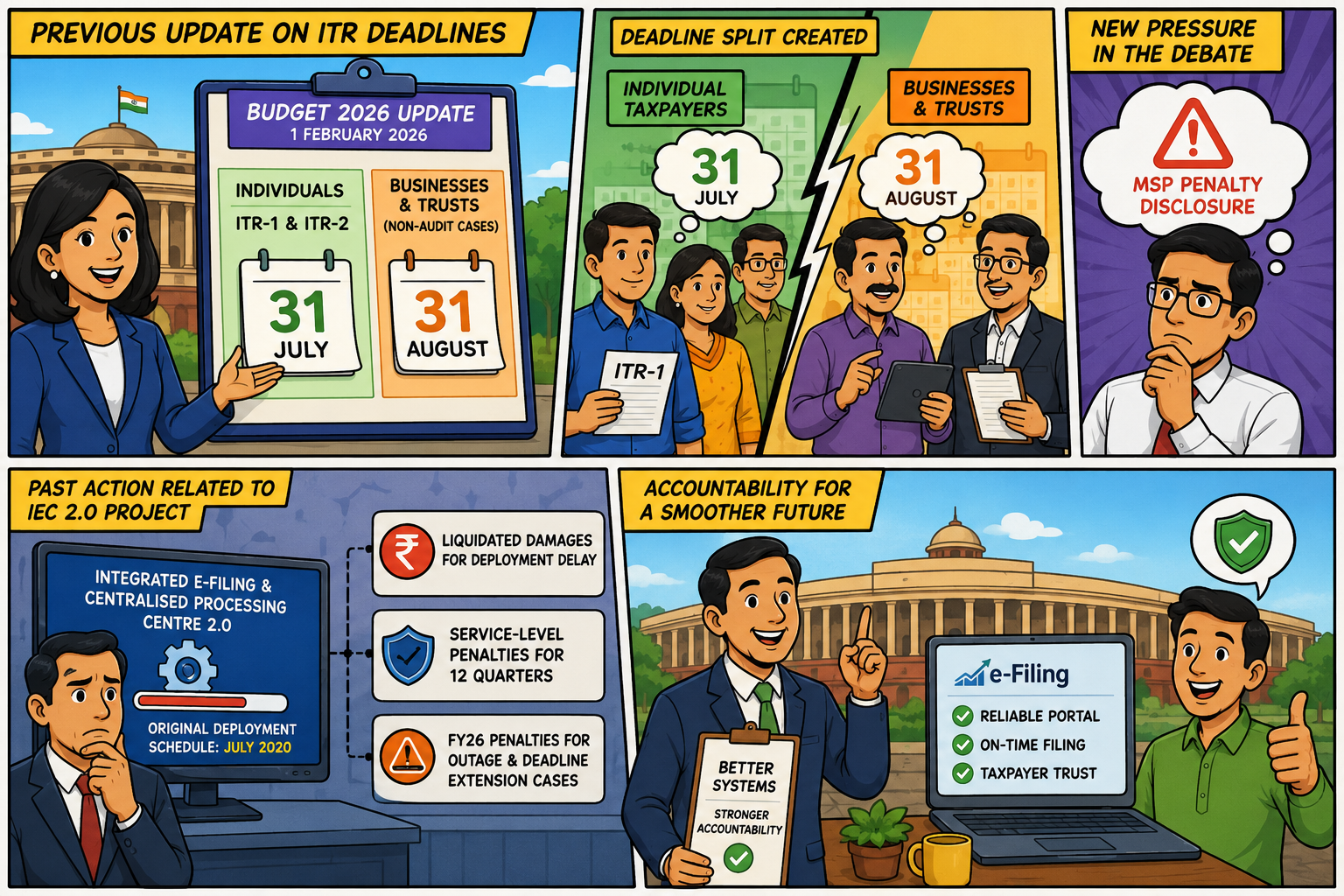
The earlier deadline position came through Budget 2026 updates. The Press Information Bureau release dated 1 February 2026 said individuals filing ITR-1 and ITR-2 would continue to file till 31 July, while non-audit business cases and trusts were proposed to get time till 31 August.
That update had already created a split in the filing calendar. Many individual taxpayers remained tied to the July deadline, while some business and trust cases received more time. The latest MSP penalty disclosure now adds pressure to the same deadline debate because it confirms that portal-linked delays have contractual consequences for the service provider.
The Finance Ministry’s reply also referred to past action connected with the Integrated e-Filing and Centralized Processing Centre 2.0 project. It mentioned liquidated damages for delay in deployment, service-level penalties over 12 quarters, and FY26 penalties for peak-period outage and deadline-extension cases linked to the MSP.
Also Read: RBI Maintains Repo Rate at 5.25% For The Eighth Time 2026
The taxpayer concern reached Parliament through MP Shyamkumar Daulat Barve, who asked about technical glitches, systemic login failures and data processing errors on the Income Tax e-filing portal. His question also asked what penalties had been imposed on Infosys for operational lapses.
Minister of State for Finance Pankaj Chaudhary said the portal serves crores of taxpayers and faces heavy traffic close to statutory due dates. The ministry said users may face slower page response or intermittent delays during high concurrent load, though it described the portal as largely stable and efficient during the ongoing peak filing period.
CBDT’s position, as shared in the reply, was that the department had strengthened the portal through higher infrastructure capacity, 24x7 monitoring, performance testing, a dedicated War Room, security measures against DDoS and bot attacks, and coordination with UIDAI, banks, CDSL, NSDL, ICAI and e-Return Intermediaries.
Taxpayers will judge it differently. If the return goes through, the system feels fine. If payment hangs, e-verification fails or login keeps dropping near the due date, the penalty imposed on the MSP may sound distant. The user still carries the filing risk.
The ITR filing rush has become a bigger accountability story after the government confirmed FY26 penalties on the MSP behind the e-filing portal. The disclosure came at a sensitive time, with millions of taxpayers moving towards the 31 July deadline and portal load rising sharply.
For taxpayers, the best step is still early filing, proper data matching and quick e-verification. For the government, the test is tougher. A digital tax portal used by crores of Indians must perform at its busiest hour, not only on ordinary days.
The government said the managed service provider faced FY26 penalties for portal-linked failures, including outage and deadline-extension cases.
MP Shyamkumar Daulat Barve raised questions about glitches, login failures, data processing errors and action against the MSP.
The deadline remains 31 July for individuals filing ITR-1 and ITR-2 for AY 2026-27.
It shows that portal failure can trigger vendor accountability, but taxpayers still need to avoid last-minute filing risk.
Yes. A delayed or unverified ITR can slow loan documentation because lenders often ask for recent return records.










.png&w=3840&q=75)


