
By continuing, you agree to LoansJagat's Credit Report Terms of Use, Terms and Conditions, Privacy Policy, and authorize contact via Call, SMS, Email, or WhatsApp
Disclaimer: The information published on LoansJagat is intended for general informational and educational purposes only and should not be considered financial, legal, or investment advice. Interest rates, loan terms, statistics, and other data may change over time and may vary by lender or source. Please verify the latest information and consult a qualified financial advisor or the respective Bank/NBFC before making any financial decisions.
Subscribe Now
About the author

Arshathul Afia is a journalism graduate and fintech content writer with 4+ years of experience in digital publishing and research-led writing. She has written 200+ articles covering personal finance, lending, banking, digital payments, credit, insurance, and major financial developments in India. At LoansJagat, she focuses on simplifying complex fintech news, RBI updates, loan-related changes, policy developments, and industry trends for everyday readers. Her journalism background helps her approach stories with research, context, and clarity, while her SEO experience ensures content remains discoverable and relevant. She aims to make financial news easier to understand, practical, and useful for readers across India.
Related News
Simplify All Your Loans Into One Affordable EMI

Customers Served

Debt Consolidated

1200+ Reviews

Locations in India
Club all Loans & Credit Card Bills into Single EMI

Quick Apply Loan
Consolidate your debts into one easy EMI.

Takes less than 2 minutes. No paperwork.

10 Lakhs+
Trusted Customers

2000 Cr+
Loans Disbursed

4.7/5
Google Reviews

50+
Banks & NBFCs Offers
Other services mentioned in this article
The Allahabad High Court set aside an assessment notice issued to a deceased taxpayer, stating that a subsequent notice by the legal heir would fail to cure the defect. The Allahabad High Court has struck down an assessment notice issued to a deceased taxpayer, stating that substitution of a legal heir couldn't rectify the defect of the notice issued.
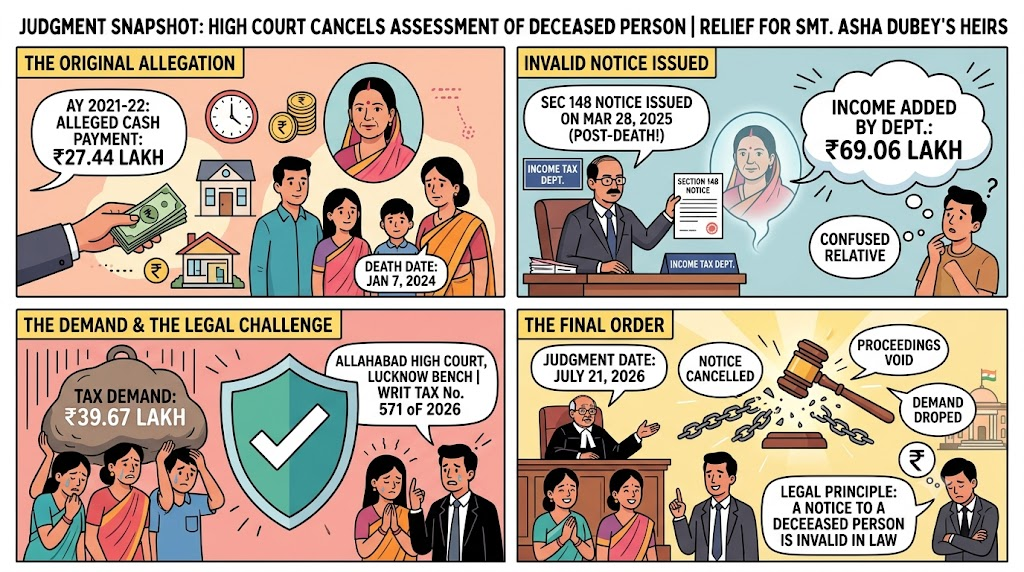
The order was passed by the Lucknow Bench of Allahabad High Court in the case of Smt. Writ Tax No. 571 of 2026 in the case of Asha Dubey v. Union of India and others. The controversy was with respect to Assessment Year 21-22. Sajjan Kumar Dubey passed away on 7th January 2024. A notice was issued by the tax officials in his name on March 28, 2025, still more than 14 months later. The judges determined that the Assessing Officer never had a legal right to reopen the assessment.
The immediate relief goes to families who receive tax notices addressed to deceased relatives. A legal heir cannot be drawn into a defective reassessment merely because an officer replaces the taxpayer’s name midway. The ruling may also create difficulty for the department where officials learn about a death after the deadline for sending a fresh notice. Genuine tax dues do not disappear, though. The department must pursue them through the route given in law.
A notice received after a taxpayer’s death often puts the family in a difficult position. Some relatives reply through the deceased person’s tax account. Others use an old Aadhaar-linked mobile number because they fear another demand or penalty. That response can create a second dispute, as this case itself shows.
The safer route is different. The family should inform the department about the death, attach the death certificate and raise an objection against the name used in the notice. The legal heir can then register separately through the Income Tax Department portal. The department asks for the deceased person’s PAN, proof of death and documents showing the applicant’s status as legal heir.
The judgment also prevents officials from treating the heir’s personal income as an automatic source for recovery. Liability under Section 159 usually follows the estate that came into the heir’s hands. Each case depends on its records. A person who inherits a small bank balance, for example, cannot simply be treated as personally liable for a far greater demand without the legal requirements being met.
The first review should focus on dates. Tax advisers will check when the taxpayer died, when the Section 148 notice went out, and when the department first addressed the legal heir. These entries can decide the case before anyone examines the alleged transaction.
Suppose a taxpayer died in January and the department sent a reassessment notice to him in March of the following year. The heir should raise the recipient issue at once. A long reply explaining the property purchase, bank entry, or cash transaction can wait. Filing a detailed response without challenging jurisdiction may give the department another argument, even though participation alone cannot legalise an invalid notice.
The relevant provision appears in the Income-tax Act available on India Code. Section 159 allows proceedings against a legal representative. It also permits valid proceedings started during the taxpayer’s lifetime to continue after death. What it does not permit is a fresh case against a person who was already dead, followed by a name change when the error comes to light.
For LoansJagat readers, the useful point is to separate estate liability from personal liability before discussing payment. A LoansJagat report on debt discovered after a borrower’s death deals with a similar family problem. Recovery can depend on inherited property, loan insurance, a co-borrower or a guarantor. Family connection by itself does not settle who must pay.
The dispute started with an Income Tax Department search involving the Omaxe Group on April 1, 2021. Material found during that search allegedly showed an unaccounted cash payment connected with a residential flat in Lucknow.
Officials linked Sanjay Dubey to a discrepancy of ₹27.44 lakh. His widow, Asha Dubey, denied that he had made such a payment.
The department approved reopening the assessment on March 20, 2025. It issued the Section 148 notice 8 days later. Sanjay Dubey had been dead for more than 14 months by then.
Tax officials later added ₹69.06 lakh to the assessed income and raised a demand of ₹39.67 lakh. Every later action depended on the first notice. Once the Court struck down that notice, the orders built on it also fell.
The table below shows where the proceeding went wrong and why the department’s later steps did not repair it.
This was not an incorrect spelling, a wrong PIN code or a defect in service. The notice named a person who could not receive it, answer it or challenge it. The judges treated that failure as fatal.
Section 292B can protect tax proceedings from certain technical defects. The Court found that it could not turn a notice issued to a dead person into a notice issued to a living legal representative. Section 292BB also failed to help the department because the problem existed before Asha Dubey took part in the proceedings.
A separate issue arose from an income tax return filed after Sanjay Dubey’s death. The return for Assessment Year 2024-25 was electronically transmitted on July 30, 2024. It was filed on November 5, 2024, using an Aadhaar OTP linked to him.
The department relied heavily on that filing. Its lawyers argued that officers had no information about the death and that the return presented Sanjay Dubey as alive. The Court did not approve of the filing. It allowed the department to examine whether the verification breached Section 140 or attracted action under Section 277.
The post-death return did not rescue the reassessment notice. One doubtful act by the petitioner could not supply authority that the Assessing Officer did not have.
Another notice reached Sanjay Dubey’s name on January 7, 2026. Asha Dubey replied on February 2 and informed the department that her husband had died. She challenged the reassessment at the same time.
Officials sent another communication on February 18. On February 20, they rejected her objection and placed her name on the case as legal representative. A show-cause notice followed on March 6.
Asha Dubey again denied the alleged cash payment. The department passed the assessment order and demand on March 24, 2026. She then moved the Allahabad High Court under Article 226 of the Constitution.
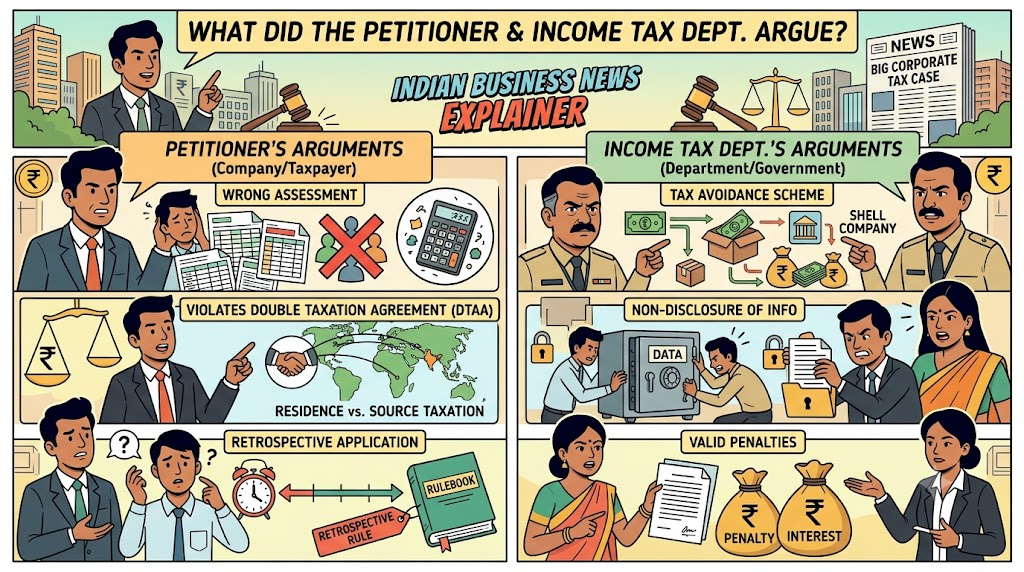
Asha Dubey’s lawyers said a Section 148 notice gives the Assessing Officer authority to reopen a completed assessment. The officer must therefore issue it to a person recognised by law. Since Sanjay Dubey had died before the notice date, the reassessment never began lawfully.
They also argued that Section 159 required officials to proceed against the legal representative from the start. It did not allow them to issue a notice to the deceased taxpayer first and correct the recipient later.
The department took a different position. Its lawyers said officers did not know about the death on March 28, 2025. They referred to the return filed through Aadhaar authentication and Asha Dubey’s later participation. According to the department, those facts should allow the case to continue.
The Bench rejected that argument. It held that consent, participation and substitution cannot create jurisdiction. The judgment included a direct line: “To tax the dead is a contradiction in terms. Tax laws are made by the living to tax the living.”
That sentence drew attention, but the legal reasoning went deeper. Tax may still be recovered from property left by a deceased taxpayer. The authority must address the correct person and remain within the statutory time limit.
The judges accepted that tax officials can face a genuine administrative problem. A department may issue a notice without knowing that the taxpayer has died. Officials may discover the death only after the final date for a fresh notice has passed.
Revenue can be lost in such cases. The Bench still refused to write a new exception into the Income-tax Act. Courts interpret the words passed by Parliament. They cannot extend limitation merely because the result appears difficult for the department.
The Senior Registrar was directed to send the judgment to the Union Finance Ministry. Parliament may now examine whether the law needs a separate rule for notices issued without knowledge of death. Until any amendment arrives, tax officers must follow Section 159 and the existing deadlines.
The Allahabad High Court has fixed a firm boundary for reassessment cases. The department can examine income linked to a deceased taxpayer. It can also recover lawful dues from the estate. The first notice, however, must name the correct legal representative when the taxpayer has already died.
Families should not ignore a notice addressed to a deceased relative. They should report the death, register the heir, and object to the notice before discussing the alleged income. Using the deceased person’s Aadhaar or tax login can create another inquiry.
For the Income Tax Department, the case points to a basic operational gap. A death-record check before issuing a reassessment notice could save months of correspondence and years of litigation. That check may not solve every file, but it would have prevented this one.
Is an income tax notice sent to a dead person valid?
The Allahabad High Court said no. A Section 148 notice issued after the taxpayer’s death was void from its issue date.
Can tax officials proceed against the legal heir?
Yes. The department must name the legal representative correctly and issue the notice within the period allowed by law.
Does the heir have to pay the demand from personal savings?
Not automatically. Liability generally depends on the value of the deceased person’s estate received by the heir and the facts recorded in the case.
Can the department replace the taxpayer’s name after issuing the notice?
The High Court rejected that approach here. Later substitution could not repair the original jurisdictional defect.
What should a family do after receiving such a notice?
The heir should submit the death certificate, register as a legal representative, and raise the recipient objection without delay.
How to file ITR for a deceased father?
Register as your father’s legal heir on the income tax portal, then file his pending ITR through your own account.
Should the notice simply be ignored?
No. Silence may lead to further notices and an assessment order. A written objection creates a record of the death and the jurisdictional challenge.
Can the department act against a return filed after the taxpayer’s death?
Yes. The Court allowed officials to examine the post-death return and Aadhaar verification separately from the invalid reassessment.
Start your journey today
Apply Now*T&C apply









.png&w=3840&q=75)


