By continuing, you agree to LoansJagat's Credit Report Terms of Use, Terms and Conditions, Privacy Policy, and authorize contact via Call, SMS, Email, or WhatsApp
Disclaimer: The information published on LoansJagat is intended for general informational and educational purposes only and should not be considered financial, legal, or investment advice. Interest rates, loan terms, statistics, and other data may change over time and may vary by lender or source. Please verify the latest information and consult a qualified financial advisor or the respective Bank/NBFC before making any financial decisions.
Subscribe Now
About the author

Arshathul Afia is a journalism graduate and fintech content writer with 4+ years of experience in digital publishing and research-led writing. She has written 200+ articles covering personal finance, lending, banking, digital payments, credit, insurance, and major financial developments in India. At LoansJagat, she focuses on simplifying complex fintech news, RBI updates, loan-related changes, policy developments, and industry trends for everyday readers. Her journalism background helps her approach stories with research, context, and clarity, while her SEO experience ensures content remains discoverable and relevant. She aims to make financial news easier to understand, practical, and useful for readers across India.
Related News
Simplify All Your Loans Into One Affordable EMI

Customers Served

Debt Consolidated

1200+ Reviews

Locations in India
Club all Loans & Credit Card Bills into Single EMI

Quick Apply Loan
Consolidate your debts into one easy EMI.

Takes less than 2 minutes. No paperwork.

10 Lakhs+
Trusted Customers

2000 Cr+
Loans Disbursed

4.7/5
Google Reviews

50+
Banks & NBFCs Offers
Other services mentioned in this article
Taxpayers should correct AIS, Form 26AS TDS and e-verification issues, if any, before 31 July 2026 to avoid income tax notices after filing ITR.
Key Highlights
Business Today’s video updated on 23 July 2026 warned Indian taxpayers that several income tax notices begin with avoidable filing errors. Tax expert Gauri Chadha named AIS and Form 26AS mismatches, incorrect TDS claims, missed e-verification, missing information and unsupported deduction claims as common notice triggers. The warning came just days before the 31 July 2026 due date for many AY 2026-27 ITR filers on the income tax e-filing portal.
This affects salaried employees, freelancers, pensioners, fixed deposit holders and small investors because the Income Tax Department already receives financial data from several reporting sources. A mismatch can delay refunds in the short term. Later, it can lead to a defective return notice, a tax demand, or more correction work after the taxpayer thought the return was done.
A taxpayer may file from Form 16 and still leave out income. That is where the risk starts. Form 16 records salary and employer TDS, but it may not show FD interest from 3 banks, dividend income, freelance receipts, share sale entries, rent income, or income from a previous employer.
The Income Tax Department’s AIS FAQ says AIS gives taxpayers a full view of information before filing and allows online feedback. It also says the taxpayer is expected to check all related information and report complete and accurate income in the ITR. The final responsibility stays with the filer.
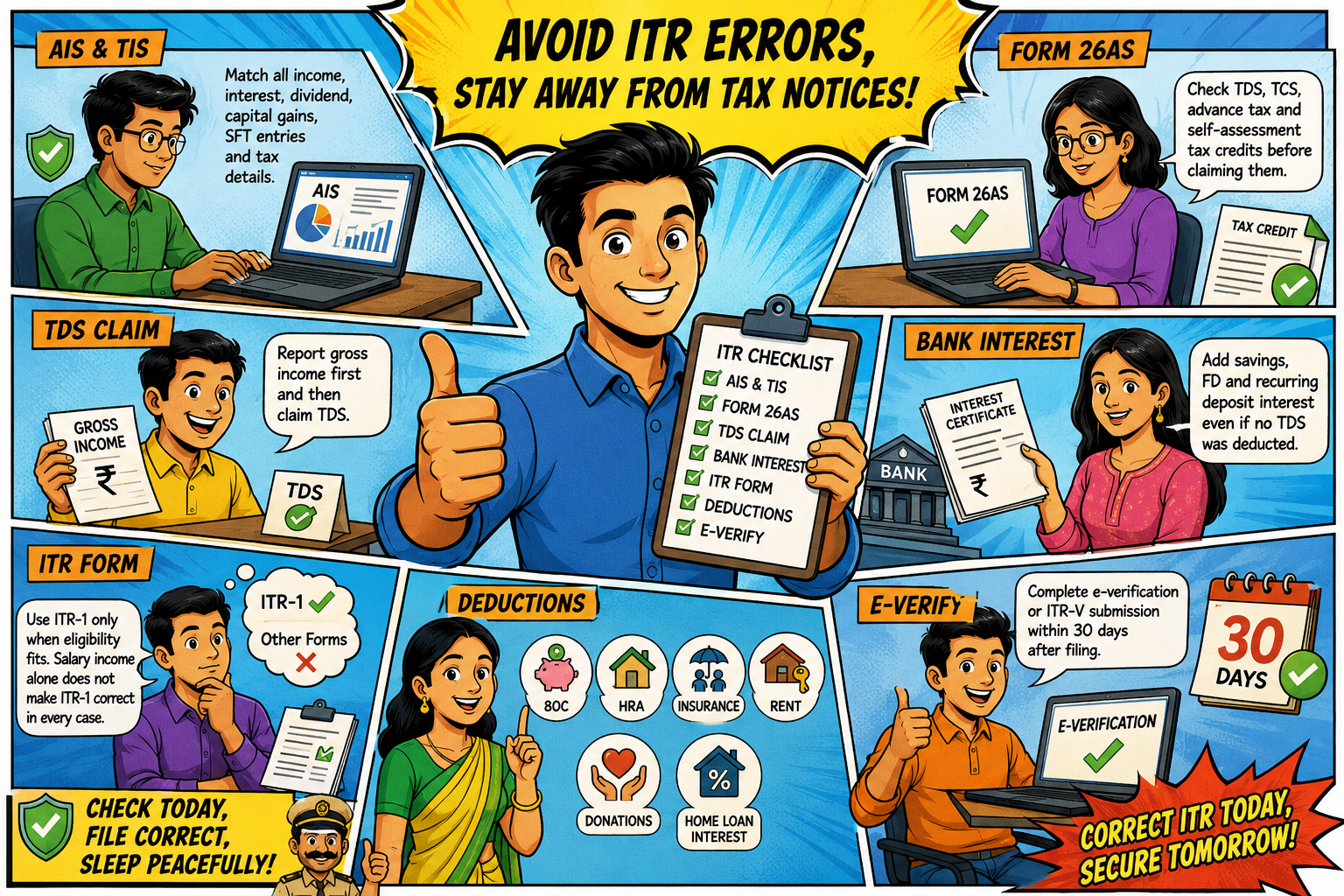
There is a useful side too. Taxpayers now get more chances to catch a wrong entry before submission. AIS can show TDS, TCS, SFT information, tax payments, refund details and other reported information. Form 26AS can help verify tax credits. Bank interest certificates can confirm FD and savings interest.
Taxpayers should remember 1 basic rule. Pre-filled ITR data should be checked line by line, not accepted in a hurry.
After these checks, taxpayers should review the refund bank account, PAN, address, mobile number and email ID. These look small, but they can affect refund communication and follow-up. A correct tax calculation can still get stuck if the refund account is not validated.
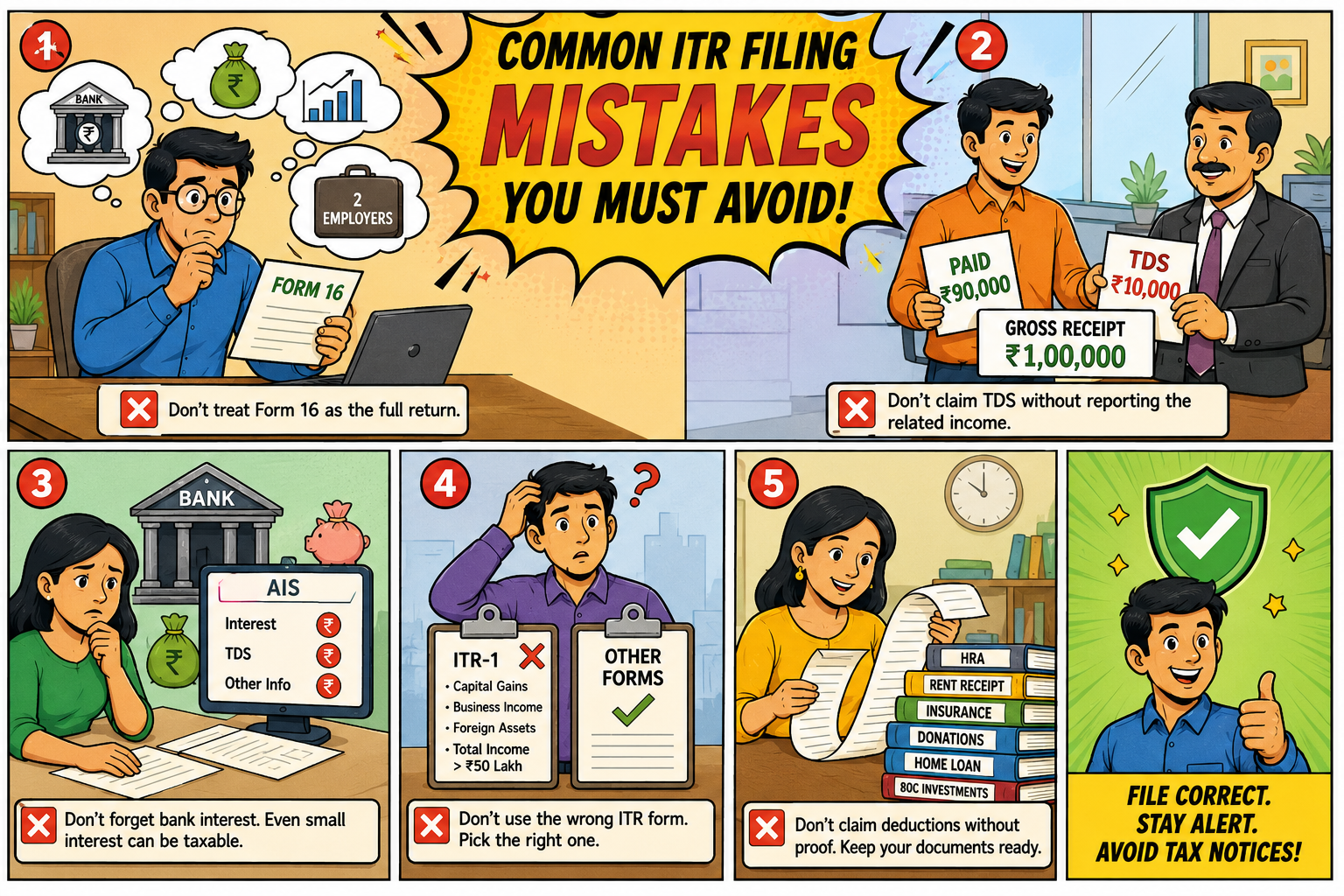
The first common mistake is treating Form 16 as the full return. For a salaried person with no other income, Form 16 may cover most details. For someone with FD interest, freelance receipts, dividend, mutual fund redemptions, or salary from 2 employers, Form 16 is only 1 part of the file.
Another mistake is claiming TDS without reporting the related income. Suppose a client paid ₹90,000 after deducting ₹10,000 as TDS on freelance work. The taxpayer should report the gross receipt of ₹1,00,000 and then claim the TDS credit. If only ₹90,000 is shown, the return may not match tax credit data.
Many taxpayers also forget bank interest because the amount looks small. Savings interest, FD interest and recurring deposit interest can still be taxable even when the bank has not deducted TDS. If AIS shows interest and the return leaves it out, the mismatch becomes easy to spot.
The wrong ITR form is another avoidable trap. ITR-1 may look easier, but it cannot be used in every case. Capital gains, business income, foreign assets, foreign income, carried-forward losses, total income above ₹50 lakh and some other cases may require another form.
Deduction claims create trouble when taxpayers cannot back them with papers. HRA, rent, insurance, donations, home loan interest and 80C investments should be supported by receipts or certificates. The documents are not uploaded with the return, but the taxpayer must keep them ready.
Gauri Chadha, Tax Expert, said in the Business Today video that taxpayers should check AIS and Form 26AS mismatches, incorrect TDS claims, failure to e-verify, missing information and unsupported deduction claims. Her advice applies strongly to people who changed jobs, earned deposit interest, claimed HRA, received freelance income, traded in shares, or filed through pre-filled details without checking every line.
The solution starts before login. Salaried taxpayers should collect Form 16 from every employer. Fixed deposit holders should download interest certificates from every bank. Freelancers should keep invoices, receipts, client-wise TDS certificates and bank entries ready. If income has been earned, it should not be left out only because no TDS was deducted.
LoansJagat’s filing coverage added a ground-level view. Its report said salary, taxable bank interest and freelance receipts earned from 1 April 2025 to 31 March 2026 may all need to appear in 1 return. It also gave the example of a salaried employee who earns FD interest from 3 banks and completes paid work for 2 clients, where no single payer sees the full income picture, as noted by LoansJagat.
A safer filing route is simple. Download AIS and Form 26AS. Match tax credits. Add every bank interest certificate. Check capital gains statements if shares, mutual funds, or securities were sold. Choose the correct ITR form. Upload the return. Then e-verify it within 30 days.
The previous update came from the tax department’s wider push for digital checking before filing. The Income Tax Department’s 17 July 2026 SMS campaign asked taxpayers to file early for AY 2026-27 and mentioned 31 July 2026 as the due date. Earlier reminder messages also pushed taxpayers to complete pending e-verification within 30 days of uploading the ITR.
The earlier filing change also gave AIS a bigger role. Form 26AS was once the main tax credit reference for many taxpayers. Now AIS gives a broader financial information view. It can include TDS and TCS information, SFT information, payment of taxes, demand and refund details and other information received from reporting sources.
Defective return notices also remain part of the filing risk. If the department finds incomplete or inconsistent information, the taxpayer may receive a notice under Section 139(9). Such issues can include claiming TDS without reporting related income, showing receipts in Form 26AS higher than receipts in the ITR, entering income incorrectly, or missing required schedules.
Business Today reported on 23 July 2026 that Gauri Chadha, Tax Expert, identified AIS mismatch, Form 26AS mismatch, incorrect TDS claims, missed e-verification, missing information and unsupported deduction claims as common reasons behind income tax notices. She also advised taxpayers to keep supporting documents ready if scrutiny begins.
According to the Income Tax Department, AIS provides an overview of taxpayer information before filing and enables the submission of feedback online. Regarding the ITR-V, their FAQ cites that e-verification or submission of ITR-V should be done within 30 days of filing. This is per Notification No. 2/2024 of 31 March 2024, and is applicable from 1 April 2024.
LoansJagat’s 2026 filing report says many taxpayers may open Form 16 and think filing is almost done, but AY 2026-27 filings may lack fixed deposit interest and freelance income if all sources of income are not reviewed.
The latest warning is direct. Taxpayers should not file ITR before 31 July 2026 only from Form 16 or prefilled figures. AIS, Form 26AS, TDS certificates, bank interest, dividend entries, capital gains statements, deduction proof and e-verification status all need a final check.
For a salaried person, Form 16 starts the filing process. It does not finish it. For a freelancer or investor, the risk is higher because income can come from several places. A return that matches records, uses the right form and gets e-verified within 30 days has a better chance of being processed without avoidable notices, refund delays, or later correction work.
What happened in this ITR filing update?
Business Today’s 23 July 2026 video warned that AIS, Form 26AS, TDS, e-verification and deduction proof errors can trigger income tax notices.
Who should be more careful before filing ITR?
Salaried employees, job changers, freelancers, pensioners, FD holders, investors and people claiming deductions should check records before filing.
What is the ITR due date mentioned by the tax department?
The Income Tax Department’s SMS campaign dated 17 July 2026 mentioned 31 July 2026 as the due date for AY 2026-27 ITR filing.
Why can AIS mismatches create a tax notice?
AIS carries financial data received by the department. If the return leaves out income shown in AIS, the system can flag the difference.
Is Form 16 enough for filing ITR?
No. Form 16 records salary and employer TDS. Bank interest, freelance receipts, dividends and capital gains may need separate checking.
What happens if ITR is not e-verified?
The Income Tax Department says an uploaded return that is not verified is treated as invalid.
Start your journey today
Apply Now*T&C apply









.png&w=3840&q=75)


