
By continuing, you agree to LoansJagat's Credit Report Terms of Use, Terms and Conditions, Privacy Policy, and authorize contact via Call, SMS, Email, or WhatsApp
Disclaimer: The information published on LoansJagat is intended for general informational and educational purposes only and should not be considered financial, legal, or investment advice. Interest rates, loan terms, statistics, and other data may change over time and may vary by lender or source. Please verify the latest information and consult a qualified financial advisor or the respective Bank/NBFC before making any financial decisions.
Subscribe Now
About the author

Arshathul Afia is a journalism graduate and fintech content writer with 4+ years of experience in digital publishing and research-led writing. She has written 200+ articles covering personal finance, lending, banking, digital payments, credit, insurance, and major financial developments in India. At LoansJagat, she focuses on simplifying complex fintech news, RBI updates, loan-related changes, policy developments, and industry trends for everyday readers. Her journalism background helps her approach stories with research, context, and clarity, while her SEO experience ensures content remains discoverable and relevant. She aims to make financial news easier to understand, practical, and useful for readers across India.
Related News
Simplify All Your Loans Into One Affordable EMI

Customers Served

Debt Consolidated

1200+ Reviews

Locations in India
Club all Loans & Credit Card Bills into Single EMI

Quick Apply Loan
Consolidate your debts into one easy EMI.

Takes less than 2 minutes. No paperwork.

10 Lakhs+
Trusted Customers

2000 Cr+
Loans Disbursed

4.7/5
Google Reviews

50+
Banks & NBFCs Offers
Other services mentioned in this article
Many taxpayers will open Form 16, check the salary figure and assume most of the filing work is done. For AY 2026-27, that shortcut can leave out FD interest and money earned from freelance assignments.
Key Highlights
A salaried employee may receive income from several sources during the same year. One employer pays the monthly salary. A bank credits interest every quarter. Then there may be 2 or 3 weekend assignments, perhaps a design project, tax consultancy, tutoring work or content writing. None of these payers sees the full picture. That responsibility stays with the taxpayer.
Bank interest needs a separate check. The Income Tax Department’s guidance updated on 2 July 2026 explains when banks must deduct TDS, but the threshold does not decide whether the interest is taxable. A depositor may earn interest below the deduction limit and still need to include it in the return.
Consider a fairly ordinary case. An employee receives a salary from 1 company, earns FD interest from 3 banks and completes paid work for 2 clients. The employer reports payroll income. Each bank reports its own interest. The clients report only what they paid. No single statement joins those entries together.
A missed figure can create a mismatch when the return is processed. The refund may take longer, extra tax may become payable, or the taxpayer may have to revise the filing later. A little checking before submission is easier than correcting the record afterwards.
Employees who worked for more than 1 company during FY 2025-26 must include salary from every employer. The final company may not know what the previous employer paid unless the employee submitted those details during payroll processing. Bonuses, taxable allowances, arrears and taxable benefits also need review.
FD holders face a quieter reporting risk. Banks generally deduct TDS when annual interest crosses ₹50,000 for other depositors and ₹1,00,000 for resident senior citizens. These limits took effect from 1 April 2025. An employee earning ₹36,000 from an FD may see no TDS in Form 26AS, but the interest can still form part of taxable income.
There is a useful side to the digital trail. Form 16 records salary and employer TDS. Bank interest certificates provide deposit-wise earnings. Freelance invoices show gross client payments. AIS and Form 26AS allow the taxpayer to compare these records before submission.
That comparison can also protect valid tax credits. A freelance client may deduct TDS before transferring payment. The taxpayer should report the gross invoice amount and claim the deducted tax separately. Reporting only the amount received in the bank understates the freelance receipt.
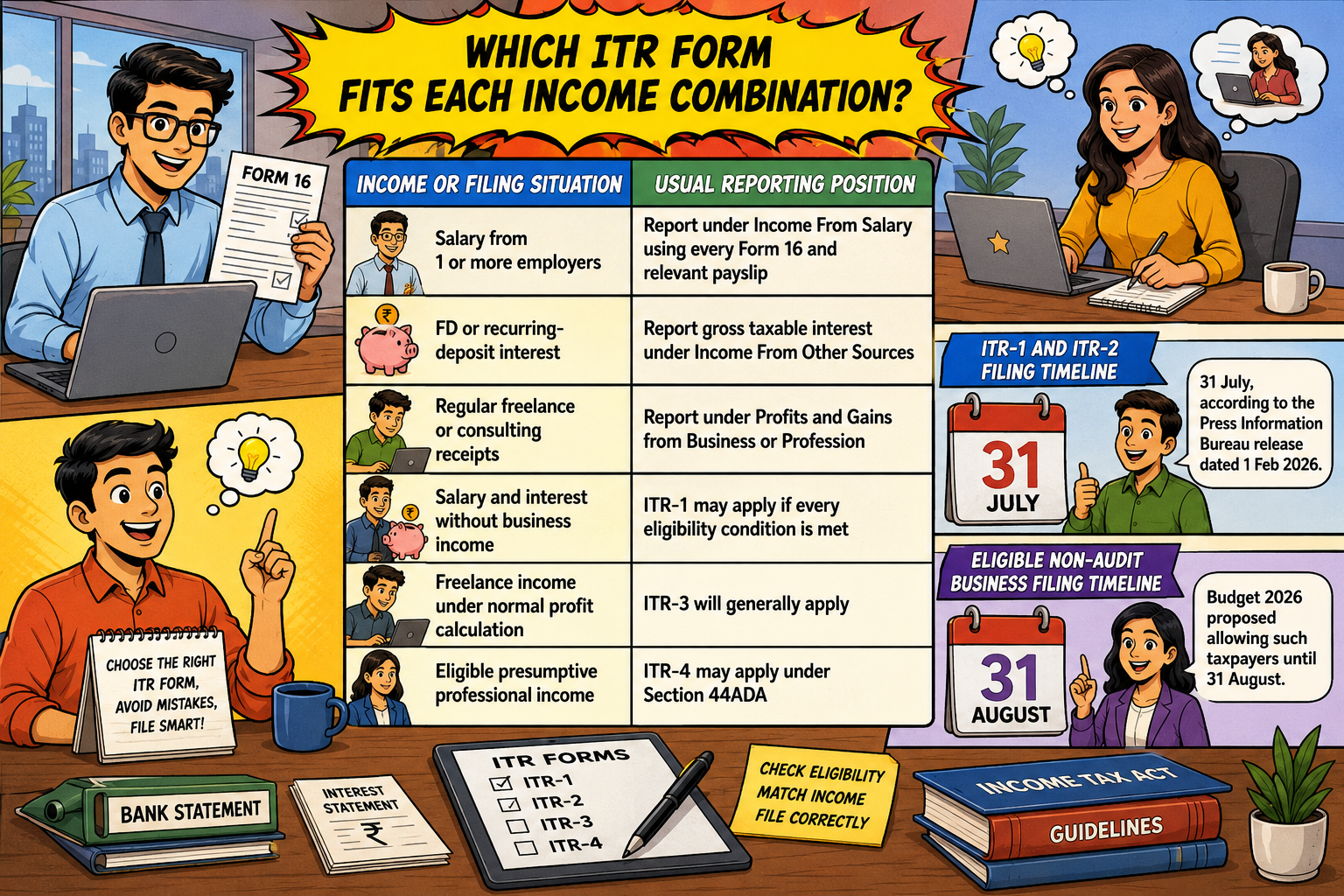
The return form depends on the type of income, not merely the highest amount earned. A person may receive most earnings through salary but still become ineligible for ITR-1 after starting regular freelance work.
The table below provides the usual reporting route. Residence status, capital gains, foreign assets, total income and other conditions can still alter the final selection.
The table gives a starting route, not an automatic answer. A taxpayer with overseas shares, foreign income, certain capital gains or carried-forward losses may need a different form even when salary remains the main source.
ITR-3 permits regular computation of business or professional profit. The taxpayer reports gross freelance receipts and then claims eligible work expenses supported by records. Depending on the occupation, these may include software subscriptions, platform fees, internet charges, equipment depreciation and travel directly connected with assignments.
Section 44ADA offers presumptive taxation to eligible resident professionals. The provision generally allows 50% of gross professional receipts to be declared as taxable profit, without listing each routine expense separately.
The basic gross-receipt limit is ₹50 lakh. It can rise to ₹75 lakh where cash receipts do not exceed 5% of total receipts. The provision covers specified professions, including legal, medical, engineering, architecture, accountancy, technical consultancy and interior decoration, along with notified categories.
A person calling an activity “freelance work” does not automatically qualify. The service performed decides whether Section 44ADA applies. Content creators, commission earners, delivery workers and people selling products online may need separate classification.
Taxpayers considering the presumptive route can read the LoansJagat explanation of Section 44ADA of the Income Tax Act. The final choice should follow the law, return-form eligibility and the actual nature of the work.
The deposit-interest TDS thresholds changed through the Union Budget 2025-26 and became effective on 1 April 2025. The limit for other depositors increased from ₹40,000 to ₹50,000. For resident senior citizens, it increased from ₹50,000 to ₹100,000.
The change reduced TDS deductions for some depositors. It did not create a new tax exemption. Interest must still be included when calculating taxable income under the applicable rules.
Another update came with the Union Budget 2026-27, presented on 1 February 2026. The government proposed retaining 31 July for individuals filing ITR-1 and ITR-2. Non-audit business cases and trusts were proposed to receive time until 31 August.
The Central Board of Direct Taxes also released the AY 2026-27 return forms and utilities in stages. By July 2026, ITR-1, ITR-2, ITR-3 and ITR-4 were available through the e-filing system.
Pranav Sai S, tax expert at ClearTax, told Business Standard on 18 May 2026 that ITR-1 should be used where income remains within the permitted salary, house-property and other-source categories. He said the form does not cover business or professional income.
Sai also identified a common error among salaried filers. Some taxpayers use ITR-1 even after receiving freelance or professional income. Such a filing may be treated as defective and could lead to a notice, tax demand or interest.
Archit Gupta, Founder and CEO of ClearTax, told The Economic Times in July 2026 that Form 26AS and AIS can change as clients submit or revise TDS returns. He advised taxpayers to raise AIS feedback when reported figures differ from actual records.
The workable answer is document reconciliation. Employees should collect Form 16 from every employer, download annual interest certificates from each bank and arrange freelance invoices client by client. Form 16A should be checked wherever a client or bank has deducted tax.
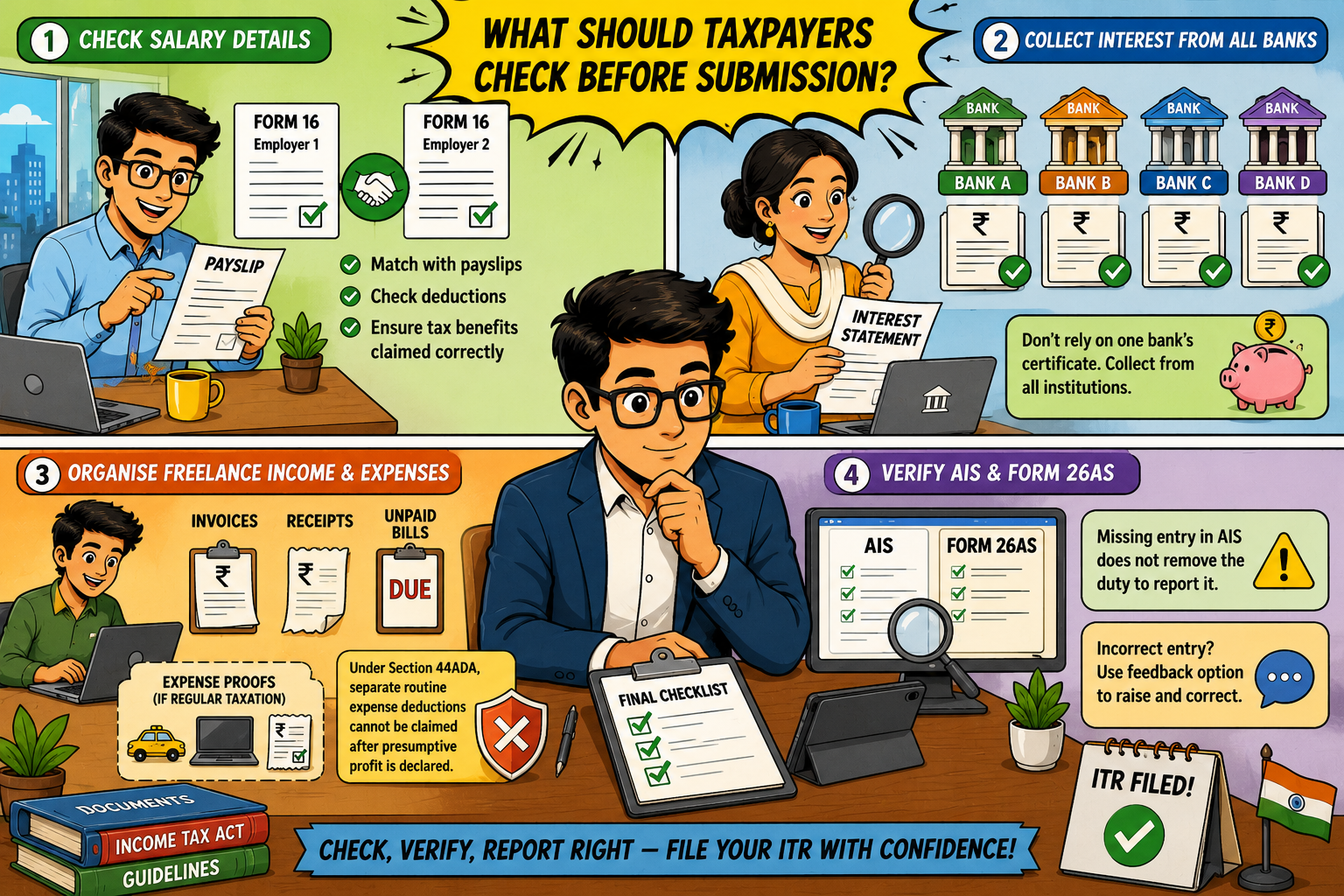
The salary figure should be matched with payslips and every Form 16. Job changers should check whether both employers allow the same deduction or tax benefit while calculating payroll TDS.
Interest should be collected bank by bank. A person holding deposits with 4 institutions should not assume that the largest bank’s certificate covers the remaining accounts.
Freelancers need a separate list of invoices, receipts and unpaid bills. Where the regular taxation method is used, expense claims should have invoices or payment proof. Under Section 44ADA, separate routine expense deductions cannot generally be claimed after presumptive profit has been declared.
AIS and Form 26AS should be used as comparison records. A missing transaction in AIS does not remove the duty to report it. An incorrect entry should be challenged through the available feedback process.
ITR Filing 2026 requires more than copying a salary figure from Form 16. Taxpayers must collect income details from employers, banks and freelance clients, then place each amount under the correct head.
Salary and FD interest may remain eligible for ITR-1 when all conditions are satisfied. Freelance business or professional income usually changes the form to ITR-3 or eligible ITR-4.
The safest approach is quite ordinary. Gather the documents, total the gross income, match the TDS credits and choose the return form only after classifying every receipt. That effort can prevent delayed refunds, defective return notices and costly corrections after filing.
Is FD interest taxable when no TDS was deducted?
Yes. The TDS threshold controls deduction by the bank, while taxable interest must still be reported.
Can a salaried freelancer file ITR-1?
Usually not when freelance receipts qualify as business or professional income. ITR-3 or an eligible ITR-4 may apply.
Should freelance income be reported before or after TDS?
The gross receipts should generally be reported. TDS deducted by the client is claimed separately as a tax credit.
Can every freelancer use section 44ADA?
No. It applies to eligible taxpayers engaged in specified or notified professions and meeting its other conditions.
Which records should be matched before filing?
Taxpayers should compare Form 16, Form 16A, interest certificates, invoices, AIS, Form 26AS, and bank statements.
Start your journey today
Apply Now*T&C apply








.png&w=3840&q=75)


