
By continuing, you agree to LoansJagat's Credit Report Terms of Use, Terms and Conditions, Privacy Policy, and authorize contact via Call, SMS, Email, or WhatsApp
Disclaimer: The information published on LoansJagat is intended for general informational and educational purposes only and should not be considered financial, legal, or investment advice. Interest rates, loan terms, statistics, and other data may change over time and may vary by lender or source. Please verify the latest information and consult a qualified financial advisor or the respective Bank/NBFC before making any financial decisions.
Subscribe Now
About the author

Arshathul Afia is a journalism graduate and fintech content writer with 4+ years of experience in digital publishing and research-led writing. She has written 200+ articles covering personal finance, lending, banking, digital payments, credit, insurance, and major financial developments in India. At LoansJagat, she focuses on simplifying complex fintech news, RBI updates, loan-related changes, policy developments, and industry trends for everyday readers. Her journalism background helps her approach stories with research, context, and clarity, while her SEO experience ensures content remains discoverable and relevant. She aims to make financial news easier to understand, practical, and useful for readers across India.
Related News
Simplify All Your Loans Into One Affordable EMI

Customers Served

Debt Consolidated

1200+ Reviews

Locations in India
Club all Loans & Credit Card Bills into Single EMI

Quick Apply Loan
Consolidate your debts into one easy EMI.

Takes less than 2 minutes. No paperwork.

10 Lakhs+
Trusted Customers

2000 Cr+
Loans Disbursed

4.7/5
Google Reviews

50+
Banks & NBFCs Offers
Other services mentioned in this article
For salaried taxpayers, the due date for ITR-1 and ITR-2 for AY 2026-27 is July 31st and they are given 10 days remaining.
Key Highlights
The general requirements for filing ITR-1 or ITR-2 include salaried employees, pensioners, and non-business taxpayers.
The income tax filing season for wage earners is getting shorter. The last date for ITR-1 / ITR-2 was 21st July 2026 for the Assessment Year 2026-27. Income on this return is for the period April 1, 2025, to March 31, 2026. With this, the
Employees with a single salary and no other income may finish filing without much difficulty. Others may need more time. A job switch, share sale, old fixed deposit, rental income or overseas stock holding can change the form and the tax calculation. Waiting until the final evening also leaves very little room to correct a missing TDS credit or failed bank validation.
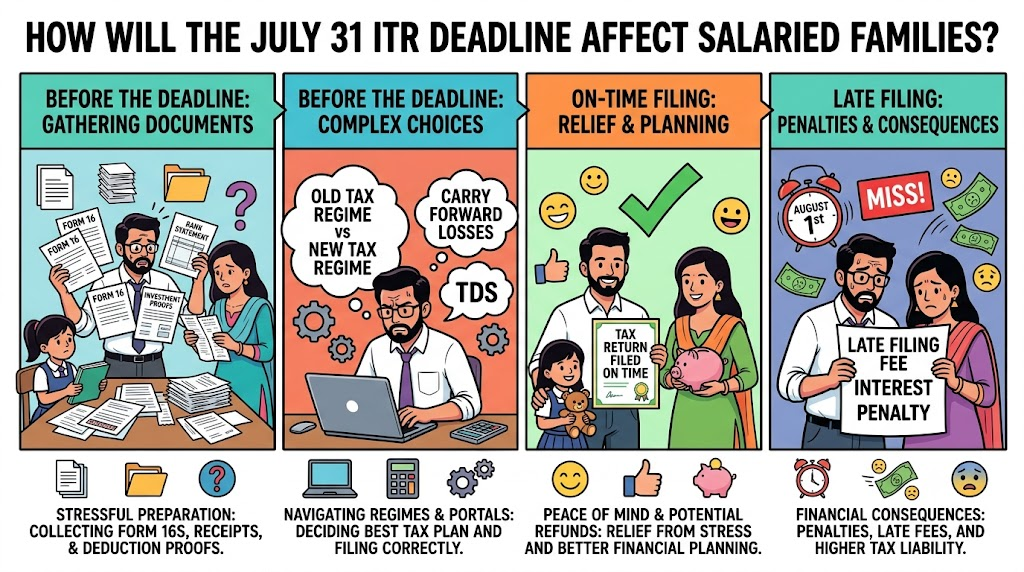
Tax gets deducted from salary throughout the year, so many employees assume the return is already prepared. That is only partly true. Form 16 records salary and deductions handled by the employer. It may not include income reported separately by a bank, broker, tenant or earlier employer.
Consider an employee who worked in Bengaluru until September 2025 and joined a Gurugram firm the next month. The new employer may have calculated TDS only on the salary paid from October onwards. The earlier salary still has to be reported. If it is missed, the filed return may differ from the information submitted by the 2 employers.
Bank interest is another routine omission. A fixed deposit opened 2 or 3 years ago can continue earning interest even when the taxpayer has forgotten about it. The bank may report that amount in AIS. Dividend income, mutual fund redemptions and rent can appear there as well.
Filing before the last few days gives families time to find missing papers and correct errors. Refund cases need extra attention. The selected account must remain active and should be validated on the portal. A closed salary account can hold up payment long after the return has been processed.
The main impact of the July 31st deadline relates to those who are eligible to file ITR-1 and those who are not required to audit their tax returns, whether they are individuals or HUFs, who do not have any business income.
An eligible resident individual with total income of up to ₹50 lakh can avail the ITR-1. These sources are allowed to be salary, pension, 1 house property and certain other income sources. Conditions notified by the Government of India may be applicable for claiming long-term capital gains as per Section 112A as well, which may be claimed in ITR-1.
If no business or professional income is there but the taxpayer is unable to file ITR-1, he/she will have to file ITR-2. If a salaried employee sells shares, has two or more than two assets, receives foreign income, or has assets held outside India, then he may require an ITR-2.
A salary slip does not decide the form. The complete income record does.
The broad deadline calendar is given below.
These dates provide a broad guide. The return form still depends on what the taxpayer earned during FY 2025-26.
A person may be employed full-time and also receive freelance fees on weekends. That second income stream can push the return into ITR-3. Doctors, lawyers, consultants and shop owners without an audit requirement may fall under the August 31 date instead of July 31.
The July date receives far more attention, which is why some business and professional taxpayers rush into the wrong form. A defective-return notice can follow. Then the filing has to be corrected within the time given by the department.
Form 16 is usually where the work begins. It should not be where it ends.
Salary from every employer needs to be included. TDS shown in Form 16 should appear in Form 26AS. AIS should then be checked against bank statements, broker reports, property records and investment statements.
Pre-filled data is useful, but it is not always final.
Suppose AIS shows that shares worth ₹4 lakh were sold during the year. That figure is the sale value, not automatically the taxable capital gain. The purchase cost, holding period, and type of security still have to be considered. Entering ₹4 lakh directly as gain can produce the wrong tax bill.
Duplicate entries can appear too. A bank or company may revise an earlier report, leaving both entries visible for some time. A hurried filer can end up reporting the same income twice.
The LoansJagat tax filing deadline guide, published on May 4, 2026, lists July 31 for eligible ITR-1 and ITR-2 filers and August 31 for qualifying non-audit business returns. LoansJagat’s editorial view is that taxpayers should trace every major figure back to a document, particularly where the return includes 2 employers, several bank accounts or investment sales.
Deduction claims require paperwork as well. Home-loan interest should agree with the lender certificate. Insurance premiums, donations and eligible investments should have receipts or statements behind them. A deduction claimed last year may no longer apply.
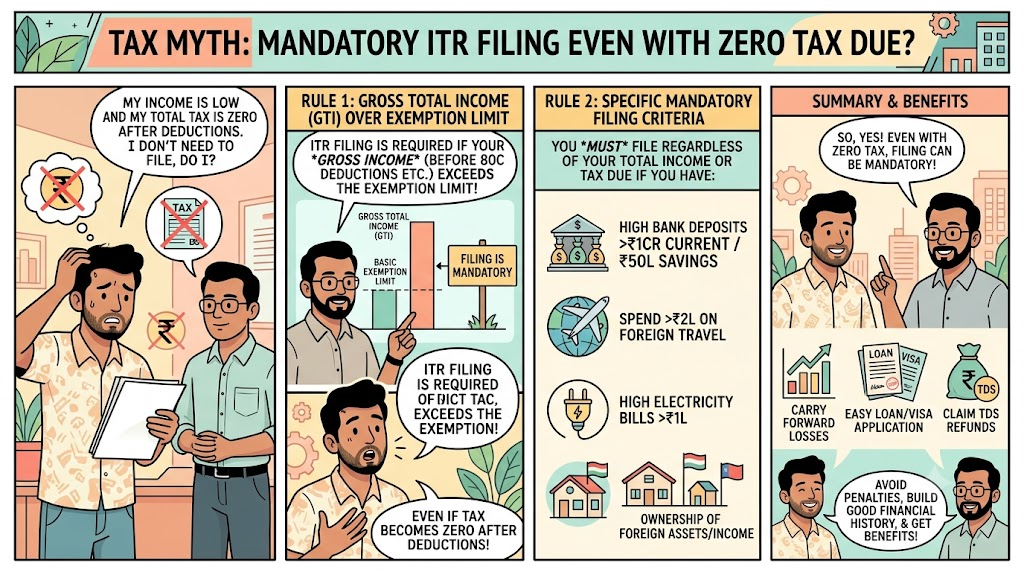
Yes. A final tax bill of ₹0 does not always remove the filing requirement.
A rebate may bring the tax payable down to zero after income has been calculated. The obligation to file can still arise because of the income level, a foreign asset, or a specified transaction. Many salaried employees overlook this because Form 16 shows no balance tax.
Overseas company shares are a useful example. An employee working for the Indian arm of a foreign company may receive stock units in the parent company. Even a small holding can create foreign asset reporting duties. ITR-1 cannot be used in such a case.
Other filing triggers may include specified deposits, foreign travel spending, electricity expenditure or prescribed TDS and TCS limits. The tax amount shown at the end of the calculation does not answer every filing question.
Last year’s extension has fuelled much of the current speculation. CBDT moved the AY 2025-26 return deadline from July 31, 2025, to September 15, 2025. The Press Information Bureau announced the change on May 27, 2025.
The government referred to changes in the ITR forms, system development, integration work, testing, and the release of filing utilities. Extra time was given because the filing setup required further preparation.
The position in 2026 was different as of July 21. The Income Tax Department continued to show July 31 for eligible ITR-1 and ITR-2 taxpayers. The principal filing utilities were available, and no CBDT circular had shifted the date.
Only a formal government communication can alter the deadline. Messages circulating on WhatsApp or posts from unverified accounts do not change it.
Waiting can create trouble for taxpayers with 2 employers, capital gains, rental income and several bank accounts. Such a return rarely gets completed properly in 20 minutes. Missing statements, unmatched TDS and unpaid tax often surface only after the calculation begins.
Tax advisers are asking employees to review the records before submitting anything.
Salary from all employers should be added first. Form 16 and Form 26AS should then be compared. AIS entries need to be checked against bank records, broker statements and other supporting papers.
Anyone who sold shares or mutual funds should download a capital-gains statement from the broker or investment platform. Sale proceeds and taxable gains are different. Purchase cost, holding period and asset category affect the final figure.
Rent and home-loan claims need supporting documents. The portal may not request them during filing, but the tax department can ask for proof later.
Bank details often get checked at the very end, when attention has already dropped. That is where avoidable errors creep in. The account number, IFSC and account type should be checked again. The refund account must remain open and should be validated.
E-verification follows submission. Aadhaar OTP, net banking and other approved methods are available. Uploading the form without verification leaves the filing incomplete.
Also Read: Income Tax Exemption Limit – Complete Guide to Slabs & Deductions
In general, a belated return for AY 2026-27 can be filed by December 31, 2026, if the assessment is not completed by this date. The late fee may be a maximum of ₹5000. The cap is ₹1000 on income of up to ₹5 lakh.
Interest may also apply when tax remains unpaid. Refund processing can begin later because the return enters the system after the original date.
Losses can create a heavier financial hit. Certain capital and business losses generally cannot be carried forward when the taxpayer misses the due date.
Take a salaried investor who sold shares at a loss during FY 2025-26. A timely return may allow that loss to be carried forward and adjusted against eligible gains in later years. A belated return can remove that benefit, depending on the type of loss. The future tax cost can be far higher than the late fee.
Eligible salaried employees, pensioners and non-business taxpayers who are filing returns in ITR-1 or ITR-2 for AY 2026-27 have July 31, 2026 as their due date. The filing date may be later for business and professional taxpayers.
Before submission, salary from every employer should be added. Form 16 needs to be compared with AIS and Form 26AS. Bank interest, dividends, capital gains, and foreign assets should be checked separately.
The last steps are easy to overlook. Confirm the refund account. Submit the return. Finish e-verification. Unless CBDT issues an official extension, eligible salaried taxpayers should continue working with July 31 as the deadline.
What is the ITR filing last date for salaried employees in 2026?
July 31, 2026 is the general due date for eligible salaried taxpayers filing ITR-1 or ITR-2.
Who can file ITR-1 for AY 2026-27?
An eligible resident individual with income up to ₹50 lakh from the sources permitted under the form.
Can a salaried employee with capital gains use ITR-1?
Limited Section 112A gains may qualify. Other capital gains generally require ITR-2.
Do freelancers have to file by July 31?
Not always. Eligible non-audit business and professional taxpayers generally have until August 31, 2026.
Which ITR should be filed for salary, rent and capital gains?
ITR-2 generally applies when income includes salary, house-property rent and capital gains, provided there is no business income.
Is the filing complete once the return is uploaded?
No. The taxpayer must also complete e-verification through an approved method within the allowed period.
Start your journey today
Apply Now*T&C apply









.png&w=3840&q=75)


