By continuing, you agree to LoansJagat's Credit Report Terms of Use, Terms and Conditions, Privacy Policy, and authorize contact via Call, SMS, Email, or WhatsApp
Disclaimer: The information published on LoansJagat is intended for general informational and educational purposes only and should not be considered financial, legal, or investment advice. Interest rates, loan terms, statistics, and other data may change over time and may vary by lender or source. Please verify the latest information and consult a qualified financial advisor or the respective Bank/NBFC before making any financial decisions.
Subscribe Now
About the author

Arshathul Afia is a journalism graduate and fintech content writer with 4+ years of experience in digital publishing and research-led writing. She has written 200+ articles covering personal finance, lending, banking, digital payments, credit, insurance, and major financial developments in India. At LoansJagat, she focuses on simplifying complex fintech news, RBI updates, loan-related changes, policy developments, and industry trends for everyday readers. Her journalism background helps her approach stories with research, context, and clarity, while her SEO experience ensures content remains discoverable and relevant. She aims to make financial news easier to understand, practical, and useful for readers across India.
Related News
Simplify All Your Loans Into One Affordable EMI

Customers Served

Debt Consolidated

1200+ Reviews

Locations in India
Club all Loans & Credit Card Bills into Single EMI

Quick Apply Loan
Consolidate your debts into one easy EMI.

Takes less than 2 minutes. No paperwork.

10 Lakhs+
Trusted Customers

2000 Cr+
Loans Disbursed

4.7/5
Google Reviews

50+
Banks & NBFCs Offers
Other services mentioned in this article
Sustained pressure remains from July 31 filings as over 3 crore ITRs were already filed. Taxpayers are currently verifying their AIS, 26AS forms, and refund statuses.
Key Highlights
According to the Tax Department, over 3 crore ITRs were filed for AY 2026-27, and an unprecedented daily filing record was set at over 150,000 ITRs. Taxpayers are encouraged to not wait for the July 31 filing rush. The July 23, 2026 Moneycontrol report noted the July 31 filing deadline applies to most salaried individuals and the majority of taxpayers who are not subject to mandatory audit requirements.
The short-term effect is already visible. More taxpayers are logging in, tax professionals are getting busier, and families are rushing to collect Form 16, bank interest certificates, capital gains statements and rent details. The long-term risk is slower. A return filed in haste can later lead to mismatch notices, delayed refunds, wrong tax regime selection or a revised return. For many taxpayers, the problem may not be filing itself. It may be filed without checking the numbers.
The filing update affects salaried employees first. A person with 1 employer, 1 bank account and no capital gains can usually file faster. Someone who changed jobs, sold mutual funds, earned FD interest, received dividend income or claimed house rent benefits has more work. Such taxpayers need to match the return with AIS, Form 26AS and Form 16 before clicking submit.
There is a helpful side too. The official Income Tax Department e-filing portal has already shown that ITR-1, ITR-2, ITR-3 and ITR-4 for AY 2026-27 are live, with Excel utilities, online filing and offline filing enabled. That gives most individual taxpayers enough routes to file without waiting for the last night. The same portal also shows ITR utility updates, so taxpayers using offline forms should download the latest version instead of using an older file.
The wider public impact is not only about tax payment. Refund claimants should also act early because processing starts only after a return is filed and verified. A refund bank account that is not validated can hold up payment. A mismatch in TDS can invite later correction. These are small details, but they cause the most frustration during peak season.
A taxpayer also needs to pick the right form. ITR-1 is not for every salaried person. People with capital gains above eligible limits, foreign assets, business income or more complex income entries may need another form. The Income Tax Department’s downloads page lists the Common Offline Utility for ITR-1, ITR-2, ITR-3 and ITR-4 for AY 2026-27, with the latest version released on July 17, 2026.
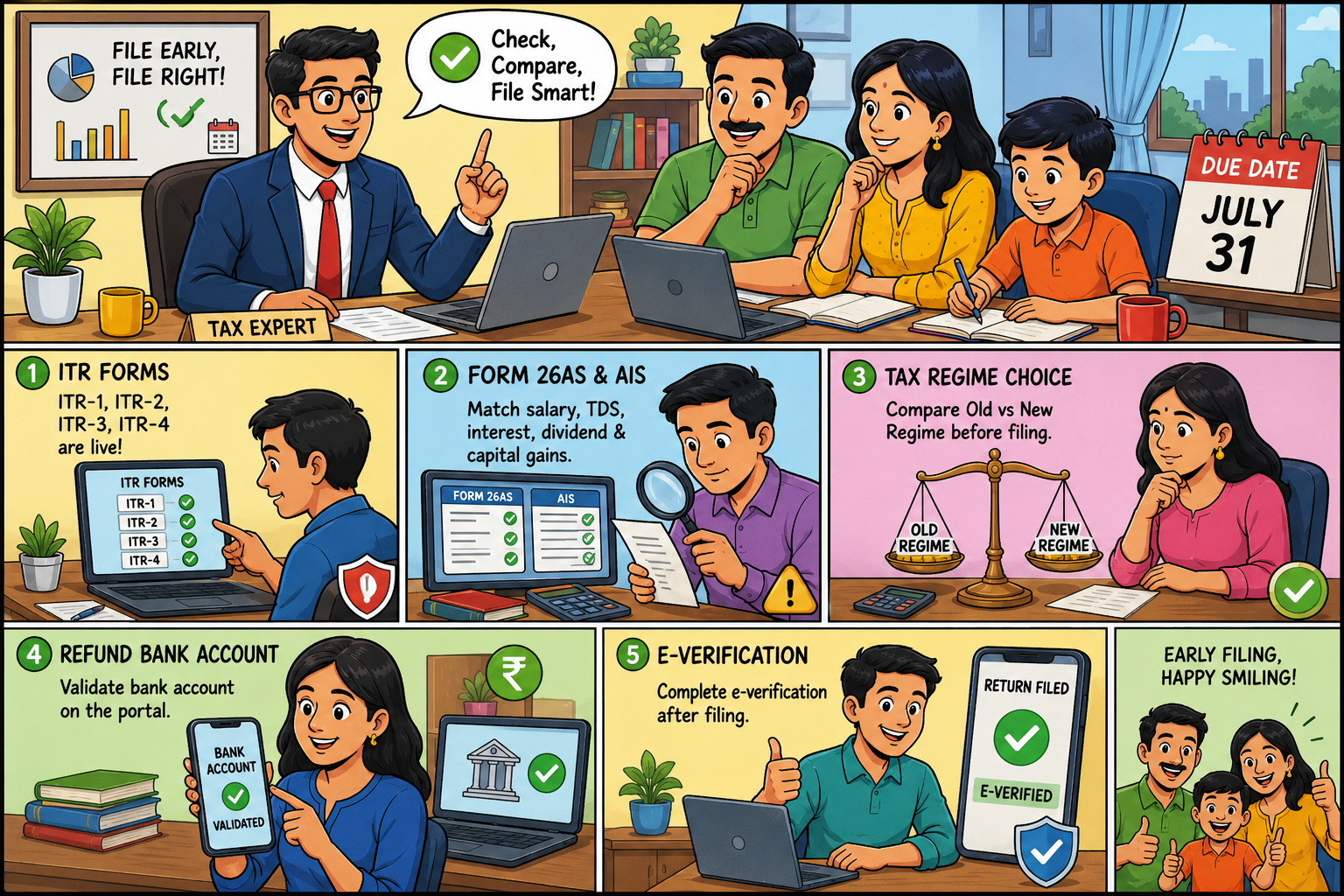
Tax experts are asking people to file early, but not blindly. Moneycontrol quoted Mohit Gupta, Partner, PNAM & Co. LLP, as saying that many taxpayers prefer the new tax regime because they do not have large deductions such as home loan interest, HRA or Section 80C investments. He also said taxpayers with sizeable deductions should compare both regimes before making a choice.
The fix is ordinary, but it takes patience. A taxpayer should download AIS, Form 26AS and Form 16 first. Then comes the slow check: salary income, savings account interest, FD interest, dividend income, capital gains, rent, deductions and TDS. The Income Tax India taxpayer guidance also asks taxpayers to file on or before the due date, verify Form 26AS, choose the correct ITR form and keep PAN, address, email and bank details accurate.
LoansJagat’s tax desk takes a similar view. Its July 6, 2026 guide says wrong ITR form selection, AIS mismatch and delayed e-verification can turn a normal return into a tax notice or refund delay. That is a useful warning for borrowers too. Many salaried borrowers use ITR acknowledgements for personal loans, home loans, business loans or credit reassessment, so a delayed or faulty return can slow paperwork later. The LoansJagat guide places the issue where taxpayers often feel it, not in tax theory but in daily paperwork.
Here is a quick filing check that taxpayers can use before submission.
The table shows why the last step should not be rushed. Filing is one part. Checking, submitting and verifying together complete the process. A taxpayer who stops after upload may still have unfinished compliance.
Before the 3 crore filing update, the department had already started preparing taxpayers through portal changes and reminders. The e-filing portal showed that major individual return forms were live for AY 2026-27. That rollout gave salaried taxpayers, HUFs and non-audit filers the forms needed to file before July 31.
The department also widened support for the final filing period. The official downloads and support page says e-filing and Centralised Processing Centre support lines will operate 24x7 from 08:00 hrs on July 25, 2026, until 23:59 hrs on July 31, 2026. This move came as more taxpayers started logging in during the final stretch.
There was also a wider portal-performance discussion before this update. In Parliament, Minister of State for Finance Pankaj Chaudhary said ITR filings between July 8 and July 14 more than doubled year-on-year on several days, reaching 12.22 lakh returns on July 14, while daily logins rose to nearly 99 lakh. The Economic Times reported this on July 21, 2026, while covering the government’s response on portal readiness.
That earlier context explains why the department is warning taxpayers now. The portal may be ready for heavy use, but taxpayers still lose time when they file with missing papers. A crowded deadline week also leaves little space to correct rejected bank validation, wrong income entries or a forgotten deduction.

The Income Tax Department said 3 crore+ ITRs had been filed for AY 2026-27 and that 15 lakh+ returns were filed on the previous day alone. Its message to taxpayers was direct: do not wait for the deadline rush.
Mohit Gupta, Partner, PNAM & Co. LLP, said to Moneycontrol that the new tax regime has become easier for those who do not claim large deductions, like home loan interest, HRA, or Section 80C investments. They must also compare both regimes before filing, as he said taxpayers with large deductions must still compare both regimes before filing.
Pankaj Chaudhary, Minister of State for Finance, said to Parliament that e-filing has increased sharply before the deadline. In his written reply, the portal has largely remained stable, and taxpayers may face delays during the periods of higher than normal usage, even though the system has largely remained stable.
For taxpayers, the takeaway is plain. The department wants early filing. Experts want careful filing. Both warnings point to the same practical step: finish the return before the last few days, but only after checking the documents.
ITR filing numbers indicate that the week of busy tax filing has approached, with over 3 crore registered filings for AY 2026-27. The Income Tax Department has begun to release forms, issue reminders, and provide after-hours support, but the biggest concern for most citizens is not the portal, it is a rushed filing.
There is no reason to delay filing your returns if your paperwork is in order and your income declarations are complete. You should take extra care when submitting your return if you have changed jobs, have capital gains, foreign income, rental income, business income, or significant deductions. It is always better to file your return a few days before the deadline than to file a return in a hurry at 11 PM on July 31.
What happened in the latest ITR filing update?
More than 3 crore ITRs have been filed for AY 2026-27, and the department has warned against last-minute filing.
Who needs to file by July 31, 2026?
Most salaried individuals, pensioners and non-audit HUF taxpayers need to file by July 31, 2026.
What should taxpayers check before filing ITR?
They should check AIS, Form 26AS, Form 16, bank interest, capital gains, deductions and refund bank details.
Can taxpayers file after July 31?
Yes, but late filing may attract a fee and can reduce some tax choices or benefits.
Why is e-verification important after filing?
The return moves for normal processing only after successful verification through the allowed methods.










.png&w=3840&q=75)


