By continuing, you agree to LoansJagat's Credit Report Terms of Use, Terms and Conditions, Privacy Policy, and authorize contact via Call, SMS, Email, or WhatsApp
Disclaimer: The information published on LoansJagat is intended for general informational and educational purposes only and should not be considered financial, legal, or investment advice. Interest rates, loan terms, statistics, and other data may change over time and may vary by lender or source. Please verify the latest information and consult a qualified financial advisor or the respective Bank/NBFC before making any financial decisions.
Subscribe Now
About the author

LoansJagat Team
‘Simplify Finance for Everyone.’ This is the common goal of our team, as we try to explain any topic with relatable examples. From personal to business finance, managing EMIs to becoming debt-free, we do extensive research on each and every parameter, so you don’t have to. Scroll up and have a look at what 15+ years of experience in the BFSI sector looks like.
Related News
Simplify All Your Loans Into One Affordable EMI

Customers Served

Debt Consolidated

1200+ Reviews

Locations in India
Club all Loans & Credit Card Bills into Single EMI

Quick Apply Loan
Consolidate your debts into one easy EMI.

Takes less than 2 minutes. No paperwork.

10 Lakhs+
Trusted Customers

2000 Cr+
Loans Disbursed

4.7/5
Google Reviews

50+
Banks & NBFCs Offers
Other services mentioned in this article
Home loan interest rates remain one of the biggest deciding factors for Indian borrowers planning to buy a house. Even a small difference of 0.25–0.50 percentage points can change monthly EMIs and total repayment by several lakhs over a 20-year tenure.
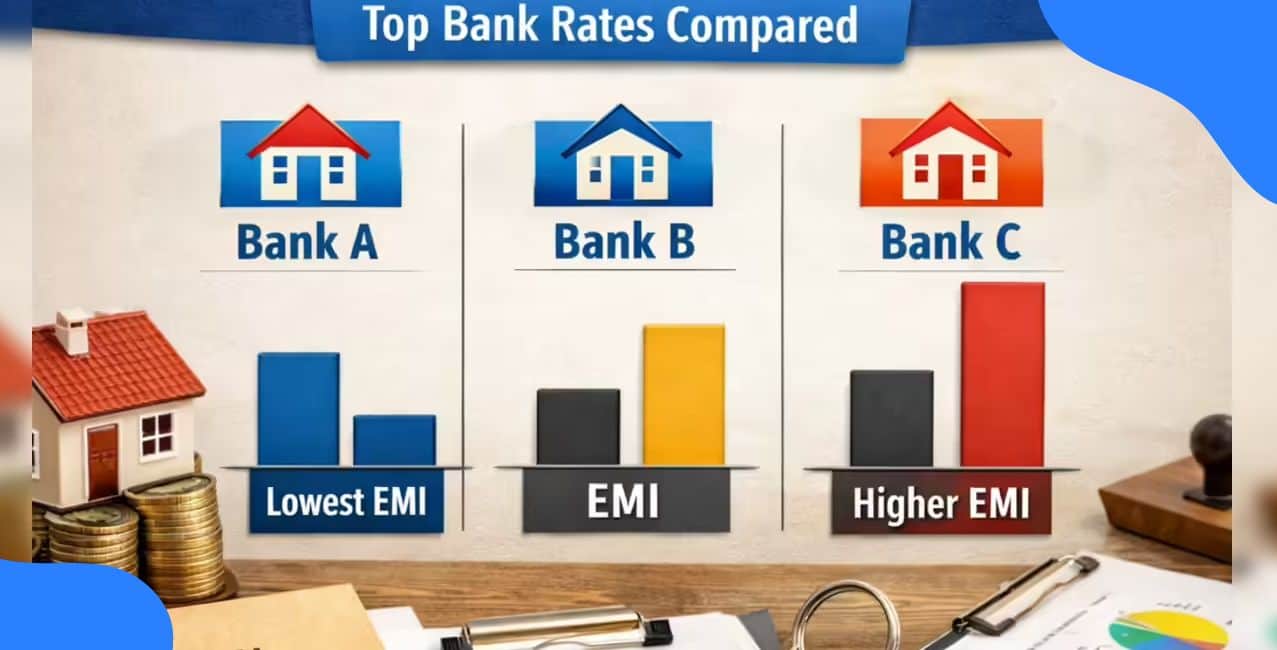
A recent comparison among major lenders — State Bank of India (SBI), HDFC Bank, ICICI Bank and Canara Bank — shows that while rates appear similar on paper, the actual borrowing cost varies depending on borrower profile, concessions and bank pricing strategy.
Public sector banks continue to lead the race in offering lower starting interest rates, while private banks compete through faster processing and customised offers.
Currently, home loan rates across major lenders broadly fall in this range:
These rates vary based on credit score, income stability and loan amount. Borrowers with a CIBIL score above 750 typically qualify for the lowest slabs.
Public sector lenders often price loans slightly cheaper due to lower cost of funds, which helps reduce EMIs marginally.
Read More : Latest Home Loan Rates Across Lenders
How EMI Differences Actually Play Out
Interest rate differences may look small but compound significantly over long tenures.
For example:
Since home loans are long-term products, comparing rates before applying becomes essential rather than choosing a bank purely on brand familiarity.
Also Read : Home Loan Interest Rates
Factors That Decide Your Final Interest Rate
Banks do not offer a single uniform rate to all borrowers. Pricing depends on multiple factors:
Savings of several lakhs
*T&C Apply
Floating-rate loans linked to external benchmarks such as the RBI repo rate adjust automatically when policy rates change, meaning EMIs can move over time.
Some lenders also offer concessions, for example, special rates for women borrowers or balance transfer customers, which can further reduce borrowing costs.
Choosing the best home loan is not just about the lowest headline rate. Processing fees, flexibility, customer service and prepayment rules also influence the total cost.
Still, current comparisons suggest that public sector banks like SBI and Canara Bank generally offer slightly lower entry rates, while private banks such as HDFC Bank and ICICI Bank compete through service efficiency and customised pricing.
For borrowers, the smartest approach is simple: compare offers, maintain a strong credit score, and evaluate total repayment, not just EMI, before finalising a lender.
Related Financial News | |||









.png&w=3840&q=75)



